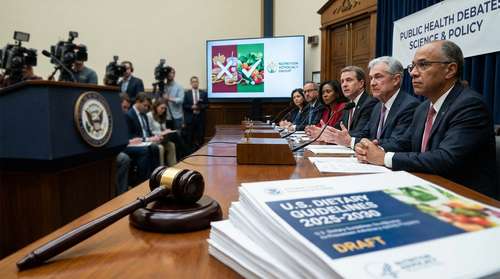
A high-stakes battle for the nation's plate has erupted in Washington. Just weeks after the release of the 2025-2030 Dietary Guidelines for Americans, a coalition of leading medical experts and advocacy groups is demanding an unprecedented recall of the federal nutrition policy. The controversy intensified yesterday with the publication of a scathing JAMA nutrition commentary 2026, which accuses the federal government of bypassing its own scientific advisory committee to favor industry interests, risking a "regression in public health policy" that could set chronic disease prevention back by decades.
The "Inverted Pyramid" Sparking Outrage
At the center of the firestorm is the newly unveiled visual representing the 2025-2030 Dietary Guidelines for Americans: an "inverted pyramid" that prioritizes animal proteins and dairy while minimizing grains. Critics argue this graphic directly contradicts the rigorous scientific report provided by the independent 2025 Dietary Guidelines Advisory Committee (DGAC), which had recommended a shift toward plant-based proteins and stricter limits on saturated fats.
The new guidelines, released jointly by the USDA and HHS under the leadership of Secretaries Brooke Rollins and Robert F. Kennedy Jr., promote "real food" and explicitly list beef tallow and butter as "healthy fats" to be incorporated into daily diets. While the text of the guidelines technically retains the 10% cap on saturated fat, experts argue the visual emphasis on high-fat animal products sends a dangerous, conflicting message to a public already struggling with heart disease.
JAMA Commentary: "A Regression in Public Health"
On January 28, the Journal of the American Medical Association (JAMA) published a blistering viewpoint titled "When Nutrition Science is Ignored," fueling the USDA dietary guidelines controversy. The commentary, authored by prominent nutrition scientists, describes the new policy as a departure from evidence-based nutrition policy. The authors warn that ignoring the DGAC's advice to limit red and processed meats in favor of industry-friendly messaging undermines the integrity of federal health guidance.
"This is more than a scientific concern—it represents a regression in evidence-based public health policy," the commentary states. It highlights that while the guidelines correctly identify the processed food health risks, the solution proposed—increasing intake of full-fat dairy and red meat—lacks support from current nutritional epidemiology.
The "Make America Healthy Again" Diet Clash
The new guidelines are being championed as the cornerstone of the "Make America Healthy Again diet" (MAHA), a movement spearheaded by HHS Secretary Kennedy. The MAHA agenda focuses aggressively on eliminating ultra-processed foods, a goal that has found bipartisan support. However, the movement's simultaneous embrace of saturated animal fats has alienated the traditional nutrition science community.
Supporters argue the guidelines represent a necessary "reset" to return to ancestral eating patterns, rejecting the "low-fat" dogma of previous decades. "My message is clear: Eat real food," Kennedy stated at the launch. Yet, the chronic disease prevention 2026 goals cited by the administration are at odds with the American Heart Association and other major health bodies, which have warned that re-normalizing high intakes of saturated fat could stall progress in fighting cardiovascular disease.
Physicians Committee Demands Withdrawal
The backlash has moved beyond academic debate to legal action. The Physicians Committee for Responsible Medicine (PCRM) filed a formal petition on January 8 with the Offices of Inspector General for the USDA and HHS, demanding the immediate withdrawal of the guidelines. The petition alleges "rampant industry influence," citing that the final policy discarded over half of the scientific committee's recommendations to appease the meat and dairy lobbies.
"The 'cholesterol cartel' has insidiously manipulated federal diet guidelines," said Dr. Neal Barnard, President of PCRM, in a press statement. The group argues that the "healthy fats" designation for butter and tallow violates the National Nutrition Monitoring and Related Research Act, which mandates that guidelines be based on the "preponderance of scientific and medical knowledge."
What This Means for Consumers
For the average American, the 2025-2030 Dietary Guidelines for Americans present a confusing mix of sound advice and controversial shifts. The strong stance against ultra-processed foods—advising a "dramatic reduction" in packaged snacks and sugary drinks—is widely applauded. However, the contradictory advice on fats and proteins has left nutritionists worried.
As the "Nutrition War" unfolds, experts advise consumers to look beyond the headlines. The consensus on eating more fruits, vegetables, legumes, and whole foods remains unshaken, regardless of the political battles over the food pyramid's shape. With the PCRM threatening further legal escalation and the JAMA nutrition commentary 2026 providing academic ammunition, it remains to be seen if the administration will walk back its most controversial recommendations.