The American dinner plate is officially under new management. In a historic and controversial shift that has sparked intense debate this week, the U.S. government has redefined federal nutrition policy with the introduction of an "Inverted Food Pyramid". Part of the newly released 2025-2030 Dietary Guidelines for Americans, this radical overhaul—spearheaded by Health and Human Services Secretary Robert F. Kennedy Jr.—prioritizes whole proteins and healthy fats while aggressively targeting ultra-processed foods. As of January 21, 2026, nutritionists and environmental experts are still reeling from the implications of what officials are calling the "Make America Healthy Again" (MAHA) agenda.
Flipping the Script: What is the Inverted Food Pyramid?
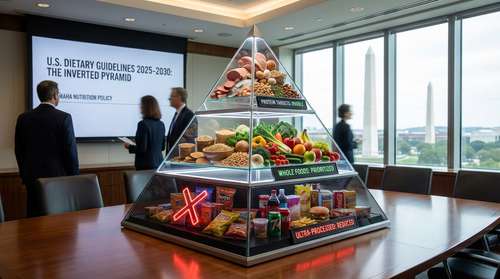
For decades, the classic food pyramid placed grains at its wide base, suggesting they should form the bulk of a daily diet. The new 2025-2030 framework completely inverts this logic. Under the new MAHA dietary guidelines, the largest section of the pyramid—now positioned at the top to signify priority—is dedicated to "Protein, Dairy, and Healthy Fats," alongside an equally weighted section for "Vegetables and Fruits."
Whole grains, once the foundation of federal advice, have been demoted to the narrow bottom tip of the triangle. The messaging, unveiled on the new realfood.gov portal, is blunt: "Eat Real Food." The guidelines explicitly advise Americans to treat refined carbohydrates and sugar not as staples, but as occasional indulgences to be sharply limited.
The New Protein Mandate: 1.2 to 1.6g Per Kilogram
Perhaps the most significant change in the 2025-2030 Dietary Guidelines for Americans is the dramatic increase in recommended protein intake 2026. Secretary Kennedy declared recently that the administration is "ending the war on protein," a sentiment reflected in the new daily targets.
The new guidelines recommend adults consume between 1.2 and 1.6 grams of protein per kilogram of body weight—nearly double the previous standard of 0.8 grams. For an average adult, this translates to a minimum of 100 grams of protein daily. This week, experts speaking to PBS noted that while this shift aims to combat muscle loss and metabolic dysfunction, it challenges decades of conventional advice regarding red meat and saturated fats.
Redefining Saturated Fats and Dairy
While the technical text of the guidelines retains the longstanding 10% limit on saturated fats, the visual hierarchy and accompanying rhetoric suggest a softer stance. Full-fat dairy, eggs, and red meat are now featured prominently as "nutrient-dense" staples. This contradiction has led to confusion among health professionals, with some praising the return to "ancestral" eating and others warning of potential cardiovascular risks.
Cracking Down on Ultra-Processed Foods
If protein is the winner of the new guidelines, the loser is clear: ultra-processed food reduction is now a primary federal objective. For the first time, the guidelines categorize "highly processed foods"—defined as packaged items high in added sugars, sodium, and chemical additives—as a distinct category to be avoided entirely rather than just moderated.
This aligns with the RFK Jr nutrition policy goal of eliminating "toxic" ingredients from the American food supply. The guidelines urge consumers to shun "ready-to-eat" meals in favor of whole food nutrition prepared at home. "We are calling out the dangers of highly processed foods," the USDA stated, marking a decisive break from industry-friendly language of the past.
Breaking: The Environmental and Health Backlash
While the "Inverted Food Pyramid" has been celebrated by low-carb advocates and the regenerative agriculture movement, it faces fierce opposition that has intensified in the last 48 hours. A bombshell report released yesterday warns that the new protein-heavy recommendations could have staggering environmental costs.
According to an analysis cited by The Guardian on January 20, meeting the new protein targets could require an additional 100 million acres of agricultural land—an area roughly the size of California. Critics argue that doubling the nation's reliance on animal agriculture contradicts climate goals and could accelerate deforestation.
Furthermore, leading nutritionists cautioned this week that a blanket recommendation for high protein might strain the kidneys of older adults and ignore the longevity benefits of plant-based diets. As schools and military programs begin adapting their menus to these 2025-2030 Dietary Guidelines for Americans, the battle over what constitutes a "healthy plate" is far from over.