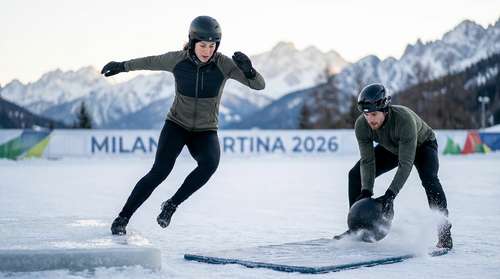
With the opening ceremony at San Siro Stadium still fresh in our minds and the 2026 Winter Olympics fitness craze officially kicking off, the world is watching Italy. As elite athletes descend upon the treacherous Stelvio slopes in Bormio and the pristine ice of Milan, viewers aren't just marveling at the medals—they're asking how to build that level of functional resilience. The 'Milano Cortina Workout' is emerging as the premier training trend of the season, blending explosive lateral power with the bulletproof core strength required to survive the Dolomite descents.
1. The "Stelvio" Eccentric Squat: Leg Endurance for the Long Haul
The men's downhill course at Bormio is notorious for its steep, icy, and leg-burning sustained turns. To survive the Stelvio, athletes don't just need strong quads; they need eccentric strength—the ability to control muscles as they lengthen under tension. This is the cornerstone of winter sports conditioning, preventing injury when absorbing high-G forces.
How to do it: Stand with feet shoulder-width apart. Lower yourself into a squat very slowly, taking a full 4-5 seconds to reach the bottom (the eccentric phase). Pause for one second, then explode up powerfully. This tempo mimics the sustained pressure skiers endure during a long turn.
Why it works: By increasing time under tension, you build the specific type of endurance fiber needed to hold a tuck position without your legs turning to jelly halfway down the mountain.
2. The "Milan" Skater Bound: Developing Lateral Agility
While alpine skiing gets the glory, the speed skaters at the Milan Ice cluster are showcasing pure lateral agility exercises. Unlike running, which is linear, winter sports are defined by side-to-side power production. The Skater Bound is the ultimate move to develop the glute medius and adductors, essential for generating speed on ice or snow.
How to do it: Start standing on your left leg. Explosively jump laterally to your right, landing softly on your right foot while sweeping your left leg behind you (without touching the floor). Pause and stabilize for a split second before bounding back to the left. Keep your chest up and core engaged.
Elite Tip: Focus on the distance of the jump, not the speed. The goal is to generate maximum explosive leg power with each push-off, simulating the stride of a 500m speed skating champion.
3. The "Tofane" Single-Leg RDL: Unilateral Balance & Stability
The women's technical events on the Olimpia delle Tofane course in Cortina demand impeccable balance. When a skier hits a rut at 80 mph, they are often balancing on a single edge. This exercise targets the posterior chain (hamstrings and glutes) while challenging your proprioception—your body's ability to sense its position in space.
How to do it: Hold a kettlebell or dumbbell in your right hand. Stand on your left leg with a slight bend in the knee. Hinge at the hips, lowering the weight toward the ground while extending your right leg straight back. Keep your back flat like a table. Return to standing by squeezing your left glute.
Why it matters: This is a non-negotiable for elite athlete training routines. It corrects strength imbalances between legs, ensuring that your weaker side doesn't become a liability on uneven terrain.
4. The "Arena" Rotational Med Ball Slam: Functional Core Strength
Whether it's a hockey player shooting a puck or a slalom skier bashing a gate, rotational power is key. The "Armonia" (Harmony) theme of the opening ceremony emphasizes the connection between upper and lower body, and nothing bridges that gap like rotational core work. This move builds functional core strength that translates directly to athletic performance.
How to do it: Stand perpendicular to a sturdy wall, holding a medicine ball. Pivot your feet and rotate your torso to slam the ball against the wall as hard as possible. Catch the rebound and immediately repeat. Do 10 reps, then switch sides.
Focus point: The power should come from your hips, not just your arms. Think of your core as the transmission engine that transfers energy from your legs to your upper body.
5. The "Podium" Box Jump: Explosive Vertical Power
Every event at Milano Cortina 2026 fitness levels begins with an explosion—the start gate of the Super-G, the push-off in Luge, or the face-off in Hockey. Box jumps train your fast-twitch muscle fibers to fire instantly, creating the raw power needed for those gold-medal moments.
How to do it: Stand in front of a sturdy box (20-24 inches). Swing your arms back and hinge your hips, then explode upward, landing softly on top of the box with both feet flat. Stand up tall to finish the rep, then step down carefully.
Safety check: Land quietly. A loud landing means you're absorbing the shock with your joints instead of your muscles. This exercise perfectly rounds out a routine designed to mimic the holistic demands of the Milano Cortina 2026 athletes.
Recover Like an Olympian
The intensity of the 2026 Winter Games isn't just about the workout; it's about the recovery. Following this routine, prioritize mobility work and hydration. As we watch the drama unfold across the Italian Alps this week, you can take pride in knowing your training mirrors the functional resilience of the world's best.