For decades, the medical consensus held that getting older was a slow, linear slide. You celebrate a birthday, gain a wrinkle, and lose a fraction of your stamina. However, a major accelerated aging study newly dominating longevity research 2026 discussions shatters that assumption. According to a landmark multi-organ analysis, human biology actually staggers forward, hitting a dramatic wall right around your fiftieth birthday. Scientists have officially identified this phenomenon as the age 50 aging cliff, a precise biological turning point where the molecular deterioration of organs and tissues drastically speeds up.
The findings, recently highlighted by the Chinese Academy of Sciences and published in the journal Cell, offer the most comprehensive protein-level map of human life ever assembled. Researchers analyzed 516 samples across 13 different tissues spanning five decades of life, allowing them to pinpoint exactly when and how our internal systems begin to fail. By looking closely at the building blocks of our cells, experts are fundamentally changing the approach to healthy aging.
Decoding the Age 50 Aging Cliff
Why does turning 50 feel so different from turning 40? The answer lies in your proteins. The research team discovered widespread "transcriptome-proteome decoupling" occurring right at the half-century mark. In simpler terms, the instructions sent by your genes no longer match the proteins your cells actually produce. This communication breakdown triggers a collapse in proteostasis—the body's ability to regulate, recycle, and clear out damaged cellular materials.
When this recycling process falters, misfolded proteins and amyloids begin to build up in the tissues. The sheer volume of these accumulated errors creates a sudden, steep drop in organ function. It is not just one system shutting down; it is a synchronized, body-wide failure to maintain structural integrity. Acknowledging this timeline is crucial for anyone interested in midlife health optimization, as it highlights a narrow window to intervene before the most severe damage takes root.
Vascular Aging: The Body's Internal "Senohub"
Perhaps the most striking revelation from the data is that not all organs break down simultaneously. The acceleration is heavily driven by vascular aging. The aorta, the body's primary blood vessel, exhibits the earliest and most continuous signs of wear and tear, beginning even in young adulthood. By the time a person reaches the age 50 aging cliff, the vascular system has taken a massive hit, accumulating chronic inflammation and tissue damage.
Researchers now refer to the blood vessels as a central "senohub". Because the circulatory system connects everything, aging blood vessels broadcast destructive signals to other organs. The study identified circulating "senoproteins"—specifically one known as GAS6—that actively drive systemic decline. When your blood vessels age, they effectively drag your liver, heart, and immune system down with them, dramatically increasing the risk of type 2 diabetes, cardiovascular disease, and cognitive disorders.
Measuring Decline with Proteomic Age Clocks
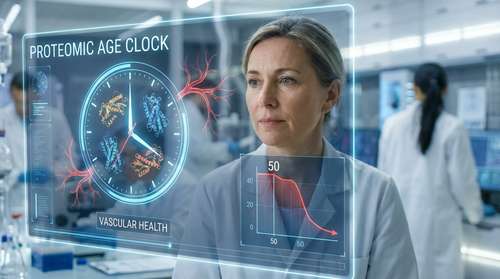
To track this asymmetrical deterioration, scientists developed tissue-specific proteomic age clocks. While chronological age simply counts the years since birth, biological age measures cellular wear. These new tools analyze an organ's unique protein profile to determine its true biological condition.
Using these advanced assessments, a doctor might soon look at a blood sample and inform a 55-year-old patient that while their lungs are functionally 50, their liver holds the protein profile of a 70-year-old. The precision of proteomic age clocks provides an unprecedented correlation coefficient, offering a highly accurate method to detect organ-specific diseases long before outward symptoms appear.
The Future of Midlife Health Optimization
The realization that our bodies undergo such a volatile shift at 50 changes the paradigm of preventative medicine. Current longevity research 2026 emphasizes that the decade leading up to this inflection point is the most critical period for intervention. If you can preserve the integrity of your vascular system during your 40s, you can potentially blunt the impact of the biochemical cascade that follows.
Strategies for healthy aging must now prioritize interventions that support proteostasis and reduce vascular inflammation. This includes rigorous cardiovascular conditioning, prioritizing sleep to aid protein clearance, and adopting nutritional protocols designed to minimize the buildup of senescent cells. The goal is no longer just extending lifespan, but smoothing out the steep trajectory of the biological aging curve.
Ultimately, this accelerated aging study arms the medical community with highly actionable data. By understanding the precise mechanisms and timing of cellular decline, targeted therapies can be developed to clear harmful senoproteins and reset our internal biological rhythms. The passage of time remains inevitable, but thanks to these molecular breakthroughs, how our bodies respond to that time is increasingly within our control.