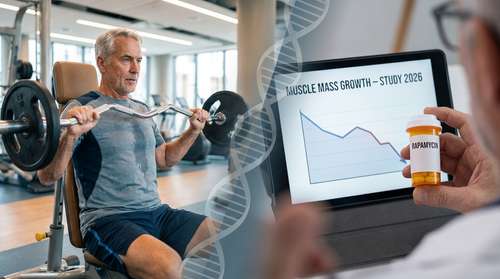
For thousands of health-conscious adults, the quest to live longer has shifted from simply eating well to experimenting with off-label medications. At the center of this movement is a well-known immunosuppressant that many hope holds the key to the fountain of youth. However, a startling new clinical trial published in April 2026 reveals a serious complication. When it comes to the rapamycin and exercise interaction, taking this popular anti-aging pill might actually sabotage the physical fitness gains you work so hard to achieve.
The latest findings, published this month in the Journal of Cachexia, Sarcopenia and Muscle, deliver a sobering reality check for the biohacking community. While previous animal studies showed incredible lifespan extensions, human trials are proving that our biology is far more complex. Can a pill truly replicate or enhance the benefits of a hard workout? It turns out that attempting to pharmacologically hack the aging process can directly conflict with the most proven longevity tool we have: physical activity.
The RAPA-EX-01 Trial: Testing Rapamycin for Longevity
Led by physician and researcher Dr. Brad Stanfield, alongside aging expert Dr. Matt Kaeberlein, the RAPA-EX-01 trial is one of the first human studies to directly investigate the rapamycin and exercise interaction. The researchers recruited 40 sedentary adults between the ages of 65 and 85 to participate in a 13-week home exercise program. The regimen consisted of stationary cycling and bodyweight resistance training three times per week.
Participants were randomly assigned to receive either a weekly 6-milligram dose of rapamycin or a placebo. The study was specifically designed to see if rapamycin for longevity could enhance the functional gains of working out. Because the drug targets cellular pathways involved in clearing out biological debris—a process called autophagy—scientists hoped it would make the aging body more resilient and responsive to fitness routines.
Instead, the data pointed in the exact opposite direction. The group taking the active drug experienced noticeably blunted physical adaptations compared to their counterparts on the placebo, sending ripples through the world of anti-aging drug research.
The Battle Over mTOR: Why The "Cycling" Theory Failed
To understand why this happened, you have to look at an essential cellular enzyme known as mTORC1. This pathway acts as a master switch for cell growth and protein synthesis. When you lift weights or ride a bike, your body activates mTORC1 to repair tissue and build muscle.
Rapamycin, however, does the exact opposite. It inhibits mTORC1 to stop cellular growth, forcing the body into a maintenance mode that cleans up damaged cells. Researchers proposed a "cycling hypothesis"—the idea that taking the drug 24 hours after the final workout of the week would allow enough time for post-exercise muscle adaptation before the drug triggered its cellular cleanup.
A Lingering Chemical Footprint
Unfortunately, the human body didn't cooperate with this timeline. The drug's long half-life meant it likely lingered in participants' systems throughout the week, continuously suppressing the anabolic signals needed to grow stronger. As a result, the subjects taking the medication missed out on the robust hypertrophic responses that usually follow a solid workout.
Blunted Muscle Mass in Seniors and Unexpected Risks
The clinical measurements from the 13-week study were telling. To assess physical function and muscle mass in seniors, researchers used the 30-second chair-stand test—a highly reliable indicator of lower-body strength and fall risk. While both groups saw improvements, the subjects taking rapamycin completed roughly two fewer repetitions on average compared to the placebo group.
Maintaining robust muscle tissue is a matter of survival as we age. Sarcopenia, the age-related loss of muscle, drastically increases the risk of debilitating falls and metabolic dysfunction. Because lower-body strength is strongly correlated with independent living, any intervention that reduces a senior's ability to build power is inherently counterproductive to extending lifespan.
Beyond the lack of physical progress, the trial highlighted concerning longevity drug side effects. The treatment group reported a higher frequency of minor adverse events, logging 99 issues compared to the placebo group's 63. Participants noted unusual aches and lingering fatigue. Blood tests also revealed elevated levels of C-reactive protein (CRP), a prominent biomarker for inflammation, in some participants taking the drug. One subject on the active medication even developed a serious case of pneumonia, which researchers noted was a known risk of taking an immunosuppressant.
Navigating the Latest Geroscience Updates
This trial arrives as one of the most highly anticipated healthy aging breakthroughs 2026 has offered so far, but perhaps not for the reasons enthusiasts originally hoped. It serves as a vital reminder that while pharmaceutical interventions are fascinating, they cannot seamlessly replace or even cleanly operate alongside foundational health habits without careful scientific scrutiny.
For those closely following geroscience updates, the takeaway is clear. Exercise remains the undisputed champion of extending both lifespan and healthspan. If an experimental medication interferes with your ability to gain strength, improve cardiovascular health, and maintain mobility as you age, the trade-off is likely not worth the risk. As researchers continue mapping the complexities of the rapamycin and exercise interaction, sticking to the proven basics of regular resistance training and cardiovascular fitness is the safest, most effective longevity prescription available.