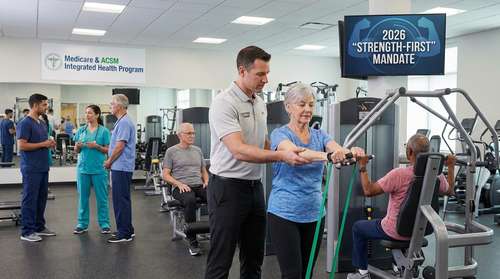
(March 5, 2026) — The era of unchecked weight loss is officially over. In a landmark shift that redefines the American fitness landscape, the American College of Sports Medicine (ACSM) and the Centers for Medicare & Medicaid Services (CMS) have effectively codified a new national health standard: the "Strength-First" mandate. Following the release of the ACSM 2026 fitness trends report this week—which places "Exercise for Weight Management" at a historic #3 ranking—medical providers are now pivoting en masse to a muscle-centric care model. This strategic alignment aims to combat the sarcopenia epidemic associated with the widespread use of GLP-1 medications.
The End of 'Skinny at Any Cost': Addressing the Muscle Crisis
For the past two years, the rapid adoption of GLP-1 agonists (like Ozempic and Wegovy) created a paradox: patients were losing weight, but they were also losing critical lean muscle mass at alarming rates. The 2026 clinical data is irrefutable—without intervention, up to 40% of weight lost on these medications comes from muscle tissue, leading to metabolic slowdowns and frailty.
"We are no longer looking at the scale as the primary metric of health," says Dr. Elena Rostova, a leading metabolic endocrinologist. "The new 2026 clinical guidelines prioritize muscle preservation workouts over calorie burning. If you are on a GLP-1, resistance training isn't optional anymore; it's as vital as the medication itself."
Medicare's Historic Pivot: Exercise as Medicine
Perhaps the most significant driver of this surge is the federal government's financial entry into the fitness arena. Beginning January 1, 2026, Medicare exercise reimbursement policies underwent a radical expansion. For the first time, physicians can now bill Medicare for conducting physical activity and nutrition risk assessments twice a year.
This policy change effectively turns doctors into fitness gatekeepers. Under the new pilot programs launched mid-2026, Medicare eligibility for certain obesity treatments is now increasingly tied to participation in structured metabolic health resistance training. This financial incentive has forced healthcare providers to prescribe heavy lifting alongside prescriptions, creating a direct pipeline from the doctor's office to the weight room.
HSA & FSA Expansion: The Gym Is Now a Clinic
Millions of Americans are discovering that their workouts are now tax-deductible. With the "Strength-First" protocols establishing exercise as a medical necessity for metabolic health, HSA eligible fitness programs 2026 have expanded significantly. Services like Truemed and Dr. B have streamlined the process of obtaining Letters of Medical Necessity (LMNs), allowing funds to cover:
- Personal training fees for muscle-building protocols
- Smart home gym equipment (like Tonal or Peloton)
- Gym memberships specifically prescribed for sarcopenia prevention
"If you have a prescription for a GLP-1, you almost certainly qualify for HSA-funded fitness," explains benefits analyst Sarah Jenkins. "The IRS views strength training for GLP-1 users not as a hobby, but as a critical countermeasure to muscle wasting."
The 'Strength-First' Protocol: What It Looks Like
The medical fitness integration occurring in gyms across the country has changed how people work out. The days of endless cardio for weight loss are fading. The new clinical standard—dubbed the "Strength-First" protocol—recommends:
1. Heavy Compound Movements
To stimulate muscle retention, patients are advised to perform compound lifts (squats, deadlifts, presses) at 70-80% of their one-rep max. This intensity is crucial for signaling the body to hold onto muscle tissue despite a calorie deficit.
2. Protein Thresholds
Dietitians are enforcing a strict intake of 1.2 to 1.6 grams of protein per kilogram of body weight daily, a target that often requires supplementation for patients with suppressed appetites.
3. Frequency Over Duration
The new guidelines suggest shorter, more frequent resistance sessions (3-4 times per week) to maintain an anabolic signal without causing excessive fatigue, which is a common side effect of weight-loss drugs.
Industry Outlook: The Rise of the Clinical Gym
Gyms are rapidly adapting to this new reality. Major chains are partnering with telehealth providers to offer on-site medical diagnostics, body composition scanning, and seamless LMN processing. As we move deeper into 2026, the line between a fitness center and a medical clinic continues to blur, driven by a simple, unifying mandate: strength is health.