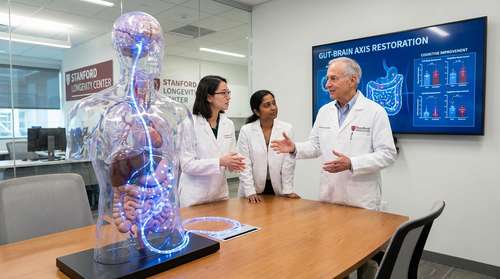
For decades, scientists have operated on a fundamental assumption: age-related memory loss is an intrinsic brain problem resulting from decades of cellular wear and tear. However, groundbreaking research published this week in the journal Nature is completely upending that biological dogma. A collaborative team from Stanford Medicine and the Arc Institute has discovered that the deterioration of our memory actually begins far away from the skull—in the intestines. By identifying the precise mechanisms within the gut-brain axis, researchers successfully mapped out how intestinal bacteria dictate long-term brain health. More impressively, they managed to reverse cognitive decline in aging models, opening an entirely new frontier for healthy aging protocols.
The findings provide a radical shift in our understanding of neurodegeneration. According to the lead investigators, the gastrointestinal tract essentially acts as a remote control for the brain. When communication along this biological superhighway breaks down, the hippocampus—the brain's command center for spatial navigation and memory—slows down right alongside it.
The Microbiome and Memory: A Surprising Link
As we grow older, our bodies undergo profound systemic shifts. The recent Stanford longevity study revealed that these changes are especially turbulent within the gut microbiome. Through rigorous testing on aged mice, the researchers identified a striking bacterial shift: as the animals naturally aged, a specific bacterial species known as Parabacteroides goldsteinii began to heavily dominate their intestinal ecosystem.
To prove this specific bacterium was the primary culprit behind faltering cognition, the team engineered an elegant, highly controlled experiment. They co-housed two-month-old mice with 18-month-old mice, allowing the younger animals to naturally acquire the aged microbiome over a period of weeks. Within just one month, the young mice exhibited severe memory deficits. They began failing standard maze tests and struggled with basic object recognition tasks they had previously mastered.
The connection between the microbiome and memory was undeniable. Once the young mice were treated with broad-spectrum antibiotics to clear out the "old" inflammatory bacteria, their sharp cognitive abilities immediately returned to normal baseline levels.
How Inflammation Severs the Communication Highway
Why exactly does a shift in gut bacteria cause forgetfulness? The answer lies in a destructive cascade of inflammatory signals. As the aging microbiome produces higher levels of specific metabolites—particularly medium-chain fatty acids—immune responders called myeloid cells detect the chemical disturbance. These immune cells then launch a localized inflammatory response directly within the gastrointestinal tract.
This targeted inflammation physically attacks the body's primary data cable: the vagus nerve. Operating as the central pillar of the gut-brain axis, the vagus nerve rapidly transmits thousands of signals from the digestive system straight to the hippocampus. When chronic gut inflammation frays this connection, the brain stops receiving the vital sensory inputs it desperately needs to contextualize and store new memories.
Dr. Christoph Thaiss, an assistant professor of pathology at Stanford Medicine and senior author of the study, summarized the phenomenon perfectly. "We tend to think of memory decline as a brain-intrinsic process," Thaiss noted. "What we learned is that the timeline of memory decline is not hardwired; it's actively modulated in the body, and the gastrointestinal tract is a critical regulator of this process".
Vagus Nerve Stimulation to Reverse Cognitive Decline
The most compelling aspect of these anti-aging breakthroughs isn't just mapping the diagnostic pathway—it is the proven therapeutic application. If a faulty connection causes memory loss, the researchers hypothesized that artificially forcing the signal through the interference might restore cognitive function.
The research team turned to vagus nerve stimulation, utilizing targeted biological techniques to jumpstart the blocked communication pathway in elderly mice. The behavioral results were staggering. Older animals that previously struggled with severe disorientation were suddenly able to navigate complex mazes and recognize unfamiliar objects just as nimbly as their younger counterparts. By simply amplifying the signal from the gut, the researchers effectively managed to reverse cognitive decline.
This localized intervention completely bypassed the need to alter the brain itself. Treating neurodegeneration by manipulating peripheral biology rather than central brain chemistry marks a monumental shift in how the medical community approaches age-related cognitive care.
A New Paradigm for Healthy Aging
The medical implications of this Stanford longevity study extend far beyond laboratory models. Because vagus nerve stimulation is already an FDA-approved treatment for human conditions like epilepsy and treatment-resistant depression, transitioning this specific therapy to clinical trials for memory preservation could happen much faster than typical drug development timelines.
Furthermore, researchers are exploring less invasive methods to regulate this internal system. Modulating the abundance of gut microbiome metabolites via precise dietary interventions, customized probiotics, or specialized medications might soon be standard preventative care.
Protecting your memory into your twilight years may not require complex, highly invasive neurological treatments. Instead, the secret to maintaining a sharp mind could be as simple as nurturing your gut health and ensuring your body's internal lines of communication remain wide open.