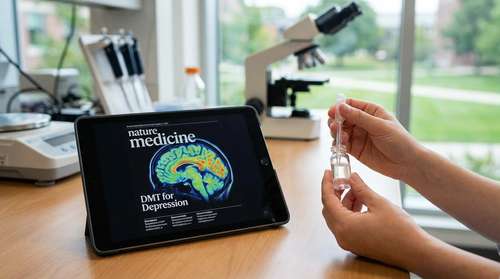
A landmark clinical trial published today in Nature Medicine has revealed that a single dose of the psychedelic compound DMT (dimethyltryptamine) can produce rapid and sustained remission from major depressive disorder (MDD). The Phase IIa study, conducted by researchers at Imperial College London and drug developer Cybin (now operating as Helus Pharma), found that patients experienced significant symptom reduction lasting up to three months after a treatment session of just 20 minutes. This breakthrough could position short-acting psychedelics as a scalable solution for the millions of Americans battling treatment-resistant depression.
Breaking Down the Nature Medicine Findings
The randomized, placebo-controlled trial involved 34 adults with moderate-to-severe major depressive disorder. Participants were administered a single intravenous dose of SPL026 (a synthetic form of DMT fumarate) or a placebo, accompanied by psychological support. Unlike traditional antidepressants that can take weeks to show efficacy, the DMT group showed a statistically significant reduction in depression scores within days.
According to the data published on February 18, 2026, the primary endpoint was met with a clear divergence between the treatment and placebo groups at the two-week mark. Remarkably, these antidepressant effects persisted for up to 90 days for many participants. "We have shown that a single DMT experience of just around 20-30 minutes duration is safe, effective and durable," noted Dr. David Erritzoe, the study's lead investigator.
Key Clinical Statistics
- Rapid Onset: Significant symptom relief was observed as early as one week post-dosing.
- High Response Rate: 35% of patients in the DMT group showed a clinical response (≥50% reduction in symptoms) at two weeks, compared to just 12% in the placebo group.
- Remission: 29% of treated patients achieved full remission at the two-week mark.
The Short-Acting Advantage: A Game Changer for Clinics
One of the most critical aspects of this study is the duration of the psychedelic experience. While psilocybin and LSD induce altered states lasting six to eight hours, necessitating a full day of clinical supervision and driving up costs, DMT is metabolized incredibly quickly. The psychoactive effects of the intravenous dose used in the trial resolved in under 30 minutes.
This "short-acting" profile addresses a major bottleneck in the rollout of psychedelic-assisted therapy: scalability. "The short duration could make this treatment far more accessible to healthcare systems," explains industry analyst Dr. Sarah Jenkins. "Clinics could treat multiple patients per room per day, drastically reducing the personnel costs that currently hamper psilocybin therapy models."
Contextualizing the 2026 Psychedelic Landscape
This study arrives during a pivotal week for psychedelic medicine. Just yesterday, February 17, Compass Pathways announced positive topline results from its Phase 3 trials of COMP360 (psilocybin), showing durable relief for treatment-resistant depression. However, the contrast in treatment delivery is stark. While Compass prepares for a potential FDA filing later this year with a long-duration treatment model, the new DMT data suggests a more efficient alternative could be on the horizon.
The sector is actively rebounding after the FDA's rejection of Lykos Therapeutics' MDMA-assisted therapy for PTSD in late 2024. The rigorous design of this new DMT trial—specifically its focus on standardized dosing and safety—appears to address many of the regulatory concerns previously raised by the FDA regarding functional unblinding and safety monitoring.
Safety Profile and Future Outlook
Safety remains the paramount concern for regulators. The Nature Medicine study reported that SPL026 was well-tolerated, with no serious adverse events. The most common side effects were mild and transient, including infusion site pain and nausea, which resolved shortly after the session. Importantly, the study found no evidence of increased suicidal ideation or potential for abuse, key safety metrics for the FDA.
While these Phase IIa results are promising, larger Phase 3 trials will be necessary to confirm efficacy across a broader population. Helus Pharma has indicated that these findings will inform their upcoming clinical programs, potentially expanding into other indications such as generalized anxiety disorder (GAD).
For patients who have failed to find relief through SSRIs or talk therapy, this research offers a renewed sense of hope. The possibility of hitting a "reset button" on depression in a lunch-hour appointment is no longer science fiction—it is a clinical reality inching closer to approval.