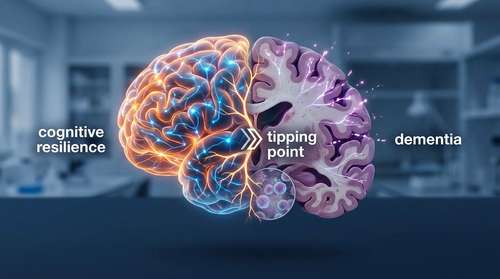
For decades, researchers have wrestled with a frustrating paradox. Some individuals accumulate massive amounts of amyloid plaques and tau tangles—the pathological hallmarks of neurodegeneration—yet their memories remain razor-sharp until the end of their lives. Meanwhile, others with the exact same brain pathology experience rapid cognitive decline. Now, the groundbreaking Nature Medicine Alzheimer's study 2026 has finally cracked the code, identifying a crucial Alzheimer's tipping point that decides who succumbs to the disease and who remains protected.
Published on June 4, 2026, the sweeping collaborative effort between VIB, KU Leuven, the UK Dementia Research Institute, and Muna Therapeutics offers a radical new perspective on memory loss. By mapping human brain tissue at an unprecedented, single-cell resolution, scientists discovered that cognitive resilience is an active, fiercely protective biological mechanism. The secret lies entirely in how the brain's immune system reacts to toxic protein buildup, marking a massive shift in how we approach neurodegenerative care.
The Pathology Paradox: Why Plaques Don't Always Mean Memory Loss
Historically, the medical community pointed the finger squarely at amyloid-beta and tau proteins. The assumption was straightforward: more plaques and tangles automatically equal severe cognitive decline. However, clinical realities routinely revealed a glaring contradiction. Many older adults who passed away with entirely intact memories possessed brains littered with the exact same abnormalities as patients suffering from advanced clinical dementia.
This discrepancy forced scientists to look beyond the proteins themselves and examine the surrounding cellular environment. They realized that measuring the volume of biological debris in the brain was the wrong metric. What truly mattered was the behavior of the cleanup crew. By examining post-mortem brain tissue from cognitively healthy centenarians, resilient octogenarians, and patients with dementia, researchers confirmed that survival depends heavily on innate immune regulation rather than the total absence of plaques.
Microglia and Dementia: Crossing the Biological Threshold
The connection between microglia and dementia rests at the center of this discovery. Microglia are the brain's resident immune cells. When toxic amyloid-beta proteins first appear, these cells leap into action, triggering an early inflammatory response to clear the debris. However, as the disease progresses toward the dangerous accumulation of tau tangles, the immune cells hit a biological crossroad.
If the microglia transition into a secondary, destructive inflammatory state, the brain tips over the edge into neurodegeneration. But researchers uncovered divergent pathways in robust minds. The resilient brain either actively blocks these immune cells from entering a harmful state, or it completely uncouples their activation from the destructive tau tangles, effectively shielding delicate neurons from collateral damage.
Two Distinct Cellular Strategies for Cognitive Resilience in Aging
The research team successfully isolated two unique biological programs that fuel cognitive resilience in aging. For individuals in their 80s who resisted memory loss, their brains successfully halted microglia from transforming into a chronic, toxic state. Conversely, healthy centenarians over age 100 actually activated that later immune state but managed to biologically disconnect it from brain tissue damage altogether. This profound adaptability highlights how healthy brain aging relies on dynamic immune state management.
The TREM2 Signaling Pathway and Future Drug Development
This paradigm-shifting discovery is already rewriting the rulebook for pharmaceutical development. The medical field has spent decades pouring resources into drugs designed exclusively to scrub amyloid plaques from the brain. While clearing plaques is beneficial, this new map of microglial transitions suggests a much more targeted approach to preventing Alzheimer's disease.
A major focus of this protective early immune response is the TREM2 signaling pathway. TREM2 is a critical receptor on the surface of microglia that dictates how these cells respond to injury and plaque accumulation. The study confirms that preserving and extending this early, beneficial TREM2-driven response can essentially freeze the brain in a resilient state, preventing the slide toward severe cognitive decline. Biotech firms are already leveraging this high-resolution roadmap, advancing clinical trials for molecules that recalibrate microglial activity through TREM2 agonism rather than blunt plaque removal.
Bolstering Natural Defenses to Save Memories
The implications of this breakthrough extend far beyond the laboratory. By viewing cognitive decline through the lens of immune cell transitions, doctors may eventually be able to intervene before patients ever cross the neurological threshold into clinical dementia.
"These findings open new opportunities to target microglial states... and extend resilience rather than simply focusing on plaque removal," noted Niels Plath, Chief Scientific Officer at Muna Therapeutics, following the publication. His words underscore the reality that the transition from amyloid buildup to tau-induced neurodegeneration is not an inevitable outcome, but a dynamic, modifiable process.
As researchers continue to decode these innate protective mechanisms, the goal for future therapeutics is becoming crystal clear: bolster the brain’s natural defenses and widen the window of resilience. Medicine is moving away from merely treating the aftermath of brain damage toward actively preserving the delicate cellular harmony that keeps our minds intact. For the millions of families globally facing the shadow of neurodegeneration, understanding this tipping point brings tangible hope for therapies that could permanently stall the disease in its tracks.