Recovering from an injury often takes significantly longer as we get older, a frustrating reality that leaves many adults searching for answers. For decades, scientists believed this decline in recovery speed was simply the inevitable breakdown of cellular machinery. However, a major discovery circulating the medical community in July 2026 fundamentally changes this perspective. Researchers have identified a specific protein that deliberately hits the brakes on tissue regeneration to keep aging cells alive. Unlocking this biological mechanism paves the way for a new era of healthy aging muscle repair.
The Survivorship Bias: Inside the UCLA Muscle Stem Cell Study 2026
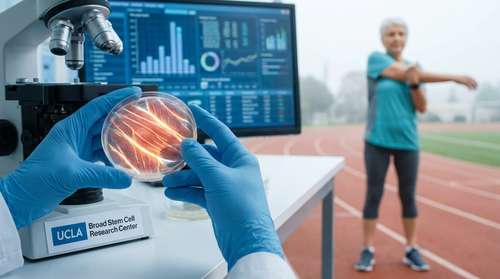
The groundbreaking findings originate from the Eli and Edythe Broad Center of Regenerative Medicine and Stem Cell Research at UCLA. Dr. Thomas Rando and his team of postdoctoral scholars, including Jengmin Kang and Daniel Benjamin, sought to understand the exact molecular shifts that occur within aging tissue. What they uncovered was highly counterintuitive.
Instead of old cells just wearing out, the stem cells that survive into old age are actually specialized survivors. In fact, the UCLA muscle stem cell study 2026 demonstrates that these surviving cells accumulate massive amounts of a tumor suppressor protein called NDRG1. Older muscle tissue exhibited NDRG1 levels roughly 3.5 times higher than those found in young, vibrant muscle.
This protein functions as a cellular brake. By actively suppressing the mTOR signaling pathway—the biological engine that drives rapid cell growth, division, and protein synthesis—NDRG1 prevents aging stem cells from quickly springing into action after a strain or tear. While this explains the sluggish recovery times seen in senior populations, it also reveals a fascinating evolutionary compromise. Slower activation protects the stem cells from the harsh, stressful environment of aging tissue. They sacrifice immediate speed for long-term longevity.
Can Scientists Reverse Muscle Aging NDRG1?
Identifying the biological brake naturally led to an ambitious follow-up question: what happens if you take your foot off the pedal? In rigorous laboratory tests involving older mice—aged to the equivalent of roughly 75 human years—researchers successfully inhibited the NDRG1 protein. The results were immediate and visually striking. Once the brake was removed, the aged stem cells regained their youthful vigor, ramping up the mTOR pathway and rapidly multiplying to accelerate healing.
This ability to reverse muscle aging NDRG1 activity highlights a viable pathway toward youthful regeneration. Yet, scientists also discovered a significant catch. While blocking the protein triggered rapid healing in the short term, it left the stem cell reserves completely vulnerable. Without their protective shield, the cells burned out quickly. Over time, this depletion led to severely impaired recovery following subsequent injuries.
The young cells act like biological sprinters, exceptionally good at a short dash but lacking the endurance required for a marathon. Therefore, completely and permanently removing this protective mechanism isn't a sustainable solution. Instead, the ultimate goal is to develop targeted therapies that can temporarily switch off the protein to boost acute healing, then turn it back on to preserve the stem cell pool.
Sarcopenia Treatment Breakthroughs and Clinical Applications
The implications of these findings extend far beyond the laboratory environment. For older adults, age-related muscle loss and weakness—clinically known as sarcopenia—create severe risks for falls, prolonged hospitalizations, and a sharp decline in physical independence. Current interventions primarily rely on resistance training and dietary protein adjustments, but these lifestyle modifications often fall short for individuals dealing with severe frailty or recovering from major falls.
This research represents one of the most promising sarcopenia treatment breakthroughs in recent years. By revealing the exact molecular trade-off between resilience and regenerative power, pharmacologists can begin designing sophisticated drugs that manipulate the cellular braking system. Imagine a scenario where a senior patient suffers a severe muscle strain. A physician could prescribe a short-term medication that temporarily blocks NDRG1, granting the patient the rapid healing capabilities of a twenty-year-old. Once the acute injury resolves, the medication is systematically reduced, allowing the protective protein to reaccumulate and safeguard the remaining stem cells.
New Horizons in Regenerative Medicine for Seniors
Advancements like this are actively pushing the boundaries of regenerative medicine for seniors. Historically, anti-aging research has focused heavily on completely eliminating the molecular markers of getting older, treating them as purely detrimental. This breakthrough flips the script entirely, suggesting that many age-related changes are actually brilliant, protective adaptations. The future of senior healthcare will involve working in tandem with the body's natural defense mechanisms rather than fighting them outright.
Rethinking How to Heal Muscles Faster as You Age
While targeted genetic and pharmacological therapies remain in the clinical development pipeline, the core principles of this discovery are already reshaping our understanding of tissue recovery today. If you are wondering how to heal muscles faster as you age, the current answer involves supporting your body's overall cellular environment to reduce the baseline stress placed on your stem cells.
Optimizing surrounding tissue health through adequate amino acid intake, managing systemic inflammation, and engaging in tailored physical therapy can help your existing stem cells function more efficiently—even when operating with elevated NDRG1 levels.
The biological reality of getting older is not a simple story of mechanical wear and tear. It is a highly sophisticated balancing act between preserving your cellular reserves and fixing immediate damage. With this latest understanding of the microscopic braking system, the medical community is moving rapidly toward giving older adults the best of both worlds: the robust, long-term resilience of age, combined with the rapid, explosive healing power of youth.