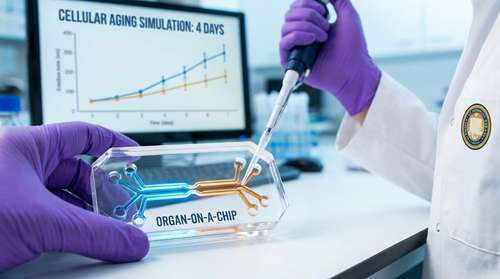
The quest to extend human healthspan just shifted into hyperdrive. In a stunning scientific leap announced this week, scientists have managed to fast-forward human biology, condensing decades of cellular wear and tear into less than a business week. This UC Berkeley anti-aging breakthrough uses a miniaturized microfluidic device to simulate 40 years of aging in a mere four days. Beyond simply watching cells age, the research team identified a surprising catalyst for turning back the biological clock: the hormone oxytocin.
The Organ-on-a-Chip Longevity Breakthrough
At the heart of this milestone is a sophisticated piece of technology that redefines how we study the human body. Published on March 25, 2026, the Nature Biomedical Engineering research details how current and former Berkeley scientists engineered a platform that mimics the critical communication between human fat and liver tissues.
Led by metabolic biologist Andreas Stahl and preeminent longevity researcher Irina Conboy at the California Institute for Quantitative Biosciences (QB3-Berkeley), the team used induced pluripotent stem cells to grow miniature organ models. These tissues sit in separate chambers connected by tiny fluid channels, perfectly replicating the human bloodstream's nutrient and hormone transport.
By circulating human blood serum through these microscopic pathways, the system aggressively accelerates biological decline. The result? Roughly four decades of tissue degradation accurately simulated in just 96 hours. This organ-on-a-chip longevity model provides scientists with an unprecedented, real-time window into the mechanics of getting older, bypassing the need to wait decades or rely on imprecise animal models.
The Fat-Liver Connection
Why focus on fat and liver cells? This interplay dictates massive shifts in our well-being as we age. Visceral fat acts as a biological command center, releasing metabolites that travel directly to the liver. Over time, these signals mutate, driving conditions like nonalcoholic fatty liver disease and insulin resistance. By isolating this pathway, the researchers established a reliable baseline for studying metabolic health and aging without whole-body complications.
Oxytocin for Cellular Rejuvenation: The Unexpected Hero
With the accelerated aging platform active, the team set out to test the most prominent longevity interventions currently known to science. They ran trials on senolytics (drugs designed to clear out dead, toxic cells), a TGF-beta signaling inhibitor, and rapamycin, the latter being one of the most widely used off-label anti-aging therapies globally.
The results completely disrupted established longevity dogma. Rapamycin, despite its massive popularity and anecdotal backing, showed almost no rejuvenative effect on the aged human tissues inside the chip.
Instead, oxytocin delivered the most dramatic results. The application of oxytocin for cellular rejuvenation aggressively reduced tissue inflammation and drove down cellular senescence. More remarkably, the hormone vastly improved insulin sensitivity and restored youthful fat and sugar metabolism. It comprehensively repaired the damage of 40 simulated years better than any other compound tested in the lab.
Revolutionizing Longevity Therapeutics Testing
The implications of this technology stretch far beyond a single hormone. Currently, the pharmaceutical industry spends over $130 billion annually on drug development in the United States, yet an astonishing 90% of those drugs fail in clinical trials. The primary culprit is often the reliance on mice and other animal models, which frequently do not accurately translate to complex human biology.
This microfluidic system rewrites the rules of longevity therapeutics testing. Researchers can now observe how a proposed drug impacts actual human tissue across a simulated lifespan in mere days. Furthermore, the study uncovered 11 novel biological indicators previously unassociated with aging, presenting fresh targets for upcoming pharmaceutical interventions.
The Path to Reverse Biological Aging in 2026
As the global population over age 60 pushes past one billion, healthcare infrastructure faces immense pressure to mitigate age-related diseases. The need to transition from simply managing symptoms to treating aging as a malleable biological process has never been more urgent.
The Stahl lab's microfluidic device proves that scientists can now selectively silence or activate individual genes within the chip, observing the immediate effects on tissue decline and repair. Efforts to commercialize the patented system are already underway.
By successfully demonstrating how to reverse biological aging 2026 style—using high-precision, miniaturized human models—UC Berkeley has handed the medical community a master key. The discovery that a familiar compound like oxytocin holds such profound restorative power is just the first revelation of what promises to be a new era in precision longevity.