If you want to predict how long you'll live, stop looking at your running shoes and start looking at your living room chair. A groundbreaking new study published this week in JAMA Network Open has upended conventional wisdom about healthy aging, revealing that muscle strength—specifically measured by grip strength and a simple "chair stand" test—may be a more accurate predictor of longevity than aerobic fitness alone. The findings, derived from a massive cohort of over 5,000 women, suggest that for seniors, raw power isn't just about opening jar lids; it's a vital survival metric.
The Breaking Science: Muscle Strength vs. Mortality
The study, led by researchers at the University at Buffalo and published in mid-February 2026, analyzed data from the Objective Physical Activity and Cardiovascular Health (OPACH) study. Following 5,472 women aged 63 to 99 for an average of eight years, the results were unequivocal: higher muscle strength was significantly linked to lower mortality risk, independent of physical activity levels.
Lead author Michael J. LaMonte, PhD, and his team found that women in the highest quartile for grip strength had a 33% lower risk of death compared to those in the lowest. Similarly, those who performed best on the chair stand test saw a 37% reduction in mortality risk. Crucially, these benefits held true even for women who did not meet the standard guideline of 150 minutes of aerobic exercise per week. This indicates that while cardio is critical, resistance training for elderly adults might be the missing link in the longevity puzzle.
The 'Chair Stand' Test: A Window into Biological Age
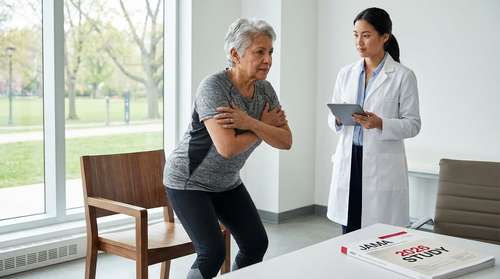
One of the study's most actionable takeaways is the validation of the "chair stand" test as a premier biological age indicator. Unlike complex lab tests, this functional assessment measures lower body strength, balance, and coordination simultaneously—all key factors in preventing falls and maintaining independence.
How the Test Works
The protocol used in the study is deceptively simple: participants were timed while performing five consecutive sit-to-stand movements from a chair without using their arms for support.
- The metric: Speed and ability to complete the motion.
- The finding: Every 6-second improvement in performance speed was associated with a statistically significant drop in mortality risk.
This test effectively mimics real-world demands. "If you don't have enough muscle strength to get up, it is going to be hard to do aerobic activities," Dr. LaMonte noted, highlighting that strength is the foundation upon which other fitness rests.
Grip Strength: The 'Vital Sign' of Aging
Alongside the chair test, the study reinforced the role of grip strength as a powerful mortality predictor. Often called a "biomarker of aging," grip strength is measured using a dynamometer. The 2026 findings showed that for every 7-kilogram increase in grip strength, participants saw a 12% lower mortality rate.
Why is your hand squeeze so important? It turns out that grip strength is a reliable proxy for overall total body muscle mass and nutritional status. A weak grip often correlates with sarcopenia—the age-related loss of muscle tissue—which is a primary driver of frailty and disability in later life.
Redefining Healthy Aging Fitness
For decades, public health messaging has heavily prioritized aerobic activities like walking or swimming. While these remain essential for heart health, this new data suggests a paradigm shift is needed. Resistance training for the elderly should not be an afterthought; it should be a prescription.
The study found that the protective effects of muscle strength were robust regardless of a woman's weight, age, or health history. This is empowering news: it means that starting a strength training routine can yield life-extending benefits at virtually any starting point. You don't need to become a bodybuilder; you simply need enough functional strength to move your body against gravity efficiently.
Actionable Steps for Longevity
Based on these findings, experts are calling for a balanced approach to healthy aging fitness that elevates muscle maintenance to the same level as cardiovascular health.
- Test Yourself: Try the chair stand test at home. Can you stand up and sit down five times rapidly without using your hands? If you struggle, this is a clear signal to prioritize leg strength.
- Start Resistance Training: Incorporate bodyweight squats, resistance bands, or light weights into your routine 2-3 times a week.
- Focus on Function: Prioritize movements that mimic daily life—lifting, carrying, and rising—to improve your biological age indicators.
As we navigate 2026, the message from the medical community is clear: to add years to your life, you must add life to your muscles. The next time you sit down, remember that the ability to stand back up is one of the most powerful health tools you possess.