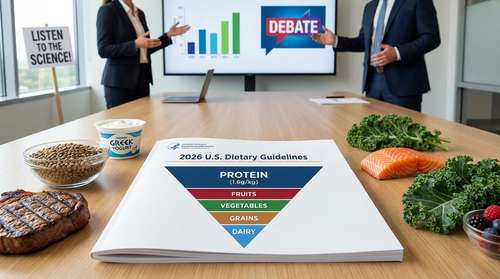
WASHINGTON, D.C. — A fresh wave of controversy erupted this week as health officials moved to implement the newly overhauled 2026 U.S. Dietary Guidelines, a radical policy shift that has literally turned the conventional food pyramid upside down. While the guidelines were initially unveiled in January, the operational rollout began yesterday with new procurement mandates for federal programs, sparking a blistering response from the American Heart Association (AHA) and deepening the divide between traditional nutritionists and the administration’s “Make America Healthy Again” (MAHA) coalition.
At the center of the storm is the new food pyramid 2026, which features an “inverted” design that places animal-based proteins, eggs, and full-fat dairy at the widest top tier, relegating grains and carbohydrates to the narrow bottom. The most contentious update, however, is the doubling of daily protein requirements for adults, a move proponents call a “muscle-centric revolution” and critics label a public health ticking time bomb.
The “Inverted” Pyramid: A Visual Overhaul
For decades, the USDA food pyramid (and later MyPlate) emphasized a foundation of grains and cereals. The new 2026 visual framework completely reverses this hierarchy. Under the guidance of HHS Secretary Robert F. Kennedy Jr. and USDA Secretary Brooke Rollins, the new graphic prioritizes “nutrient-dense animal and plant proteins” alongside healthy fats.
The “Inverted Pyramid” visually communicates that the majority of a citizen's caloric intake should come from:
- High-quality proteins: Red meat, poultry, fish, and eggs.
- Full-fat dairy: Whole milk, cheese, and yogurt (replacing low-fat recommendations).
- Healthy fats: Butter, tallow, olive oil, and avocado.
“The era of the grain-based diet is over,” Secretary Kennedy stated during a briefing on Monday, reiterating the MAHA slogan: “Just Eat Real Food.” Officials argue that the previous grain-heavy focus fueled the obesity epidemic, while the new design targets metabolic health and satiety.
New Protein Targets: 1.2–1.6 Grams Per Kilogram
Perhaps the most scientifically significant shift in the 2026 U.S. Dietary Guidelines protein recommendations is the establishment of a new “protein floor.” For over forty years, the Recommended Dietary Allowance (RDA) hovered at a modest 0.8 grams per kilogram of body weight. The new guidelines officially raise this target range to 1.2–1.6 grams per kilogram.
For a 180-pound (81 kg) adult, this jumps the daily target from roughly 65 grams to nearly 130 grams at the upper end. “The old 0.8 standard was a survival minimum, not an optimization target,” says Dr. Marcus Thorne, a metabolic health advisor to the new committee. “To combat sarcopenia and insulin resistance, Americans need to prioritize protein at every meal.”
This doubling of targets has been praised by the fitness and functional medicine communities but has left school lunch program directors scrambling to afford the increased volume of high-quality meat and dairy required to meet the new federal standards.
The Saturated Fat Debate & AHA Backlash
The inverted food pyramid controversy reached a fever pitch yesterday when the American Heart Association released an emergency position paper condemning the guidelines’ stance on saturated fats. While the text of the new guidelines technically retains a loose recommendation to limit saturated fat, the prominent placement of butter, beef tallow, and red meat in the visual guide sends a conflicting message.
The AHA warned that the “unchecked promotion of animal fats” could reverse decades of progress in cardiovascular health. “Visuals are powerful,” the statement read. “Telling the public that butter and steak are the foundation of a healthy diet contradicts the preponderance of evidence regarding LDL cholesterol and heart disease risks.”
Conversely, the MAHA nutrition policy impact focuses on eliminating “ultra-processed foods” (UPFs) and seed oils, which the administration identifies as the true drivers of inflammation. The new guidelines explicitly advise against industrial vegetable oils, replacing them with traditional animal fats—a move that has delighted regenerative agriculture advocates but horrified traditional cardiologists.
Animal Protein vs. Plant Protein 2026
The animal protein vs plant protein 2026 debate has also shifted. While the guidelines acknowledge beans and legumes, the language explicitly champions “bioavailable” animal protein as superior for muscle synthesis. This marks a departure from the “plant-forward” messaging of the 2020-2025 era.
Environmental groups voiced strong opposition this week, citing the sustainability costs of a meat-centric national diet. “Scaling this protein target to 330 million Americans is environmentally untenable,” noted a coalition of green advocacy groups in a press release issued Tuesday. However, USDA officials countered that the guidelines prioritize “American nutritional independence” over global climate metrics, emphasizing support for domestic cattle ranchers.
What This Means for Consumers
As these guidelines trickle down into food labeling and school curriculums over the coming months, consumers can expect:
- New Food Labels: Upcoming FDA proposals may highlight protein density and “processed” status more aggressively.
- School Menus: A reduction in bread and pasta options, replaced by larger servings of eggs, dairy, and meat.
- Healthcare Advice: A growing schism between federal advice and private practice cardiology recommendations regarding saturated fat dietary limits.