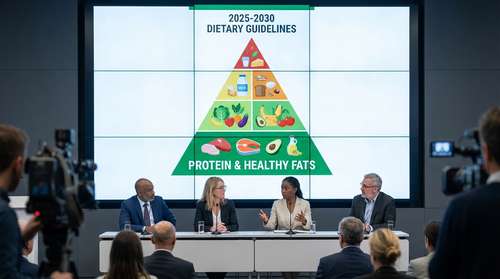
Federal health officials have officially released the 2025-2030 Dietary Guidelines for Americans, unveiling a radical new "inverted pyramid" that fundamentally restructures national nutrition advice. In a move described as the most significant policy reset in decades, the updated guidelines nearly double recommended protein intake and prioritize whole animal proteins and healthy fats, while taking an unprecedented hard line against ultra-processed foods. This dramatic shift, part of the broader "Making America Healthy Again" initiative, has drawn immediate praise for its focus on whole foods but is facing sharp scrutiny from leading nutritionists at Harvard and Yale who question the scientific transparency behind the overhaul.
The New 'Inverted Pyramid': A Radical Departure
For over thirty years, the grain-heavy food pyramid (and later MyPlate) served as the foundation of U.S. nutrition policy. The new 2026 visual flips this script entirely. The inverted pyramid places protein-rich foods—including red meat, poultry, eggs, and full-fat dairy—at the widest top section, signaling them as the primary fuel source. Vegetables and fruits share this prominent position, while whole grains have been relegated to the smallest bottom tip, encouraging significantly reduced consumption.
The guidelines introduce a new daily protein target of 1.2 to 1.6 grams per kilogram of body weight, roughly double the previous standard of 0.8 g/kg. For a 180-pound adult, this translates to approximately 100-130 grams of protein daily. The update explicitly endorses "high-quality" animal proteins and, for the first time, classifies butter, tallow, and full-fat dairy as "healthy fats" to be embraced rather than avoided.
War on Ultra-Processed Foods (UPFs)
Perhaps the most universally agreed-upon change is the guidelines' aggressive stance against ultra-processed foods. The document advises Americans to strictly limit foods containing artificial additives, seed oils, and high-fructose corn syrup. This aligns with the FDA's parallel efforts to redefine "healthy" labeling standards.
Key Changes at a Glance
- Protein: Target raised to 1.2-1.6 g/kg; emphasis on bioavailability of animal sources.
- Fats: Saturated fat limits softened in context; butter and tallow listed as viable options.
- Carbohydrates: Grains de-emphasized; focus shifts to fibrous vegetables and fruits.
- Additives: Strict advisory against artificial dyes and non-nutritive sweeteners.
Experts at Harvard and Yale Sound the Alarm
While the focus on real food has supporters, the drastic structural changes have sparked intense debate among the scientific community. Susan Mayne, a professor of epidemiology at the Yale School of Public Health, criticized the new graphic as confusing and potentially misleading. "An inverted pyramid is an odd construct," Mayne stated in a recent interview. "The pyramid used in the past was designed to show a strong foundation. This pyramid conveys a shaky foundation, which is ironically consistent with some of the underlying science."
Similarly, experts at Harvard T.H. Chan School of Public Health have raised concerns about the potential health risks of unrestricted saturated fat intake. Dr. Frank Hu, chair of the Department of Nutrition at Harvard, noted that while reducing processed foods is positive, the "mixed messages" regarding red meat and butter could confuse the public and lead to higher risks of cardiovascular disease. Critics argue that the guidelines appear to bypass standard rigorous scientific review processes, raising questions about whether industry interests or political agendas influenced the final recommendations.
Impact on Federal Food Programs
These guidelines are not just suggestions; they dictate the menu standards for school lunches, military rations, and the WIC program. The shift towards higher protein and higher fat requirements will likely force a massive logistical and financial overhaul of these federal programs. Schools accustomed to grain-based meals may struggle to meet the new expensive protein mandates, potentially widening the gap in food access for low-income communities.
As the debate unfolds, the 2025-2030 Dietary Guidelines mark a definitive end to the low-fat era, pushing America toward a protein-centric future. Whether this experiment will reverse the nation's chronic disease epidemic or exacerbate it remains the trillion-dollar question.