We've long been told that protecting our cardiovascular system requires grueling gym sessions and rigid diets. But a major shift in medical science is proving that massive health gains don't demand a massive time commitment. If you've been searching for the true minimum exercise for heart health, a groundbreaking study published today offers a surprisingly achievable answer. The research reveals that adding just four and a half minutes of vigorous movement to your day can trigger a measurable drop in your risk of fatal cardiovascular events.
The Dr. Nicholas Koemel Study: A New Era of Micro-Habits
Published on March 24, 2026, in the European Journal of Preventive Cardiology, the findings provide a blueprint for highly accessible wellness. The Dr. Nicholas Koemel study tracked over 53,000 middle-aged adults from the UK Biobank over an eight-year period, during which researchers observed over 2,000 major cardiovascular events. Rather than relying on flawed human memory, researchers utilized wrist-worn wearable devices to track participants' movements with absolute precision. The team set out to discover exactly how much sleep, physical exertion, and nutritional improvement it takes to generate genuine cardiovascular risk reduction.
The results completely dismantled the all-or-nothing approach to fitness. Koemel, a research fellow at the University of Sydney, and his team found that a trifecta of tiny behavioral tweaks creates a powerful synergistic effect on the human body, vastly outperforming major changes made to just a single habit.
The 10 Percent Formula
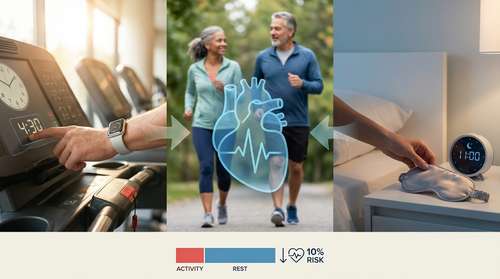
You do not need to overhaul your entire life to see clinical benefits. The researchers identified a specific baseline that lowers the risk of major adverse events—such as strokes and heart failure—by a solid 10%. The ideal daily activity for heart health breaks down into three shockingly simple components:
- Move a little more: Add exactly 4.5 minutes of moderate-to-vigorous physical activity to your daily routine.
- Rest a bit longer: Sleep an additional 11 minutes per night.
- Eat slightly better: Consume just one extra quarter-cup of vegetables daily.
This incredibly low barrier to entry highlights a major pivot in 2026 fitness trends. The industry is rapidly moving away from intimidating, hour-long workout mandates toward hyper-efficient, bite-sized health choices that people can actually sustain.
The Role of Wearables in Tracking Incidental Movement
One of the most compelling aspects of the Dr. Nicholas Koemel study is its methodology. Past cardiovascular research often relied on questionnaires where participants had to recall their physical activity and dietary habits over months or years. This self-reported data is notoriously flawed, as human beings consistently overestimate how much they exercise and underestimate what they eat. By outfitting all 53,000 participants with medical-grade wrist accelerometers, the University of Sydney researchers captured a flawless, minute-by-minute portrait of human movement.
The algorithms used in the study could differentiate between light movement, like washing dishes, and vigorous incidental activity, like running to catch a train. This level of precision is exactly what allowed the team to pinpoint the 4.5-minute threshold. This technological leap explains why 2026 fitness trends are heavily focused on incidental movement rather than just structured gym sessions. Smartwatches are now sophisticated enough to reward you for the intense, short bursts of energy you expend throughout your normal day, validating the idea that every single minute of elevated heart rate counts toward your cardiovascular risk reduction.
Scaling Up to the Optimal Longevity Exercise Routine
While finding the baseline minimum exercise for heart health provides a crucial starting line, the study also mapped out the ultimate targets for maximum protection. If you want to dramatically shield your cardiovascular system, the data points to a highly effective optimal zone. Participants who hit this optimal target saw their risk of major cardiovascular events plummet by a staggering 57% compared to those with the poorest health profiles.
To achieve this level of heart attack prevention, the daily prescription scales up slightly but remains entirely realistic. The golden ratio consists of securing eight to nine hours of quality sleep each night, maintaining a modest overall diet quality, and engaging in 42 minutes or more of moderate-to-vigorous activity. What exactly counts as moderate-to-vigorous? You don't necessarily need to be sprinting on a treadmill or paying for a boutique spin class. Everyday tasks performed with intention and intensity—like briskly walking the dog, carrying heavy grocery bags, or repeatedly taking the stairs—are highly effective ways to accumulate those crucial 42 minutes. This functional approach forms the foundation of a modern longevity exercise routine.
Why Synergistic Health Habits Outperform Extreme Overhauls
For years, public health guidelines have pushed broad targets, such as achieving 150 minutes of structured weekly exercise. While well-intentioned, these sweeping recommendations often discourage people before they even tie their sneakers. The beauty of identifying the absolute minimum exercise for heart health is that it provides a psychological win. It feels entirely doable.
The synergistic nature of these micro-habits is what makes them so potent. When you combine extra sleep with a slight bump in physical exertion, the physiological benefits compound. According to the research team, trying to achieve a 10% risk reduction through diet alone is virtually impossible in isolation. Doing it through exercise alone would require a massive 25% increase in your current activity levels. By spreading the effort across sleep, nutrition, and movement, the barrier to entry collapses.
We are witnessing a fascinating evolution in preventative medicine. As wearable technology gets better at tracking our exact movements, we are finally seeing the true clinical value of incidental activity. Understanding the exact minimum exercise for heart health shifts the narrative from punishing workouts to empowering choices. You have the power to protect your heart right now, simply by taking the stairs to your office and heading to bed just a few minutes earlier tonight.