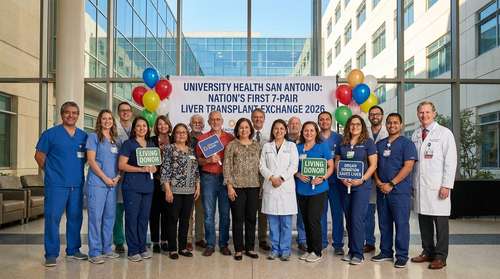
Medical history unfolded this weekend in Texas. For the first time, 14 individuals whose lives are now permanently intertwined gathered to celebrate a monumental achievement: a liver transplant exchange 2026 that successfully rescued seven patients from the brink of fatal organ failure. The emotional Friday meeting on April 10 brought together seven selfless donors and seven grateful recipients. Until that afternoon, most of these participants had never met. They represent the completion of a logistically staggering medical marathon that stands as a beacon of hope for patients waiting on extended transplant lists across the country.
Pioneering the Nation's First 7-Pair Transplant
The recent University Health San Antonio news has sent ripples through the medical community, highlighting an unprecedented achievement in surgical coordination. Orchestrating the nation's first 7-pair transplant required matching seven willing individuals who wanted to donate portions of their livers with seven patients in desperate need.
When traditional matching processes fall short, a living donor liver transplant can be the only viable pathway forward. The human liver possesses a remarkable biological trait: it can regenerate. Surgeons can safely remove a portion of a healthy donor's liver and transplant it into a recipient. Within weeks, both the donor's remaining liver and the recipient's new partial organ grow into fully functioning, normal-sized livers.
Dr. Tarunjeet Klair, the surgical director for the liver transplant program at University Health Transplant Institute, praised the courage of everyone involved. He emphasized that executing a liver transplant exchange 2026 of this magnitude requires advanced coordination. The undertaking involved seven separate surgeries spread across seven weeks.
The Complex Logistics of Saving Lives
Executing just one of these procedures is a massive clinical endeavor. According to the surgical team, each operation demands a minimum of four highly trained liver transplant surgeons working simultaneously in two adjacent operating rooms. Over the course of approximately eight hours, one team carefully extracts the donor tissue while the other prepares the recipient and implants the life-saving organ. Scaling this precise choreography to accommodate 14 people over a condensed seven-week timeframe pushes the boundaries of modern medical administration.
The Altruistic Spark: How a Kansas Donor Changed Everything
Such complex medical chains often require a catalyst. In this instance, the extraordinary sequence was ignited by an altruistic individual who traveled all the way from Kansas City. He originally intended to donate to a close friend. When that friend received a different organ match, the Kansas man did not pack his bags and go home. Instead, he chose to donate his liver to a complete stranger with absolutely no strings attached.
His selfless decision initiated a ripple effect. Because he donated to a stranger, the spouse or loved one of that recipient agreed to donate their liver to another patient in need. This domino effect continued until six families, who otherwise faced incompatible blood types or tissue mismatches with their own loved ones, found perfect matches within the pool. This chain vividly illustrates the paired organ donation benefits that are transforming modern medicine.
Emotional Liver Transplant Success Stories
The gathering on Friday yielded some of the most compelling liver transplant success stories the medical field has witnessed in recent years. Norma Cardenas, one of the seven recipients, shared her harrowing journey that began back in November 2024. Facing severe liver disease, she admitted that she didn't know if her previous Thanksgiving was going to be her last. Thanks to the liver transplant exchange 2026, she is now looking forward to going home and watching her grandchildren grow up.
Donors echoed similar sentiments of profound gratitude. Robert McDonald had also initially planned to help a friend, but when the timing didn't align, he chose to move forward and donate to someone he didn't know. McDonald called it an easy decision, noting that while he had always checked the organ donor box on his driver's license, the reality of donation didn't hit him until someone he cared about fell ill. Fellow donor Tana Lusty described the experience as a blessing, telling her recipient that they would remain connected forever.
Changing the Landscape of Organ Donation for Families
With thousands of Americans lingering on the deceased-donor waiting list, the push for living donations has never been more critical. Waiting for a deceased organ simply takes too long for many patients facing aggressive liver failure. By creating innovative matching chains, medical institutions are fundamentally shifting the paradigm of organ donation for families who feel trapped by biological incompatibilities.
April is National Donate Life Month, making this historic milestone even more poignant. As more hospitals adopt robotic technology and refine their matching algorithms, the medical community anticipates that large-scale chains will become more common. This will inevitably decrease wait times and improve overall patient survival rates.
The success of the liver transplant exchange 2026 proves that with surgical expertise, institutional dedication, and the remarkable selflessness of everyday people, the seemingly impossible becomes reality. These 14 individuals not only shared a life-altering medical procedure but also paved the way for future patients to find hope when their time seems to be running out.