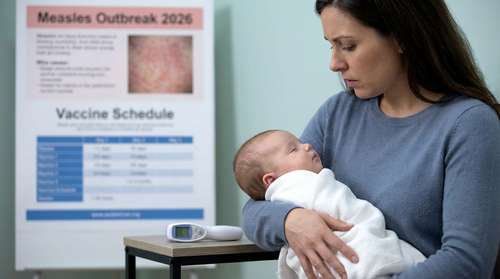
The United States is currently battling its most severe measles resurgence in over 35 years. With over 1,100 confirmed cases reported in the first quarter alone—and numbers officially surpassing 1,700 by mid-April—the measles outbreak 2026 is escalating at an alarming pace. While public health officials race to contain clusters in states like Utah, South Carolina, and Texas, one specific demographic is bearing the brunt of the risk: babies under 12 months old. Because they are too young to be vaccinated, these infants are effectively sitting ducks, entirely dependent on the adults and children around them for protection.
The Waiting Game: The MMR Vaccine for Infants
If you have a newborn, your first instinct is likely to ask your pediatrician for a preventive shot. However, the standard pediatric vaccine schedule 2026 dictates that the first dose of the MMR (measles, mumps, and rubella) immunization is given between 12 and 15 months of age. Why the delay?
During the final trimester of pregnancy, mothers pass protective antibodies to their babies. These maternal antibodies provide temporary immunity against various diseases. But there is a physiological catch: if the MMR vaccine for infants is administered too early, these lingering maternal antibodies can neutralize the vaccine before the baby's immune system has a chance to mount its own long-term defense. Because maternal protection naturally fades within the first few months of life, babies spend a stressful gap period—roughly between six and 12 months of age—with little to no defense against a highly contagious virus.
Herd Immunity Decline: The Shield Has Cracked
Because infants cannot be directly immunized, their safety relies heavily on community immunity. Measles is one of the most transmissible viruses on the planet. For a community to prevent the virus from spreading, approximately 95% of the population must be vaccinated. Unfortunately, the ongoing herd immunity decline has shattered that protective shield.
According to the Centers for Disease Control and Prevention (CDC), roughly 92% of the cases recorded this year involve patients who are unvaccinated or have an unknown vaccine status. When communities drop below that crucial 95% threshold, a single case introduced by an international traveler can trigger widespread transmission. Outbreaks are tearing through neighborhoods where vaccine hesitancy has taken root, leaving unprotected infants squarely in the line of fire.
Confusion Over Daycare Vaccine Requirements 2026
Adding complexity to the situation is the current legislative chaos surrounding childhood immunizations. Early this year, controversial proposed changes to federal health policy attempted to shift several childhood shots from universally recommended status to individual clinical decision-making. This move caused widespread confusion among parents, educators, and medical providers.
While a federal judge temporarily blocked these changes in late March, the regulatory whiplash left many parents uncertain about actual daycare vaccine requirements 2026. Childcare centers are caught in the middle. Administrators are fielding questions about whether exemptions are easier to obtain or if traditional mandates still apply. As a result, several health departments have issued urgent infant health safety alerts, reminding the public that local school mandates—which require the MMR vaccine for older children attending group care—remain fully active. For a baby attending daycare, being in a room with older toddlers who have utilized exemption loopholes is a significant health gamble.
Recognizing Measles Symptoms in Babies
If your baby is exposed, knowing what to look for is critical. Measles is a severe respiratory virus, not just a simple skin condition. Early identification can prevent severe complications such as pneumonia or encephalitis, which occur more frequently in children under five.
Initial measles symptoms in babies typically appear 7 to 14 days after exposure and mimic a severe respiratory infection:
- High fever that can spike over 104°F
- A persistent, hacking cough
- Runny nose (coryza)
- Red, watery eyes (conjunctivitis)
The Telltale Signs
Two to three days after symptoms begin, you might notice tiny white spots inside the mouth, known as Koplik spots. Three to five days after the initial symptoms, the classic rash breaks out. It usually starts as flat red spots on the face at the hairline and spreads downward to the neck, trunk, arms, legs, and feet. If you suspect your infant has contracted the virus, call your doctor immediately before showing up at the clinic. The virus can linger in the air of a waiting room for up to two hours, exposing other vulnerable patients.
Protecting the Vulnerable: What Parents Can Do Right Now
Until your child is old enough to receive their own immunization, you must create a cocoon of protection around them. Ensure that parents, older siblings, grandparents, and caregivers are all fully vaccinated. If you are planning a trip, particularly international travel or to regions currently experiencing high transmission rates, consult your pediatrician. In certain high-risk situations, doctors may recommend an early dose of the MMR vaccine for infants as young as six months, though they will still need their standard doses later.
The current public health emergency is a stark reminder that immunizations do not just protect the individual receiving the shot. They are a shared societal responsibility. Until community vaccination rates climb back to safe levels, the youngest members of our society will continue to rely on the rest of us to keep them safe.