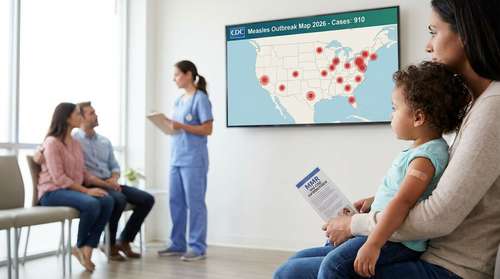
A rapidly escalating health emergency has gripped the nation as the Centers for Disease Control and Prevention (CDC) confirms that the U.S. measles outbreak 2026 has reached a critical milestone. As of February 14, confirmed infections have surged to 910 across 24 states, marking a frightening 25% increase in just one week. With the highly contagious virus finding a foothold in communities with declining vaccination rates, health departments in South Carolina, New York, and Vermont are issuing urgent alerts to families. This resurgence, following a 30-year high in 2025, threatens to overwhelm pediatric resources as experts warn that the window to contain the spread is closing.
CDC Maps Alarm 25% Weekly Surge
The latest data from the CDC measles case map paints a concerning picture of the viral trajectory. In a briefing released this week, officials reported that 822 of the 910 current cases are linked to five active, large-scale outbreaks. This represents a steep 25% week-over-week spike, driven largely by community transmission in under-vaccinated pockets. The 2026 total is already outpacing early projections, fueling fears that this year could surpass the record-breaking 2,267 cases recorded in 2025.
South Carolina has emerged as the epicenter of this year's crisis, with Spartanburg County reporting hundreds of confirmed infections. The outbreak has spilled over state lines, with significant clusters now identified in New York City, Vermont, and Florida. "This is not a slow burn; it is a wildfire," warned a CDC spokesperson. "The virus is finding every gap in our immunity wall, and with measles symptoms in children often delaying diagnosis, the spread is outpacing containment efforts."
University Campuses Become Hotspots
Unlike previous years where outbreaks were centered in primary schools, the 2026 surge has aggressively infiltrated higher education. Measles exposure sites 2026 now include major university campuses, creating a logistical nightmare for administrators. Confirmed cases have been reported at Ave Maria University in Florida and Catholic University in Washington, D.C., with additional exposures investigated at the University of Florida.
These campus outbreaks are particularly dangerous due to the high density of students living in dormitories. The virus, which can linger in the air for up to two hours after an infected person leaves a room, has forced several universities to implement quarantine protocols. Health officials are urging all college students to verify their immunization status immediately, as the childhood immunization schedule 2026 gaps from two decades ago are now manifesting in young adults.
Vaccine Rates Drop Below Herd Immunity Threshold
The driving force behind this resurgence is a documented decline in immunization coverage. Data reveals that the national vaccination rate for kindergartners has slipped to 92.5%, well below the 95% threshold required to maintain herd immunity. This 2.5% gap leaves approximately 286,000 children vulnerable to infection each year, creating the perfect environment for the virus to thrive.
Despite the overwhelming scientific consensus, hesitation remains. However, MMR vaccine safety updates continue to confirm the shot's reliability. Two doses of the MMR vaccine are 97% effective at preventing measles. "The vaccine is safe, effective, and the only way to stop this train," said Dr. Sanchi Malhotra, a pediatric infectious disease specialist. "Parents protecting family from measles need to know that delaying this vaccine is a gamble with incredibly high stakes."
Recognizing Measles Symptoms in Children
Early detection is vital but difficult. Measles often begins with non-specific flu-like symptoms before the tell-tale rash appears. Parents should be vigilant for a high fever (often spiking above 104°F), cough, runny nose, and red, watery eyes. Tiny white spots, known as Koplik spots, may appear inside the mouth two to three days after symptoms begin.
The characteristic red, blotchy rash typically erupts three to five days after the first signs of illness, starting at the hairline and spreading downward. Critically, an infected person is contagious four days before the rash appears, meaning the virus spreads silently. If you suspect exposure, call your healthcare provider immediately—do not go directly to a waiting room where you could infect others.
Urgent Steps for Families
- Check Records: Ensure all family members have received two doses of the MMR vaccine.
- Watch for Exposure: Monitor local news for updated lists of exposure sites, especially if you live in SC, NY, or FL.
- Isolate Immediately: If symptoms appear, isolate the patient and contact a doctor remotely for guidance.
As the U.S. measles outbreak 2026 intensifies, complacency is the enemy. With cases nearing 1,000 in just the first six weeks of the year, the time to act is now. Public health officials stress that this is a preventable tragedy, and recommitting to the childhood immunization schedule 2026 is the only path back to safety.