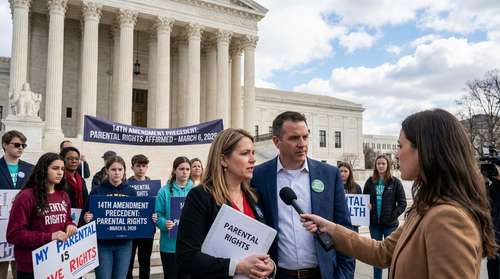
In a landmark decision that has sent shockwaves through the American education system, the Supreme Court has affirmed that parents possess a fundamental right under the 14th Amendment to be the primary decision-makers in their children's mental health care. The ruling, finalized in the case of Mirabelli v. Bonta, coincided with the conclusion of Teen Mental Health Awareness Week (March 2–6, 2026), marking a pivotal shift in how schools must handle sensitive student disclosures. As of March 6, 2026, the court effectively dismantled policies that allowed schools to act as "protective buffers," prohibiting educators from withholding critical information regarding gender identity transitions or mental health struggles from legal guardians.
The End of the "Protective Buffer" Era in Schools
The core of the court's decision rests on the interpretation of the Due Process Clause of the 14th Amendment. The justices argued that the state cannot substitute its judgment for that of a parent, particularly when it comes to consequential health decisions. For years, many districts operated under student wellness policies that prioritized student privacy above parental notification, often keeping parents in the dark about a child's social transition or expressions of gender dysphoria.
Writing for the majority, the Court stated that excluding parents from these decisions deprives them of the ability to participate in their child's mental health care at a time when support is most critical. This strikes down the argument that schools must serve as a firewall between students and potentially unsupportive families, establishing instead that parents are the default protectors of their children's well-being unless there is proven evidence of abuse.
Teen Mental Health Awareness Week Highlights Crisis
The timing of this ruling is significant, landing squarely during Teen Mental Health Awareness Week. This year, the observance has been somber, underscored by alarming new statistics regarding the youth mental health crisis. Data released in early 2026 indicates that nearly one in three high school students reports persistent feelings of hopelessness, with diagnoses of anxiety and depression jumping another 30% since 2020.
Health advocates argue that the isolation of the "secrecy" policies contributed to this crisis by severing the bond between struggling teens and their families. "You cannot treat a child's mental health in a vacuum," noted Dr. Sarah Jenkins, a child psychologist. "Effective therapy requires a support system, and for the vast majority of teens, that system starts at home." The ruling effectively mandates that schools pivot from being gatekeepers of information to partners in care.
New Mental Health Privacy Laws 2026
The federal ruling is just the tip of the iceberg in a rapidly changing legal landscape. Several states have already enacted or are fast-tracking mental health privacy laws 2026 that align with the Supreme Court's stance. For instance, Texas's Senate Bill 12, effective for the 2025-2026 school year, now requires explicit annual parental consent for all school-based health and counseling services.
Similarly, Virginia is moving forward with legislation requiring notification before administering any student surveys related to mental or sexual health. These laws collectively reinforce the parental rights in mental health doctrine, ensuring that parents are not merely informed after a crisis occurs but are involved in the preventative stages of school-based wellness programs.
Impact on Parental Notification in Schools
School districts across the nation are now scrambling to rewrite their handbooks. The directive regarding parental notification in schools is clear: withholding material information about a student's mental or emotional health is likely unconstitutional. This includes information about name changes, pronoun usage, and visits to school counselors for significant distress.
However, the transition won't be seamless. Educators have expressed concern about how to balance this mandate with building trust with students. The 14th Amendment school ruling does not prevent students from talking to teachers; rather, it prevents the institution from adopting a formal policy of deception toward parents. Schools like those in the Philadelphia district, which recently approved a comprehensive new wellness policy guaranteeing recess and break times, are now looking to integrate these parental notification requirements without dismantling their student-support infrastructure.
Moving Forward: A Partnership Approach
Ultimately, this ruling aims to bridge the gap between home and school. By reaffirming parental rights in mental health, the legal system is pushing for a model of transparency. The hope is that by removing the walls of secrecy, parents can be empowered to seek the professional help their children need before a crisis escalates. As the youth mental health crisis continues to challenge communities, this restored partnership between parents and educators may prove to be the most vital resource for struggling teens.