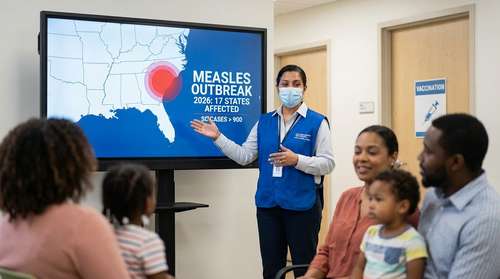
Breaking Health Alert: A rapidly escalating measles emergency has gripped the United States, with health officials confirming that outbreaks have now spread to 17 states as of mid-February 2026. The epicenter of this resurgence, South Carolina, has reported a staggering surge in infections, with confirmed cases topping 900 this week. As the virus infiltrates schools and college campuses across the nation, the Centers for Disease Control and Prevention (CDC) is issuing urgent warnings to families, citing the plummeting childhood vaccination rates in 2026 as the primary driver of this historic public health crisis.
South Carolina Crisis: Inside the Spartanburg Cluster
The situation in South Carolina has evolved into the largest single-state outbreak the U.S. has seen since the disease was declared eliminated in 2000. State health officials reported this morning that the case count has surpassed 950, with the vast majority concentrated in Spartanburg County and the surrounding Upstate region. What began as a handful of isolated cases in late 2025 has exploded into a community-wide emergency.
Local hospitals are straining under the pressure, and pediatric units are seeing a sharp increase in admissions. The outbreak is no longer confined to close contacts; the virus is circulating freely in public spaces. Exposure sites now include grocery stores, fitness centers, and post offices in towns like Boiling Springs, Greer, and Gaffney. But the most alarming spread is happening in classrooms.
"We are seeing entire classrooms quarantined," says Dr. Anita Patel, a pediatrician in Spartanburg. "This isn't just about a rash. We have children hospitalized with pneumonia and dehydration. This was entirely preventable, and that is the tragedy parents are waking up to today."
Schools and Campuses Become Hotspots
The measles spread in schools has forced administrators in affected districts to reinstate strict quarantine protocols not seen since the height of the COVID-19 pandemic. In South Carolina alone, hundreds of students are currently in isolation. Because measles is airborne and can linger in a room for up to two hours after an infected person leaves, schools are uniquely vulnerable environments.
The crisis isn't limited to K-12 education. Several universities in the Southeast have reported clusters, forcing rapid vaccination drives on campus. Health departments are reminding the public that measles is one of the most contagious viruses known to science—if one person has it, up to 90% of the people close to that person who are not immune will also become infected.
The Root Cause: Declining Childhood Vaccination Rates 2026
Why is this happening now? The data points to a clear culprit: a dangerous dip in herd immunity. Recent CDC figures reveal that the national vaccination rate for the MMR (measles, mumps, rubella) vaccine among kindergartners has dropped to approximately 92.5%—well below the 95% threshold needed to prevent community spread.
Even more concerning is the rise in vaccine exemptions. Non-medical exemptions for kindergarten entry have reached an all-time high of 3.6% nationally. In some of the hardest-hit counties in South Carolina and Idaho, vaccination coverage has fallen below 85%, creating "immunization deserts" where the virus can spread like wildfire. This decline is fueled by a growing wave of vaccine skepticism and misinformation that has eroded trust in public health institutions over the last two years.
Critical Guide: Measles Symptoms in Children
With the virus circulating in 17 states—including new cases in Florida, New York, and Vermont—parents need to be vigilant. Measles symptoms in children typically appear 7 to 14 days after contact with the virus. Early recognition is vital to preventing further spread.
Watch for these early signs:
- High Fever: Often spiking above 104°F (40°C).
- The "Three Cs": Cough, Coryza (runny nose), and Conjunctivitis (red, watery eyes).
- Koplik Spots: Tiny white spots with bluish-white centers inside the mouth.
Three to five days after symptoms begin, the tell-tale rash appears. It usually starts at the hairline and spreads downward to the neck, trunk, arms, and legs. If you suspect your child has measles, call your doctor immediately—do not just show up at the waiting room, where you could infect others.
Preventing Measles in Kids: Immediate Action Required
The CDC and the American Academy of Pediatrics are issuing a family health alert: Check your vaccination records today. The MMR vaccine is safe and highly effective. Two doses are 97% effective at preventing measles. If your child has missed a dose, it is not too late to catch up.
"We are at a precipice," warns a CDC spokesperson. "If these trends continue, the U.S. risks losing its measles elimination status, a public health achievement we held for over 25 years. The virus doesn't care about politics or debates; it finds unprotected children. The only wall against it is vaccination."