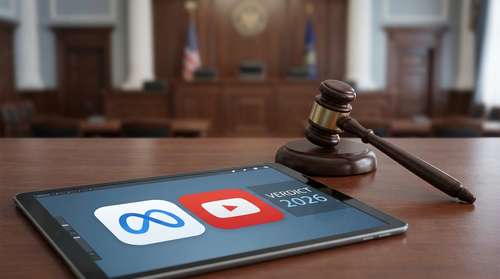
A Los Angeles jury has delivered a stunning blow to Silicon Valley, awarding $6 million to a 20-year-old woman in a groundbreaking social media addiction lawsuit. In late March 2026, jurors ruled that Meta and Alphabet's YouTube were legally negligent for designing addictive products that severely damaged the plaintiff's psychological well-being. This historic Meta YouTube verdict 2026 represents the first time technology giants have been held directly responsible by a jury for the mental health crises fueled by their platform architecture.
The plaintiff, identified in court documents as K.G.M., testified that her exposure to YouTube at age six and Instagram at age nine led to severe depression, body dysmorphia, and suicidal ideation. After a grueling six-week trial and nine days of deliberation, the 12-person jury concluded that the platforms were not just passive hosts of information, but inherently dangerous products designed to hook young minds.
Decoding the Meta YouTube Verdict 2026
The financial breakdown of the verdict illustrates the jury's assignment of blame. Jurors awarded the plaintiff $3 million in compensatory damages and an additional $3 million in punitive damages, finding that the tech companies acted with malice, oppression, or fraud. Meta, the parent company of Facebook and Instagram, bears 70 percent of the financial responsibility, while YouTube is liable for the remaining 30 percent.
What sets this teen mental health legal case apart is the strategic approach taken by the plaintiff's legal team. They modeled their arguments after the historic litigation against the tobacco industry in the 1990s. Internal company documents and executive testimonies revealed that engineers intentionally implemented engagement-maximizing features like infinite scrolling, persistent push notifications, and aggressive video autoplay. These features were specifically engineered to exploit human psychology and maximize screen time, prioritizing corporate profits over safety.
The Science of Compulsive Engagement
During the trial, expert witnesses detailed how the constant intermittent reinforcement of algorithmic video feeds triggers dopamine responses in developing brains. Because the frontal cortex is not fully developed until the mid-20s, adolescents are uniquely vulnerable to these manipulative design tactics. The jury agreed that these specific design choices were a substantial factor in causing the plaintiff's injuries.
A Groundbreaking Section 230 Lawsuit Outcome
For nearly three decades, social media networks have successfully shielded themselves from liability using Section 230 of the Communications Decency Act. This federal law largely protects internet companies from being sued over content posted by third-party users. However, this recent trial successfully sidestepped that defense.
By focusing on defective product design and a failure to warn users about known psychological hazards, the legal team achieved a paradigm-shifting Section 230 lawsuit outcome. The jury agreed that the algorithms themselves—not just the user-generated videos or photos—were the source of the harm. Establishing this direct causation proves that technology platforms can be held accountable under standard product liability and negligence laws, permanently altering the legal landscape for Silicon Valley.
Addressing the Impact of Social Media on Children
The staggering impact of social media on children has been a growing concern for educators, medical professionals, and lawmakers. The Los Angeles decision did not occur in a vacuum. Just 24 hours prior, a New Mexico jury ordered Meta to pay a staggering $375 million in civil penalties for violating state consumer protection laws. In that separate trial, state investigators presented evidence demonstrating that Meta actively misled the public about the safety of its platforms. Undercover agents posing as young teenagers were rapidly targeted by predatory accounts and exposed to explicit material, further underscoring the severe lack of platform moderation.
These back-to-back legal defeats validate the thousands of families and school districts currently participating in massive multidistrict litigation against tech companies. From skyrocketing rates of adolescent anxiety to widespread sleep disruption, the medical community has long warned about the side effects of compulsive app usage. Now, the justice system is forcing the industry to acknowledge the tangible damage inflicted on a generation of users.
The Future of Parental Rights Digital Safety and Wellness
The ramifications of the March 2026 verdicts extend far beyond a single courtroom. With over 1,000 similar claims pending nationwide, legal experts anticipate a tidal wave of litigation. For families, this represents a monumental victory for parental rights digital safety. Parents finally have a legal mechanism to demand accountability from corporations that deploy addictive algorithms into their homes.
Establishing New Standards for Digital Wellness for Kids
Moving forward, the pressure is mounting for tech companies to fundamentally redesign their applications rather than just paying out settlements. Legal accountability advocates are demanding robust guardrails to support digital wellness for kids. These proposed changes include replacing algorithm-driven feeds with simple chronological timelines, implementing strict and mandatory age verification protocols, and completely disabling autoplay features for minor accounts.
Furthermore, these verdicts empower parents to take immediate, proactive steps at home. Families can leverage built-in smartphone screen time limits, require devices to be stored outside bedrooms at night, and foster open dialogues about the manipulative nature of app notifications. The upcoming bellwether trials scheduled for later this summer in federal court in Oakland, California, will likely determine whether the tech industry faces massive global settlements or continuous, grueling public trials. Until sweeping systemic changes are codified into federal law, this landmark jury decision serves as a powerful warning to the technology sector: the era of unchecked digital experimentation on youth has officially come to an end.