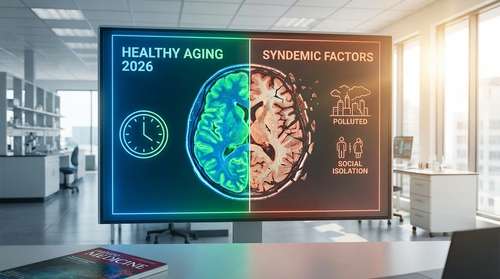
The conversation around healthy aging 2026 has officially shifted. Forget the singular focus on individual lifestyle choices like crossword puzzles or restrictive diets. A massive international study published today, April 3, 2026, fundamentally rewrites the rules of cognitive decline. Analyzing neuroimaging and health data from 18,701 individuals across 34 countries, researchers have uncovered a chilling reality: the environment you live in and the societal structures surrounding you can dictate your biological brain age more forcefully than isolated clinical diagnoses.
The 'Syndemic' Multiplier: Why 1+1=15 in Brain Aging
Led by Agustín Ibáñez and a team at the Global Brain Health Institute (GBHI) at Trinity College Dublin, this groundbreaking Nature Medicine brain study introduces a grim but vital concept to neuroscience: the "syndemic" nature of cognitive decay. When it comes to the brain, societal and physical stressors do not merely add up sequentially. They multiply, creating a compounding crisis that accelerates neurological decay across both healthy individuals and those already facing neurodegenerative conditions.
Researchers examined 73 distinct country-level variables, mapping out the human "exposome". This exposome represents the lifetime accumulation of environmental, social, and political exposures an individual navigates. The GBHI team discovered that when multiple adverse conditions overlap—a common reality in disadvantaged communities—they trigger a syndemic reaction. These combined threats interact and exacerbate one another, driving up an individual's biological brain age with alarming speed.
According to the advanced statistical models used in the study, aggregated exposome models explained up to 15.5 times more variance in biological brain age than any single risk factor alone. You might live in an area with high air pollution, which carries its own baseline risk. But if you compound that fine particulate exposure with extreme temperature fluctuations, inadequate public housing, and severe socioeconomic inequality, the acceleration of neurological decay skyrockets. The study noted that this cumulative exposome burden accounted for a 3.3 to 9.1-fold higher risk of accelerated aging, a metric that actually exceeded the effects of having a clinical dementia diagnosis.
Physical vs. Social Exposomes: Two Paths of Neurological Decay
One of the most striking revelations in modern cognitive longevity research is the precise way different exposures physically alter the brain. The study carefully distinguishes between the physical exposome and the social exposome, proving that environmental factors in aging leave highly specific, observable biological fingerprints on human neuroanatomy.
Structural Erosion from the Physical Environment
Physical stressors—like chronic exposure to poor air quality, hazardous water supplies, and a glaring lack of access to urban green spaces—are heavily associated with structural brain aging. Through multimodal brain metrics, the researchers observed pronounced atrophy in subcortical, limbic, and cerebellar regions. These physical alterations correlate strongly with mechanisms like neuroinflammation, oxidative stress, and vascular dysfunction. Ultimately, these physical environments wear down the brain's hardware, accelerating the deterioration of areas critical for memory retention, autonomic function, and emotional regulation.
Functional Decline from Societal Inequity
Conversely, social and sociopolitical factors—such as systemic poverty, severe income inequality, and a lack of institutional support—profoundly impact the brain's functional aging. Chronic exposure to these societal disparities disrupts the frontotemporal networks. In essence, the constant psychological and systemic burden of navigating deep socioeconomic divides rewires how different brain regions communicate and process information. The stress of inequality literally changes the brain's operating system.
Redefining the Future of Brain Health Trends
These sweeping findings force a major reckoning for global public health officials and medical professionals. Slowing biological aging is no longer just a biological or pharmaceutical challenge; it is a structural, environmental, and political imperative. The data clearly shows that populations in marginalized areas and the Global South carry a disproportionate vulnerability to accelerated decay, simply because of where they are situated geographically and socioeconomically.
Fortunately, the protective factors identified in the research offer a clear, if challenging, roadmap for macro-level intervention. Key strategies to delay cognitive decline at a population level now include:
- Environmental Remediation: Aggressive reductions in fine particulate air pollution and the expansion of urban green spaces.
- Housing Reform: Ensuring access to safe, climate-resilient public housing to minimize physical stressors.
- Socioeconomic Equity: Implementing policies that close the income gap and provide robust institutional support.
- Healthcare Access: Guaranteeing fair and timely medical care, which acts as a profound buffer against systemic aging accelerators.
As we analyze emerging brain health trends, the message from the scientific community is unequivocal. Treating neurodegenerative diseases solely in the clinical setting is akin to fighting the battle long after the war has been lost. True prevention requires treating the zip code, purifying the air quality, and repairing the social fabric just as aggressively as we treat medical symptoms. The future of cognitive preservation demands that we heal our environments before they permanently age our minds.