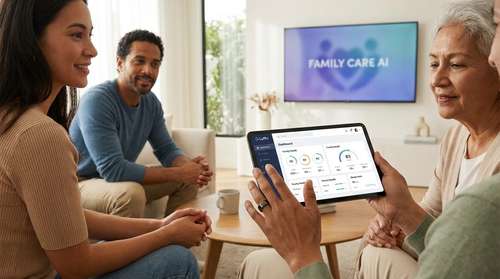
James Park and Eric Friedman changed the world of personal fitness with Fitbit. Now, two years after leaving Google, the duo is back with a more ambitious mission: solving the crisis of caregiver burnout. On Tuesday, the pair unveiled Luffu, a new company debuting an "intelligent family care system" designed to manage the complex, often overwhelming mental load of caring for children, aging parents, and even pets.
Moving beyond simple step counting, Luffu employs advanced AI to act as a silent guardian. The platform aggregates health data from disparate sources—wearables, medical portals, and manual logs—to proactively flag meaningful changes in a family member's well-being. With a public beta for the app opening today and a $199 smart ring available for pre-order, Park and Friedman aim to do for family health what they once did for 10,000 steps.
From Personal Stats to Shared Family Wellness
For over a decade, the narrative of digital health has focused on the individual—my sleep, my heart rate, my activity. Luffu represents a philosophical pivot to shared family wellness. The founders realized that for the "sandwich generation"—adults caring for both kids and elderly parents—health is rarely a solo journey.
"At Fitbit, we focused on personal health—but after Fitbit, health for me became bigger than just thinking about myself," CEO James Park shared in a press statement. "The moments that matter most are often the most chaotic: a late-night fever, a sudden urgent care visit, or a doctor asking questions you can't answer quickly because the details are scattered."
Luffu tackles this fragmentation by serving as a central hub. Instead of one person holding all the medical knowledge in their head, the app democratizes care, allowing spouses and other family members to stay on the same page without endless text threads or sticky notes.
How the Intelligent Family Care System Works
At the core of Luffu is an AI engine that operates quietly in the background. Unlike standard health apps that function as passive data repositories, Luffu is designed to be active and conversational. The system uses natural language processing, allowing users to query their family's health data as easily as texting a friend.
The "Guardian" Approach
Luffu's primary differentiator is its proactive "Guardian" feature. The AI continuously monitors data streams to detect anomalies that a human might miss. For instance, if an elderly parent's sleep quality suddenly drops while their resting heart rate rises, Luffu can alert the caregiver to a potential developing illness before it becomes an emergency. It aims to shift care from reactive firefighting to proactive management.
Effortless Data Logging
Recognizing that caregivers are already time-poor, the app minimizes data entry friction. Users can log information via voice notes, text, or photos. You can simply snap a picture of a medication label or a doctor's discharge summary, and the AI extracts the relevant details to update the family's health record automatically. This feature directly addresses the mental load of caregiving, automating the administrative burden that leads to burnout.
Hardware Roadmap: The Luffu Smart Ring
While the immediate launch focuses on the software experience, Park and Friedman are returning to their hardware roots. The company has announced the Luffu Smart Ring, a $199 wearable available for pre-order. Unlike competitors like Oura that require a monthly subscription, the Luffu ring is positioned as a one-time purchase designed to feed continuous, passive health data into the ecosystem.
The ring tracks sleep patterns, heart rate, blood oxygen levels, and activity metrics. Its integration with the app ensures that even family members who aren't tech-savvy—like seniors who might struggle with a smartwatch—can be easily monitored. The device promises up to seven days of battery life, directly challenging established players in the wearable space by offering a lower price point and a family-centric value proposition.
Privacy and the "Guardian" Promise
In an era of data skepticism, Luffu is positioning its privacy stance as "guardian, not surveillance." The founders emphasize that users retain strict control over what data is shared and with whom. The goal is to facilitate care, not intrusion. For example, an adult child can see that their parent is active and sleeping well without needing to see every minute-by-minute detail, preserving dignity while ensuring safety.
As the U.S. faces a growing shortage of professional caregivers, tools like Luffu that empower families to manage their own health ecosystems are likely to become essential. By combining the founders' consumer hardware expertise with modern AI, Luffu is betting that the future of health isn't just about living longer—it's about caring better, together.