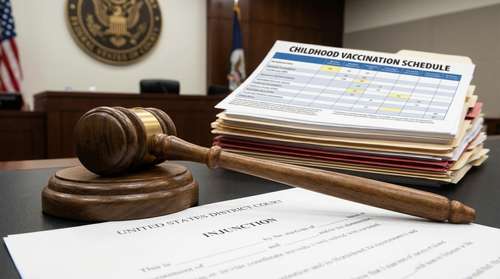
A federal judge in Massachusetts has issued a temporary injunction halting controversial changes to the federally recommended childhood vaccine schedule. The March 16, 2026, ruling puts an abrupt pause on Health and Human Services (HHS) Secretary Robert F. Kennedy Jr.'s aggressive push to reshape national immunization guidelines. For parents, school administrators, and pediatricians preparing for the upcoming academic year, the sudden legal pivot introduces both relief and profound questions about the future of family health policy.
U.S. District Judge Brian Murphy's decision sided with the American Academy of Pediatrics (AAP) and a coalition of medical organizations that sued the government to stop the sweeping HHS vaccine changes. By blocking the administration's efforts, the court has essentially frozen a fierce debate over public health, regulatory authority, and the fundamental standards that dictate classroom entry across the United States.
The Core of the Federal Vaccine Ruling 2026
At the center of the dispute is a January 2026 directive from HHS and Acting CDC Director Jim O'Neill that would have drastically scaled back the number of recommended routine immunizations for children. The proposed RFK Jr vaccine policy aimed to cut the standard childhood roster from 17 down to 11 vaccines, stripping general recommendations for several critical inoculations, including hepatitis A and hepatitis B, and relegating them to high-risk categories only.
Judge Murphy's ruling determined that the administration likely violated the Administrative Procedure Act by bypassing established scientific protocols. Furthermore, the injunction suspends the appointments of 13 new members to the Advisory Committee on Immunization Practices (ACIP). The court noted that these members, selected by Kennedy after he dismissed the previous panel, lacked the necessary technical expertise to dictate pediatric vaccine safety standards.
A Victory for Medical Societies
Medical professionals celebrated the stay as a crucial defense of evidence-based medicine. Dr. Andrew Racine, president of the AAP, stated that the ruling protects a historically rigorous process that has kept children healthy for decades. Before the injunction, pediatricians warned that the sudden shift in federal guidance was sowing widespread chaos among families trying to secure timely medical care. Removing general recommendations for certain shots directly impacts insurance coverage. Under the Affordable Care Act, insurers are required to cover vaccines without cost-sharing only if they are officially recommended by the ACIP. By slashing the schedule, the administration inadvertently threatened to make standard inoculations financially inaccessible for millions of working-class families, forcing them to pay out-of-pocket for basic preventive care.
Navigating Immunization Requirements for School
While the federal government sets the baseline recommendations, individual states ultimately dictate immunization requirements for school attendance. Anticipating the HHS rollback, approximately 30 states had already begun drafting independent benchmarks to maintain higher immunization standards. This proactive state-level maneuvering has created a dizzying patchwork of regulations for the 2026-2027 school year.
In some regions, lawmakers have rushed to codify the traditional ACIP standards into state law, actively rebelling against Washington's new directives. In others, conservative legislatures have embraced the scaled-back HHS approach, pushing bills that strip long-standing local vaccine mandates to align with the proposed federal cuts. Depending on where you live, the legal whiplash means your local school district might adhere to the traditional AAP-backed schedule, pivot to the now-paused HHS guidelines, or enforce an entirely new state-specific mandate. Families relocating across state lines face the highest burden, as they must reconcile conflicting health department rules just to enroll their children in elementary or middle school.
What This Means for Family Health Policy
With the federal vaccine ruling 2026 temporarily blocking the overhaul, parents find themselves caught in a high-stakes waiting game. The ACIP, effectively paralyzed by the suspended appointments, cannot currently hold votes or issue further guidance. This leaves the established, pre-2025 childhood vaccine schedule as the prevailing medical standard while the broader lawsuit makes its way through the federal courts.
Here is what families should prioritize in the immediate term:
- Consult Your Pediatrician: Rely on your primary care provider rather than federal political shifts. Medical societies universally advise sticking to the AAP's established immunization timeline.
- Check State Mandates: Verify requirements directly with your local health department or school district, as state laws will ultimately dictate enrollment prerequisites for the fall.
- Maintain Records: Keep detailed, easily accessible copies of your child's vaccination history to avoid delays if local regulations abruptly shift.
The Road Ahead
The Boston court's preliminary injunction is not the final word on RFK Jr vaccine policy. The Department of Justice is expected to vigorously appeal the decision, setting the stage for a protracted legal battle over who fundamentally controls public health messaging in America.
Until an appellate court or the Supreme Court weighs in, the traditional immunization framework remains intact. For now, the focus for everyday Americans shifts back to local clinics, where pediatricians continue to advocate for the comprehensive protection of children against preventable diseases.