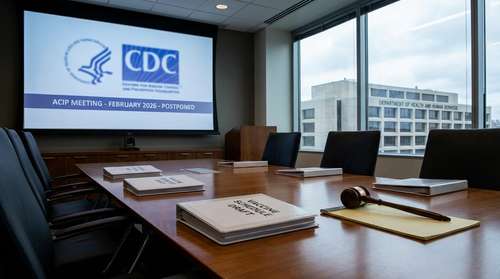
In a move that has intensified the growing rift between federal health officials and the medical community, the Centers for Disease Control and Prevention (CDC) has indefinitely postponed its critical Advisory Committee on Immunization Practices (ACIP) meeting, originally scheduled for February 25-27. The abrupt cancellation comes as a coalition of public health faculty joined the American Academy of Pediatrics (AAP) today in a widening legal battle challenging the legitimacy of the administration's controversial 2026 childhood immunization schedule.
ACIP Meeting Halted Amid Legal and Administrative Chaos
The postponement of the February ACIP meeting marks a significant escalation in the standoff over the nation's vaccine policy. Sources close to the Department of Health and Human Services (HHS) confirmed the delay late last week, citing ongoing litigation in a Massachusetts federal court. However, legal experts point to procedural failures as the primary driver: the committee reportedly failed to publish a meeting agenda or public notice 15 days in advance, a violation of the Federal Advisory Committee Act.
The meeting was widely expected to be a battleground for cementing the administration's new "17 to 11" policy, which drastically reduces the number of universally recommended childhood vaccines. "This postponement is a symptom of a broken process," said Dr. Andrew Racine, President of the AAP, in a statement. "We are witnessing the dismantling of a safety review system that has protected children for decades, replaced by unilateral decisions made without transparency."
The "17 to 11" Overhaul: A Radical Shift in Policy
At the heart of the controversy is the revised CDC vaccine schedule 2026, released on January 5 under the direction of HHS Secretary Robert F. Kennedy Jr. The new guidance removes routine recommendations for six major vaccines—Hepatitis A, Hepatitis B, Influenza, Rotavirus, RSV, and Meningococcal—reclassifying them under "Shared Clinical Decision Making" (SCDM). This change effectively reduced the standard childhood regimen from 17 preventable diseases down to 11.
Federal officials argue the changes align the U.S. with "peer nations" like Denmark and Germany, prioritizing parental choice. However, the move has sparked confusion among providers. Under the new SCDM designation, these vaccines are no longer automatically administered but require an individual conversation between doctor and parent—a hurdle critics say will plummet coverage rates and spark outbreaks.
"The concept of 'shared decision making' sounds empowering, but in practice, it removes the default recommendation that schools and insurers rely on," explains health policy analyst Sarah Gunders. "It turns standard preventive care into an optional negotiation."
Pediatricians and States Rebel Against Federal Guidance
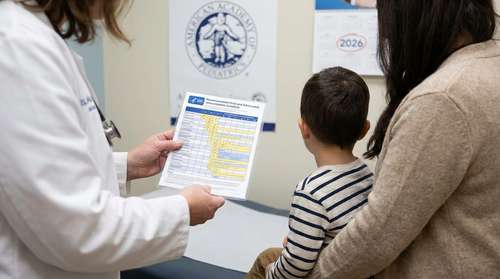
In an unprecedented break from federal authority, the AAP released its own independent 2026 immunization schedule on January 26, maintaining the traditional recommendation for all 18 diseases. This "dual schedule" reality has forced states to pick a side. As of this week, 28 states—including California, New York, and Illinois—have announced they will adhere to the AAP's robust guidelines rather than the stripped-down federal version.
The legal pressure mounted further today, February 23, as over 40 faculty members from the Milken Institute School of Public Health filed an amicus brief supporting the AAP's lawsuit. The pediatrician lawsuit against the CDC alleges that the new schedule is "arbitrary and capricious," arguing that the administration bypassed the scientific review process typically mandated for such sweeping public health changes.
School Health Requirements in Limbo
For parents, the immediate concern is school health requirements for 2026. Historically, state school mandates mirrored CDC recommendations. With the federal list now shrinking, families are left in a patchwork system where requirements vary wildly across state lines. While the CDC's changes do not immediately override state laws, they weaken the legal footing for mandates, potentially opening the door for more exemptions in states sympathetic to the new federal stance.
Family Vaccine Coverage and Insurance Concerns
Beyond the courtroom, the delay raises urgent questions about family vaccine coverage. The Vaccines for Children (VFC) program, which covers costs for millions of low-income families, is legally tied to ACIP recommendations. While HHS has promised that funding will continue for all previously recommended shots, medical groups fear that the shift to "non-routine" status could eventually allow insurers to drop coverage for vaccines like the flu shot or Hep B.
"Parents are calling our offices asking if their insurance will still pay for the flu shot," notes Dr. Pia Pannaraja, a pediatrician in Boston. "For now, the answer is yes, but the uncertainty is causing unnecessary anxiety. We advise all families to stick to the AAP schedule to ensure their children remain fully protected against all preventable diseases."
With the ACIP meeting indefinitely on hold and the lawsuit gaining momentum, the future of America's childhood immunization landscape remains in a volatile deadlock. For now, the advice from the nation's pediatricians is clear: ignore the noise and stay up to date.