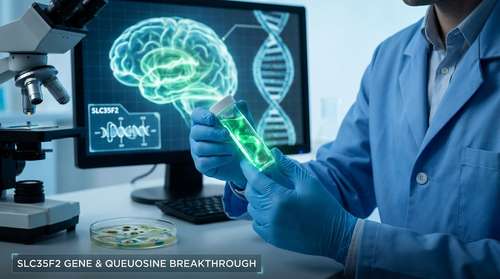
For decades, cellular biologists suspected that a hidden nutritional gateway must exist to allow specific, powerful compounds from our diet to enter human cells. That 30-year puzzle was officially solved this week in April 2026, fundamentally shifting our understanding of disease prevention. An international research team, co-led by scientists at the University of Florida and Trinity College Dublin, identified the precise biological transporter that absorbs queuosine. With this breakthrough, researchers are beginning to map out the profound queuosine brain health benefits and cancer-fighting properties that this previously overlooked molecule provides.
Cracking the Code of Nutritional Dark Matter 2026
First identified in the 1970s, queuosine is a microscopic, vitamin-like compound. The human body is entirely incapable of manufacturing it on its own. Instead, we rely heavily on dietary sources—such as certain meats, dairy, and fermented foods—along with the bacterial factories living inside our intestines. For years, it languished as a mysterious biological footnote.
Today, researchers classify such compounds as nutritional dark matter 2026—substances essential for human physiology whose mechanisms largely remain a mystery until modern tools uncover them. Once inside the body, queuosine modifies transfer RNA (tRNA), essentially fine-tuning how your genetic code translates into functional proteins. Without this precise decoding process, cellular machinery becomes prone to the types of errors that drive cognitive decline and tumor growth. Yet until this recent publication in the Proceedings of the National Academy of Sciences (PNAS), nobody understood how the compound actually crossed the cell membrane.
The SLC35F2 Gene Discovery Nutrition Breakthrough
The solution to the decades-old mystery centers on a specific stretch of human DNA. The SLC35F2 gene discovery nutrition researchers revealed that this gene acts as a high-specificity transporter, opening the cellular gates exclusively for queuosine and its precursor, queuine.
"For over 30 years, scientists have suspected that there had to be a transporter for this nutrient, but no one could find it," said Valérie de Crécy-Lagard, a distinguished professor at the University of Florida and one of the principal investigators. The research required massive collaboration, uniting experts from UF, San Diego State University, the Ohio State University, and institutions in Ireland.
Ironically, scientists were already familiar with the SLC35F2 gene, but for entirely different reasons. In previous medical literature, it was primarily studied as an avenue that certain viruses and cancer drugs exploit to penetrate human cells. Its actual, healthy biological purpose was completely unknown. Recognizing that it exists primarily to transport a crucial micronutrient shifts the perspective on how targeted therapies might be designed in the near future.
A Highly Specific Gateway
The molecular gateway does not accept just any compound. Transport uptake studies confirmed that the SLC35F2 protein is not a general ribonucleobase transporter. It selectively imports queuosine from the bloodstream, functioning as the sole mechanism human cells have to capture this vital nutrient and transport it through the cell membrane and Golgi apparatus.
Validating the Gut Microbiome Brain Connection
Because the human body outsources the production of queuosine to gut bacteria, the findings offer a concrete mechanism explaining the gut microbiome brain connection. When microbial colonies in the intestinal tract synthesize this molecule, the SLC35F2 transporter ensures it gets salvaged and distributed to billions of human cells, including sensitive neural tissue.
Vincent Kelly, a professor in Trinity College Dublin's School of Biochemistry and Immunology, emphasized the massive scale of this biological operation. He noted that while biologists knew the molecule influenced stress responses, metabolic regulation, and learning, the distribution network remained a complete black box. By mapping the route from bacterial synthesis in the colon to gene translation in the brain, researchers can now see a direct chemical line between intestinal health, diet, and memory retention.
Rare Micronutrients for Cancer Prevention
Perhaps the most clinically urgent application of this research lies in oncology. Tumor cells often exhibit chaotic genetic translation, creating the flawed proteins that drive malignancy. Proper tRNA modification acts as a biological proofreader.
By establishing how cells maintain their supply of queuosine, oncologists can begin looking at rare micronutrients for cancer prevention as a viable medical strategy. Because the SLC35F2 transporter itself has been identified in the past as an oncogene—a gene with the potential to cause cancer under certain conditions—understanding its primary nutritional function creates a novel therapeutic target. Modulating this gateway could theoretically starve cancer cells of the resources they need to proliferate, or conversely, fortify healthy cells against cancerous mutations.
New Essential Nutrients 2026 and Functional Nutrition Breakthroughs
As medical science catalogs the new essential nutrients 2026 is bringing to the forefront, queuosine is positioned at the top of the list. The realization that our daily diet and microbial ecology dictate genetic translation pushes the very boundaries of dietary science.
These types of functional nutrition breakthroughs suggest that standard dietary guidelines may soon undergo a massive revision. Future clinical applications will likely include therapeutic supplementation of queuosine for patients suffering from neurodevelopmental disorders or those undergoing targeted cancer treatments. For now, this landmark scientific discovery stands as a testament to the fact that some of our most powerful medical defenses have been hiding right inside our own digestive tracts, waiting for the right genetic key to unlock them.