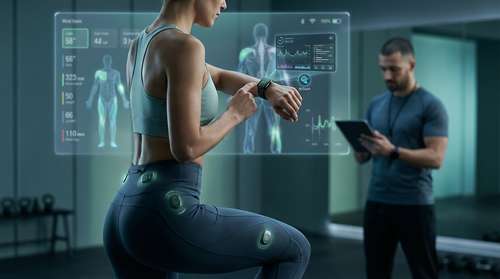
The era of blindly following a pre-written 12-week marathon plan or a static gym routine is officially coming to a close. A groundbreaking shift in the fitness industry is unfolding right now, driven by what engineers and physiologists are calling bio-adaptive workout technology. Rather than telling you what to do based on what you planned yesterday, these systems tell you exactly what your body can handle right now. By analyzing sudden fluctuations in continuous blood sugar data, heart rate variability, and oxygen saturation, your wearable device is no longer just a passive tracker—it is an active, real-time governor of your physical exertion.
The Shift to Real-Time Biometric Training
For decades, athletes relied heavily on static heart-rate zones or perceived exertion scales to measure their output. However, sports scientists have long known that heart rate is often a lagging indicator. By the time your beats per minute spike dangerously high, the physiological cost on your nervous system has already been incurred. Real-time biometric training turns this antiquated model upside down. Leading wearable manufacturers are currently rolling out major software updates that adjust your prescribed workout intensity mid-session based on live biological feedback.
A prime example of this aggressive market shift occurred just days ago. On March 31, 2026, WHOOP announced a massive $575 million funding round, propelling its valuation to $10.1 billion. The company is scaling its health platform specifically to prioritize continuous biometric data paired with advanced artificial intelligence. Their proprietary AI models, powered by billions of hours of physiological data, are now designed to predict health risks and guide user behavior in the moment. This rapid financial and technological investment forms the backbone of what true AI personalized fitness coaching looks like today.
Closing the Loop with Metabolic Data
Perhaps the most profound addition to the bio-adaptive ecosystem is the seamless integration of real-time metabolic metrics. While the FDA has historically cautioned against standalone, non-invasive smartwatch blood glucose monitoring due to potential accuracy risks and misdiagnoses, major tech players have circumvented this barrier by directly syncing their smartwatch interfaces with clinical-grade Continuous Glucose Monitors (CGMs). Companies like Ultrahuman are actively connecting the complex dots between sleep architecture, metabolic blood markers, and daily physical strain.
When you merge accurate, subcutaneous glucose tracking with the processing power of metabolic health wearables 2026, the wearable can detect if your blood sugar is crashing mid-run. Instead of an app pushing you to hit a specific 5K pace, the AI intervenes. It can instruct your connected earphones to scale back the intensity to a safer aerobic zone, preserving your metabolic health and preventing a severe hypoglycemic crash before you even feel fatigued.
Beyond the Morning Readiness Score
Historically, fitness trackers gave you a single "readiness" or "recovery" score when you woke up. You either had a green, yellow, or red light to dictate your entire day. Bio-adaptive systems recognize that human recovery is highly dynamic. Your physical readiness at 7:00 AM might plummet by 4:00 PM after a highly stressful workday, dehydration, or skipped meals.
This is precisely where next-gen recovery optimization takes over. Instead of relying on a static morning number, these AI systems continuously update your training capacity throughout the day. If your wearable detects a drop in blood oxygen saturation (SpO2) or an increase in stress-induced heart rate variability during back-to-back afternoon meetings, the aggressive high-intensity interval session you scheduled for 6:00 PM is automatically rewritten into a low-intensity active recovery protocol. The technology prevents overtraining before you even step foot in the gym.
What Fitness Tech Trends 2026 Mean for Everyday Athletes
The democratization of elite-level sports science is arguably the defining characteristic among fitness tech trends 2026. Previously, only professional athletes had a dedicated team of physiologists monitoring their lactate thresholds, fueling strategies, and respiratory rates on the sidelines. Now, the immense computational power of AI models—such as the conversational generative AI integrations seen in the WHOOP Coach—brings that exact level of physiological scrutiny directly to your wrist.
You no longer have to guess if you are overtraining or if you should push harder on a given day. The broad integration of bio-adaptive workout technology means your exercise programming is perpetually aligned with your actual, real-time physiology. If you sleep poorly, your workout adapts. If your glucose spikes after a heavy meal, your workout adapts to utilize that fuel. This seamless synchronization protects your central nervous system, optimizes your metabolic health, and ensures that every minute of exertion actively moves you closer to peak performance.