February 15, 2026 – The simmering war over America's dinner plates boiled over this weekend as a coalition of leading cardiologists and nutrition deans issued a blistering joint statement condemning the newly implemented 2025-2030 Dietary Guidelines. At the center of the firestorm is the USDA's radical new "inverted food pyramid," a graphic released under the "Make America Healthy Again" (MAHA) initiative that visually prioritizes animal proteins and natural fats like beef tallow over grains and carbohydrates. While HHS Secretary Robert F. Kennedy Jr. defends the overhaul as a necessary "reset" to combat chronic disease, critics argue the protein-first nutrition news dominating headlines could set public health back decades.
The 'Inverted' Pyramid: A Radical Departure
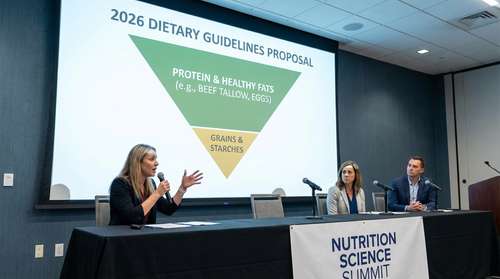
For over forty years, the base of the American food pyramid was built on grains, breads, and cereals. As of last month, that foundation has been upended. The new inverted food pyramid explained in the 2026 guidelines places "nutrient-dense animal proteins" and "natural fats"—including butter, ghee, and tallow—at the broad top of the triangle, signaling they should comprise the bulk of caloric intake.
Conversely, grains, fruits, and what the administration terms "refined carbohydrates" have been demoted to the narrow tip at the bottom. The visual shift is striking and intentional. "We are flipping the script on the failed low-fat experiment," declared USDA Secretary Brooke Rollins in a press briefing yesterday. "The era of government-subsidized sugar spikes is over."
However, the new graphic has sparked confusion. While the visual suggests unlimited consumption of red meat and dairy, the fine print still retains a contradictory cap on saturated fat at 10% of daily calories—a discrepancy that experts from the American Heart Association highlighted in their emergency summit on Saturday. "You cannot visually promote a diet centered on ribeyes and butter while technically advising a limit that makes such a diet impossible," noted Dr. Sarah Jenkins, a lead cardiologist at the summit.
Protein-First: The New 1.6g Standard
Beyond the graphics, the new USDA dietary guidelines 2026 introduce a concrete policy shift: a recommendation for nearly double the historical protein intake. The new "Protein-First" mandate advises Americans to consume between 1.2 and 1.6 grams of protein per kilogram of body weight daily.
Implications for the Average American
For a 180-pound adult, this translates to roughly 130 grams of protein a day—a target difficult to hit without significant consumption of meat, eggs, or dairy. This guidance aligns with the MAHA movement's push to support American ranchers but has drawn sharp rebuke from environmental scientists and plant-based nutrition advocates.
Supporters argue this higher protein target is essential for reversing the obesity epidemic, citing research that protein promotes satiety and metabolic health. "We are seeing a return to ancestral eating," says functional medicine advocate Dr. Mark Hyman, a key advisor to the MAHA transition team. "Muscle is the organ of longevity, and you can't build it on cereal and skim milk."
The Beef Tallow vs. Seed Oil Debate
Perhaps the most culturally charged aspect of the new guidelines is the explicit endorsement of animal fats. The beef tallow health benefits debate has moved from niche internet forums to federal policy. The 2026 text explicitly categorizes tallow, lard, and butter as "preferred natural cooking fats," while categorizing industrial seed oils (like soybean and canola oil) as "processed additives" to be minimized.
This weekend's backlash focused heavily on this classification. The Harvard T.H. Chan School of Public Health released a preliminary analysis Friday warning that replacing polyunsaturated fats with high-saturated animal fats could increase LDL cholesterol levels nationwide by 15% within two years. "This isn't science; it's nostalgia disguised as policy," the analysis read. Yet, for proponents, the demonization of "ultra-processed" seed oils is a long-overdue correction, tapping into a growing public skepticism of industrial food systems.
Ultra-Processed Foods in the Crosshairs
If there is one area of tentative agreement, it is the crackdown on ultra-processed food restrictions 2026. The new guidelines effectively ban "chemically modified" ingredients from school lunch programs starting this fall. This means products with high-fructose corn syrup, artificial dyes (like Red 40), and certain preservatives will be stripped from cafeteria menus.
While nutritionists generally applaud the removal of junk food, they worry the baby is being thrown out with the bathwater. "Banning soda is great," says registered dietitian Michelene Lewis. "But grouping whole-grain bread and tofu into the 'avoid' category because they are 'processed' is dangerous misinformation."
MAHA Nutrition Policy Impact: What's Next?
The 2025-2030 Dietary Guidelines controversy is far from over. As of this morning, three major medical associations have threatened to formally boycott the guidelines, advising their member physicians to ignore the USDA's new pyramid in clinical practice. This creates an unprecedented schism between federal policy and medical consensus.
For the average consumer, the message is mixed. Government posters in schools may soon preach the virtues of steak and raw milk, while family doctors warn of heart attacks. What is clear is that nutrition has become the latest, and perhaps most personal, front in America's culture wars.