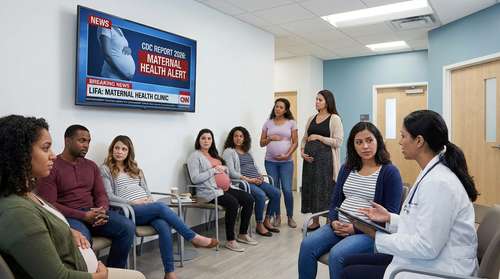
A sobering new report released Thursday by the Centers for Disease Control and Prevention (CDC) reveals that access to essential prenatal care in the United States has reached a alarming low, signaling a deepening US maternal health crisis. The data, published by the National Center for Health Statistics, indicates that nearly 25% of expectant mothers are now missing critical first-trimester health screenings—a statistic that experts warn could reverse years of progress in preventing maternal and infant mortality.
CDC Prenatal Care Report 2026: The Numbers Behind the Crisis
The CDC prenatal care report 2026 paints a grim picture of reproductive health access. According to the findings, which analyzed national birth certificate data through late 2024, only 75.5% of pregnant women received prenatal care during their first trimester. This represents a significant drop from the peak of 78.3% observed in 2021.
Michelle Osterman, the report’s lead author, highlighted that this decline ends a five-year period of steady improvement. "We are seeing a fundamental shift in how and when women are able to access care," Osterman stated. The report details that the percentage of women receiving late prenatal care (starting in the third trimester) or no care at all has risen to 7.3%, increasing the risk of undetected complications like preeclampsia and gestational diabetes.
Racial Disparities and the "Access Gap"
The burden of this decline is not shared equally. The maternal health trends 2026 data exposes widening racial fissures in the healthcare system. While access dropped across all demographics, Black mothers saw the steepest decline, with first-trimester care rates falling from 69.7% to just 65.1%.
"We know that early engagement in prenatal care is linked to better overall health outcomes," says Dr. Clayton Alfonso, an OB-GYN at Duke University. "When patients delay medical care during pregnancy, we’ve missed that window to optimize both fetal and maternal care."
Health officials point to a "perfect storm" of systemic failures driving these disparities, including the unwinding of pandemic-era Medicaid protections and the proliferation of maternity care deserts. A related 2026 assessment by the March of Dimes recently gave the U.S. a "D+" grade for maternal health, noting that more than 35% of U.S. counties now lack a single birthing facility or obstetric provider.
Rural Hospital Closures and Provider Shortages
The collapse in prenatal care access is particularly acute in rural America, where hospital closures have left millions of women miles from the nearest doctor. In states like Texas, Georgia, and Florida, more than 1 in 10 women now receive late or no prenatal care.
Dr. Grace Ferguson, a Pittsburgh-based obstetrician, notes that the exodus of providers is exacerbating the issue. "Many hospitals have shut down labor and delivery units, and the prenatal care providers that work at those hospitals have moved," Ferguson explained. She also cited the chilling effect of post-Roe v. Wade abortion restrictions, which have caused some OB-GYNs to leave states with strict bans, further widening family healthcare gaps.
The Link to Maternal Mortality Prevention
The delay in care is not just a logistical inconvenience; it is a matter of life and death. Pregnancy health outcomes are inextricably quality of early screening. Missing first-trimester appointments means missing the chance to detect high-risk conditions such as hypertension, which is a leading cause of pregnancy-related death.
With the U.S. already holding the highest maternal mortality rate among wealthy nations, these new figures suggest the trend may worsen before it improves. The maternal mortality prevention strategies relied upon for the last decade—primarily increasing insurance coverage and early screening—are faltering as the infrastructure to deliver that care crumbles.
What Needs to Change?
Healthcare advocates are calling for immediate policy intervention. Proposed solutions include expanding Medicaid postpartum coverage universally to 12 months, increasing reimbursement rates for midwives and doulas to fill rural gaps, and federal incentives to keep rural labor and delivery units open.
"If this trend continues," Dr. Alfonso warned, "I worry about what that would mean for morbidity and mortality for our moms. We cannot allow 75% to become the new normal."