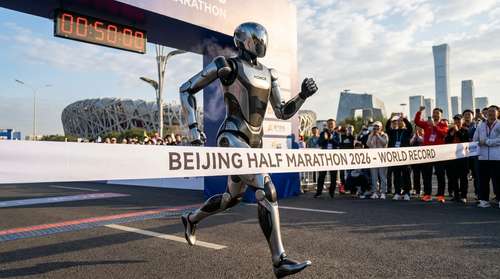
The undeniable rhythm of footfalls hitting the pavement during Sunday's race carried a distinctly metallic resonance. On April 19, 2026, a new chapter in athletic history was written when a machine developed by the Chinese smartphone giant Honor shattered the humanoid robot world record—and eclipsed the fastest human half-marathon time in the process. Clocking in at an astonishing 50 minutes and 26 seconds, the Honor robot athlete conquered the 13.1-mile course, proving that the gap between biological limitation and engineered perfection is closing faster than anyone anticipated.
A Historic Sprint at the Beijing Half Marathon 2026
Staged in the Beijing Economic-Technological Development Area, also known as Beijing E-Town, the Beijing half marathon 2026 served as a high-stakes proving ground for the global robotics industry. The event featured a separate, parallel track for mechanical competitors alongside the 12,000 human runners to avoid collisions.
The sheer scale of the showcase was roughly five times larger than its inaugural 2025 edition, with more than 100 teams joining the competition. Last year, the winning machine lumbered across the finish line in two hours, forty minutes, and forty-two seconds. What a difference twelve months can make. This weekend, Honor's flagship autonomous runner slashed that time dramatically, cruising past the existing human benchmark of roughly 57 minutes set by Uganda's Jacob Kiplimo in March.
Interestingly, the race featured complex weighted scoring rules. While state media outlets reported that a remotely controlled robot—also from Honor—crossed the finish line first in just 48 minutes and 19 seconds, the official championship was awarded to the 50-minute model because it navigated the twisting course autonomously. Honor swept the podium, with its autonomous runners-up finishing in approximately 51 and 53 minutes.
The Anatomy of AI-Driven Fitness Performance
To understand this quantum leap in AI-driven fitness performance, you have to look under the carbon-fiber hood. Engineers at Honor, a company that originally spun off from Huawei, leaned heavily on their background in mobile technology. Du Xiaodi, an engineer on the winning team, revealed that the model was developed over the course of just one year.
Adapting Smartphone Tech for the Track
The secret to the machine's sustained speed lies in its thermal regulation. The robot utilizes advanced liquid cooling technology originally designed to prevent high-end smartphones from overheating. This allowed the machine's actuators and motors to fire continuously without degrading performance—a critical failure point for earlier humanoid models.
Coupled with mechanical legs measuring 90 to 95 centimeters designed to perfectly replicate the biomechanical stride of elite human long-distance runners, the hardware represents a masterclass in modern engineering. But muscle needs a brain. Navigating the course required split-second decision-making, utilizing onboard sensors and mapping algorithms to dynamically adjust pace and direction without human intervention.
Robot vs Human Running: A Metronomic Pace
The spectacle of robot vs human running highlights a fascinating divergence in how we measure athletic achievement. Human endurance requires a fragile balance of oxygen intake, lactic acid management, and psychological grit. For a machine, it is a calculus of battery efficiency, gyroscopic stabilization, and algorithmic pathfinding.
The top-tier robotic athletic technology on display maintained a relentless, metronomic pace that biological systems simply cannot sustain. However, the exhibition was not completely flawless. The unpredictable nature of live environments still poses challenges for roboticists. At the starting line, one machine fell completely flat, while another crashed into a course barrier and required assistance just meters from the finish line,.
The event also featured functional robotics in supporting roles. State broadcasters highlighted a specialized unit acting as a traffic officer, utilizing precise arm gestures and voice commands to direct human and mechanical runners alike.
Reshaping the Future of Endurance Sports and Industry
As autonomous systems continue to rapidly evolve, the future of endurance sports faces an existential paradigm shift. We are entering an era where the absolute pinnacle of physical speed is no longer restricted to flesh and bone. While humanoid robots are unlikely to compete directly for Olympic medals anytime soon, their ability to analyze, replicate, and surpass elite human movement offers incredible insights for sports science and biomechanics.
Beyond the track, this marathon serves as a proxy for global technological dominance. Speeding up the development of embodied intelligent robots is a major pillar of China's 2026-2030 economic plan. The physical prowess demonstrated on the marathon course highlights the potential for these machines to transition into widespread commercialization, eventually taking on dangerous industrial jobs, advanced manufacturing roles, and disaster response operations.
The 50-minute half-marathon is much more than a novelty act; it is the opening sprint of a new industrial revolution. The starting pistol has fired, and the real race is seeing how quickly these innovations will outpace our wildest expectations.