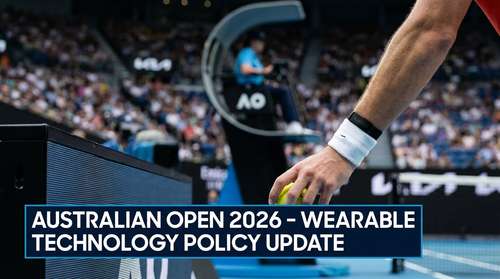
The 2026 Australian Open has delivered its fair share of on-court drama, but the most heated battle at Melbourne Park isn't being fought with racquets. It’s being fought over wristbands. In a move that has baffled fans and frustrated athletes, tournament officials have cracked down on the use of wearable fitness trackers, forcing top-ranked stars like Aryna Sabalenka, Carlos Alcaraz, and Jannik Sinner to remove their devices mid-tournament. The Australian Open 2026 fitness ban has sparked a fiery debate about the intersection of athlete health, modern technology, and the traditional rules of the Grand Slams.
The Controversy: Stars Stripped of Tech Mid-Match
The controversy exploded into the public eye during the fourth round, when the chair umpire interrupted world No. 1 Carlos Alcaraz before his clash with Tommy Paul. Alcaraz, who had been wearing a WHOOP strap discreetly tucked under his sweatband, was ordered to remove it immediately. The Spaniard complied, handing the device to his team, but the visual of a top athlete being stripped of a health-monitoring tool broadcasted a confusing message to millions of viewers.
Alcaraz wasn't alone. Women's world No. 1 Aryna Sabalenka was asked to remove her device ahead of her opening match, while Jannik Sinner faced a similar directive before his fourth-round appearance. "Rules are rules, and I understand," Sinner said post-match, though he noted the data is crucial for analyzing recovery and strain, not for cheating.
The 'Grand Slam' vs. Tour Divide
The confusion stems from a glaring regulatory disconnect in professional tennis. On the regular tours, these devices are perfectly legal. The WTA approved wearable technology in 2021, and the ATP followed suit in July 2024, recognizing the value of biometric data for injury prevention and performance analysis. However, the four Grand Slams—the Australian Open, Roland Garros, Wimbledon, and the US Open—operate independently of the tours and set their own regulations.
Tennis Australia's stance is that wearable technology trends in 2026 have outpaced the current Grand Slam rulebook. While the ATP and WTA see these devices as essential health tools, Grand Slam officials are wary of the potential for "internal load" data (like real-time heart rate) to be transmitted to coaches, potentially violating rules against coaching or opening doors to betting integrity issues.
'Data Is Not Steroids': The Industry Hits Back
The ban has drawn sharp criticism from tech leaders and player advocates. Will Ahmed, CEO of WHOOP, took to social media to blast the decision, calling it "ridiculous." His argument is simple: "Data is not steroids." Proponents of athlete performance tracking argue that denying players access to their own physiological data—such as heart rate variability, strain, and sleep recovery—is a step backward for player safety.
"WHOOP is approved by the International Tennis Federation for in-match wear and poses no safety, fairness, or competitive risk," the company stated. "Blocking access to personal health data does not protect the sport; it leaves athletes playing blind to their body's needs."
The irony is palpable. While officials ban personal trackers, the tournament itself uses advanced systems like Bolt 6 to track "external load" metrics—distance covered, speed, and changes of direction—which are broadcasted to fans and teams. The line between "allowed data" and "banned data" appears increasingly arbitrary to players who rely on these insights to prevent burnout in a grueling 11-month season.
Why the Ban Exists: The Fear of 'Internal Load'
Tennis Australia defends the Grand Slam ban on wearable fitness trackers by distinguishing between external and internal data. A spokesperson clarified that devices providing "internal load" metrics offer a "360-degree view" of an athlete's physical state that could theoretically offer a competitive edge if analyzed in real-time. The fear is that a coach could monitor a player's heart rate spiking and signal them to change tactics or call a medical timeout—a scenario officials are desperate to avoid.
However, players like Sinner have pointed out that they aren't looking at the data mid-point. The devices in question are screenless and passive. "It's not for the live thing," Sinner explained. "It's more about what you can see after the match." The technology is used primarily to dictate recovery protocols for the next day, a critical factor in a two-week tournament where endurance is key.
Future Outlook: Will Regulations Evolve?
Despite the hardline enforcement this year, there are signs that the smartwatch sports regulations may soften. Tennis Australia has admitted they are involved in "ongoing discussions" about how the situation could change for future Slams. As Carlos Alcaraz fitness news continues to dominate headlines, the pressure is on the Grand Slam Board to harmonize their rules with the rest of the tennis world.
For now, the message to players at the 2026 Australian Open is clear: leave the tech in the locker room. But as the gap between modern athletic training and archaic rulebooks widens, this controversy is likely just the first set in a long match over the future of sports technology.