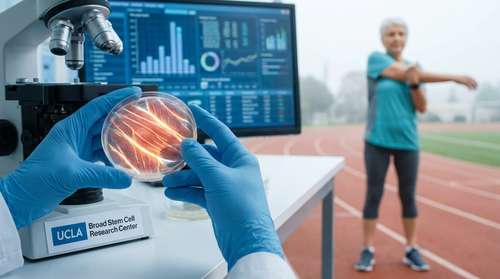
In a watershed moment for longevity science, humanity has officially crossed the threshold from slowing aging to potentially reversing it. Just yesterday, at the 2026 World Governments Summit in Dubai, Harvard geneticist David Sinclair stunned the audience by announcing that his team is preparing to launch broader human clinical trials for biological age reversal. This announcement comes on the heels of a historic FDA decision granting Life Biosciences the green light for the first-ever human trials of partial epigenetic reprogramming. For the first time, the science of 'resetting' our cellular clock is moving from the lab bench to the clinic.
The Dawn of Epigenetic Reprogramming Trials
The core of this week's breaking news centers on a therapy known as ER-100, developed by Life Biosciences. Unlike traditional medicines that treat symptoms, this cellular rejuvenation therapy targets the root cause of aging: the loss of epigenetic information. The FDA's Investigational New Drug (IND) clearance allows the company to begin a Phase 1 trial treating patients with two specific optic neuropathies: open-angle glaucoma and non-arteritic anterior ischemic optic neuropathy (NAION).
"We are about to test, for the first time in history, whether we can reverse aging and cure diseases," Sinclair declared from the summit stage on Thursday. The therapy utilizes a modified version of the Nobel Prize-winning Yamanaka factors—specifically Oct4, Sox2, and Klf4 (OSK)—to essentially reboot the software of older cells. By toggling these gene switches, the therapy aims to restore a youthful epigenetic pattern without erasing the cell's identity, a process known as partial epigenetic reprogramming.
David Sinclair's 2026 Vision: Aging as a Treatable Condition
While the Life Biosciences trial focuses on restoring vision, the implications extend far beyond eye health. Speaking to global leaders in Dubai, Sinclair emphasized that aging should no longer be viewed as an inevitability but as a "medical condition that is increasingly treatable." He argued that current healthcare models are outdated because they play "whack-a-mole" with individual diseases like cancer and heart disease, which often strike simultaneously in late life.
The Information Theory of Aging
This new wave of longevity medicine breakthroughs is grounded in the Information Theory of Aging. Sinclair likens the aging process to a scratched CD: the digital music (our DNA) is still intact, but the reader (the cell) can no longer read the tracks due to accumulated noise (epigenetic changes). The new epigenetic reprogramming trials are designed to polish the scratches, allowing the cell to read its original youthful instructions again. If successful in the eye, this technology could theoretically be applied to rejuvenate the liver, kidneys, and even the brain.
From Mice to Men: The Road to Healthy Aging 2026
The shift to human trials marks a massive acceleration in the field. Until now, these age-reversal feats were limited to animal models. In 2020, Sinclair's lab successfully restored vision in blind mice and extended their remaining lifespan. Now, with Life Biosciences FDA approval, we are seeing the first tangible steps toward translating those animal results into healthy aging 2026 solutions for humans.
However, experts caution that safety remains the primary hurdle. The trial will rigorously monitor for immune responses and adverse effects. Unlike systemic treatments, the eye offers a contained environment to test these powerful gene therapies safely. "This is a pragmatic step forward," noted industry analysts this week. "It places reprogramming on a familiar path of dose-finding and clinical validation."
A Competitive Race for Cellular Rejuvenation
Life Biosciences is not alone in this race. The FDA's decision has likely fired the starting gun for other major players like Altos Labs and Retro Biosciences, who are also pursuing cellular rejuvenation therapy. The global longevity market is projected to explode as these therapies prove their viability. For the average person, this means we might soon see a transition from reactive sick-care to proactive health-preservation, where maintaining a youthful biological age is as routine as a dental check-up.
As we close out this historic week, one thing is clear: the question is no longer if we can reverse aging in humans, but when these therapies will become widely available. With the FDA's blessing and major global platforms like the World Governments Summit highlighting these advances, 2026 is shaping up to be the Year of Longevity.