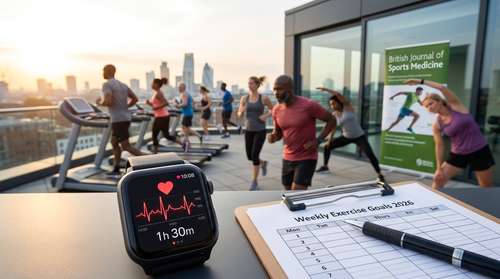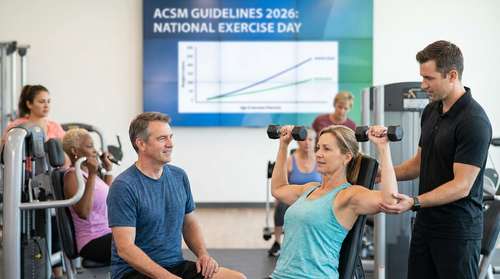
As the United States recognizes National Exercise Day 2026 today, the medical and fitness communities are experiencing a seismic shift in how they view physical activity. The American College of Sports Medicine (ACSM) has chosen April 18 to release its highly anticipated ACSM 2026 resistance training guidelines, addressing what experts are calling a nationwide "muscle-loss crisis". Driven by the explosive popularity of GLP-1 receptor agonists, these new standards provide a definitive clinical roadmap for patients who are rapidly shedding pounds but inadvertently destroying critical lean tissue in the process.
The Hidden Cost of the Weight-Loss Drug Revolution
Medications like semaglutide and tirzepatide have transformed obesity medicine, offering unprecedented, rapid reductions in body weight. However, accumulating clinical data reveals a startling consequence: a massive percentage of the weight lost on these medications is not adipose tissue, but structural skeletal muscle. When patients undergo severe caloric restriction without a structured physical defense strategy, their resting metabolic rate plummets. This sets the stage for aggressive fat regain once they taper off the medication, effectively leaving them metabolically worse off than when they started.
This reality is exactly what the new ACSM framework targets. Historically, public health initiatives leaned heavily into aerobic activity, encouraging Americans to simply walk more. Today, the message is radically different. The focus has pivoted squarely to strength training for weight loss drugs. The new publication establishes resistance exercise not as an optional lifestyle addition, but as a non-negotiable medical necessity for anyone undergoing pharmacological obesity treatment.
Prioritizing Muscle Mass Retention
Losing muscle doesn't merely impact physical strength; it compromises long-term metabolic health. Muscle tissue acts as the body's primary metabolic engine. Stripping it away accelerates frailty, diminishes insulin sensitivity, and increases the risk of bone density loss. By aggressively prioritizing muscle mass retention, patients protect their metabolic baseline.
The ACSM's massive update synthesized data from 137 systematic reviews, representing over 30,000 participants. The findings conclusively demonstrate that without a mechanical stimulus signaling the body to keep its muscle, rapid pharmacological weight loss inevitably results in a state of sarcopenic obesity. The patient becomes physically smaller, but structurally and metabolically weaker.
Inside the New ACSM Standards
The landmark publication, officially titled Resistance Training Prescription for Muscle Function, Hypertrophy, and Physical Performance, fundamentally rewrites how physicians should prescribe exercise. The guidelines clarify that walking and light cardio, while beneficial for the heart, are entirely insufficient for muscle preservation GLP-1 users. Instead, a targeted approach to lifting heavy loads is required.
According to the newly minted protocols, patients must engage in resistance training a minimum of two to three times per week. The standards mandate focusing on compound movements that recruit multiple large muscle groups simultaneously—exercises such as squats, lunges, chest presses, and rows. Surprisingly, the guidelines are highly accessible for deconditioned adults who may be intimidated by traditional gym environments. Heavy barbell lifting is not strictly required. The ACSM confirms that moderate loads between 40% and 70% of a one-rep maximum (1RM)—achieved through free weights, selectorized machines, or even high-quality elastic resistance bands—produce the necessary biological response to save lean mass.
Hypertrophic Training Protocols and Strategic Nutrition
The updated literature goes well beyond simply telling patients to lift weights. It outlines highly specific hypertrophic training protocols combined with strategic rehabilitative nutrition. To counter the muscle-wasting effects of a severe, drug-induced caloric deficit, the guidelines heavily emphasize protein timing and total daily intake. Consuming high-quality protein in close proximity to resistance sessions ensures the body has the necessary amino acid building blocks to repair micro-tears and construct new tissue.
Progression remains the critical mechanism highlighted in the release. Whether a patient is using adjustable dumbbells in their living room or heavy machines at a commercial facility, they must continuously challenge the muscle through progressive overload. Moving with distinct intent, controlling the lowering phase of the movement, and taking work sets close to muscular fatigue are the central pillars of the 2026 recommendations.
Redefining Fitness for Longevity 2026
The timing of this release alongside the spring holiday is highly intentional. Previous iterations of National Exercise Day focused heavily on step counts and heart rates. The 2026 messaging demands a much higher standard of physical preparedness. We are witnessing a monumental paradigm shift in how the medical establishment approaches fitness for longevity 2026.
Moving forward, the true measure of a successful weight-loss intervention won't be calculated solely by the raw number on the scale, but by the precise ratio of fat lost to lean mass preserved. For the millions of Americans utilizing these revolutionary medications, the path forward is now unmistakably clear. Cardiovascular health remains vital, but protecting the structural foundation of the body is the ultimate priority. To secure the life-changing benefits of modern weight-loss science, patients must be willing to pick up the weights.