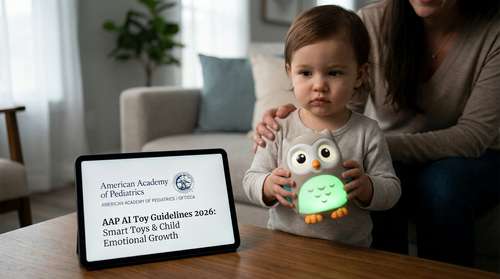
Parents and caregivers have long viewed interactive gadgets as harmless educational tools or helpful digital babysitters. However, an urgent new report released earlier this week fundamentally changes how we should approach early childhood playtime. According to the groundbreaking AAP AI toy guidelines 2026, excessive interaction with artificial intelligence-integrated "smart" toys may actively delay core emotional regulation and empathy building in children under five. While these advanced devices often promise accelerated cognitive benefits, pediatricians are sounding the alarm: algorithms cannot replace the complex socio-emotional cues provided by human caregivers and traditional play.
The Hidden Impact of Smart Toys on Toddlers
The pediatric community has monitored screen time for decades, but the integration of generative AI into physical toys presents an entirely new challenge. Unlike traditional electronic toys that play pre-recorded sounds or light up when a button is pressed, the latest generation of smart toys uses conversational AI to simulate real relationships. The April 2026 findings indicate that this simulated bonding disrupts normal child emotional development.
Children between the ages of one and five are in a critical window for learning empathy. They learn to read facial expressions, interpret vocal tones, and navigate conflict through reciprocal human interaction. When toddlers spend hours interacting with AI companions, they receive predictable, programmed responses. An AI toy never gets frustrated, never requires the child to wait their turn, and never models genuine human emotional repair. Consequently, the impact of smart toys on toddlers often manifests as a lower tolerance for frustration and delayed conflict-resolution skills in real-world settings.
The Danger of "Artificial" Empathy
One of the most concerning revelations in the report is how young children perceive these devices. Toddlers easily anthropomorphize objects, meaning they assign human feelings and thoughts to inanimate things. When a smart bear or robotic dog responds with advanced language processing, children under five genuinely believe the toy is a sentient friend. This blurs the line between pretend play and reality, potentially stunting a child's ability to navigate genuine social dynamics.
Pediatric Mental Health Trends Linked to AI Technology
This week's guidance from the American Academy of Pediatrics arrives against the backdrop of shifting pediatric mental health trends. Clinical observations over the past two years show a noticeable increase in social withdrawal among toddlers who rely heavily on AI companions. The report notes that early reliance on these tools correlates with an overall decrease in peer-to-peer interactive play.
Furthermore, AI technology in early childhood introduces subtle privacy and emotional risks. AI toys collect massive amounts of voice data to personalize their interactions. While tech companies argue this data creates a better user experience, pediatricians point out that a hyper-personalized playmate eliminates the productive friction necessary for growth. A toy that automatically anticipates and caters to a child's every whim deprives them of the opportunity to practice patience, compromise, and resilience.
Digital Parenting Tips 2026: Navigating Educational Toy Safety
The AAP is not calling for a total ban on technology in the home. Instead, they are advocating for extreme caution and active parental involvement. If you are navigating the modern toy aisle, keeping educational toy safety for kids at the forefront requires a new set of rules.
The report outlines several essential digital parenting tips 2026 to help families strike a healthy balance:
- Prioritize Co-Play: If you introduce an AI-enabled toy, use it together. Treat the device as an interactive book rather than a substitute companion. Ask your child questions about what the toy is saying to maintain human connection.
- Limit Solo "Conversations": Children under five should not be left alone to converse with AI chatbots or smart toys. Maintain strict boundaries around how long these devices are powered on.
- Encourage Unstructured Traditional Play: Blocks, dolls, and physical outdoor activities require children to use their imagination and navigate physical space. These traditional methods remain the gold standard for developing gross motor skills and emotional intelligence.
- Audit the Tech: Before purchasing a smart toy, verify its data collection policies. Ensure the device does not connect to the open internet and features robust privacy settings.
Rethinking the "Smart" Nursery
As the consumer electronics industry pushes further into early childhood markets, the definition of a "good" toy is shifting. Educational value is no longer just about teaching the alphabet or early math skills; it is about protecting a child's psychological well-being. By adhering to the new guidelines, caregivers can ensure that technology enhances their child's world without replacing the fundamental human connections they need to thrive.