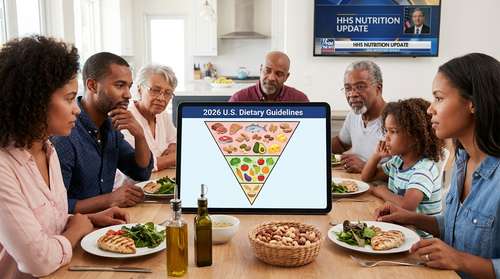
On January 7, 2026, the U.S. Department of Health and Human Services (HHS) officially released the 2026 U.S. Dietary Guidelines, marking the most significant overhaul of federal nutrition policy in decades. Spearheaded by HHS Secretary Robert F. Kennedy Jr. and USDA Secretary Brooke Rollins, the update introduces a radical new visual model: an inverted pyramid. This new graphic, which flips the script on traditional nutritional advice, places high-quality proteins and healthy fats at the widest top section while relegating grains to the narrow bottom. While the core message to "eat real food" resonates with many health advocates, the dramatic departure from the familiar "MyPlate" system has left nutritionists and parents questioning if the new guide is actionable for healthy eating for families or simply a recipe for confusion.
The 'Inverted Pyramid': A Radical Departure from Tradition
For years, Americans have been guided by the "MyPlate" visual, which divided a meal into clear, portion-based sections of fruits, vegetables, grains, and protein. The new RFK Jr food pyramid abandons this portion-based approach in favor of a hierarchy of nutrient density. At the "base"—now the widest part at the top—sits a robust recommendation for animal proteins (meat, eggs, dairy) and "healthy fats." Below them are fruits and vegetables, followed by a significantly shrunken section for whole grains at the bottom tip.
This "inverted" structure is designed to visually represent the HHS nutrition update 2026 philosophy: prioritizing nutrient-dense, whole foods over caloric volume. The guidelines explicitly call for a reduction in refined carbohydrates, which historically occupied the largest base of the original food pyramid. However, critics argue that the visual metaphor is abstract. Unlike a plate, which shows you exactly what a meal should look like, an inverted pyramid is a theoretical ranking system that doesn't easily translate to the dinner table.
'Eat Real Food': The Core Philosophy
The driving force behind the inverted pyramid dietary guide is the "Make America Healthy Again" (MAHA) agenda, which seeks to combat chronic disease by eliminating ultra-processed foods. The text accompanying the guidelines is blunt: avoid "highly processed packaged, prepared, ready-to-eat" foods and strictly limit "chemical additives." For the first time, federal policy explicitly advises against foods containing synthetic dyes and preservatives, a move long championed by clean-label advocates.
The Crackdown on 'Industrial' Fats and Processed Foods
One of the most controversial elements of the new guidelines is the shift in language regarding fats. While previous iterations demonized saturated fats, the 2026 update declares an end to the "war on saturated fats." The guidelines now encourage the consumption of full-fat dairy, butter, and tallow, alongside olive oil and avocado oil. This aligns with RFK Jr.'s public criticism of industrial seed oils, which he has frequently labeled as inflammatory "industrial sludge."
While the official document carefully avoids a total ban on all vegetable oils—likely a concession to agricultural lobbyists—the rhetoric is clear: processed food health risks are the enemy. The guidelines advise families to swap margarine and shortening for "traditional" fats and to avoid "unhealthy fats" often found in ultra-processed snacks. For parents navigating the grocery store, this adds a new layer of complexity: scanning labels not just for sugar, but for specific types of oils and additives that were previously considered standard ingredients.
Why Parents and Nutritionists Are Confused
Despite the praise for prioritizing whole food nutrition for kids, the practical application of the inverted pyramid is proving difficult for many families. The "MyPlate" model was intuitive: half your plate is veggies, a quarter protein, a quarter starch. The new model, with its emphasis on "prioritizing" protein and fat, lacks that immediate visual cue for portion control.
"With this new inverted pyramid, I really don't think it helps people navigate meal planning," said Roberta Burkhart, a registered dietitian who has analyzed the new guidelines. "I think it's less actionable for people. It’s difficult to grasp how a busy parent is supposed to apply a 'pyramid' concept to a Tuesday night dinner."
The Accessibility Challenge
Beyond the visual confusion, there is a distinct economic concern. The new guidelines heavily favor expensive food groups—high-quality meats, organic produce, and pure animal fats—while minimizing cheap staples like grains and pasta. For low-income families relying on SNAP or school lunches, the shift to a protein-heavy, grain-light diet presents a significant financial hurdle. Critics worry that without increased subsidies for fresh foods, the 2026 U.S. Dietary Guidelines may become a luxury lifestyle brand rather than a public health policy.
Navigating the New Landscape
As schools and federal programs begin to align with these new standards, parents will likely see changes in school lunch menus, with fewer bread rolls and more meat and cheese options. The removal of flavored milks and sugary snacks is a widely supported move, but the aggressive pivot toward high-fat, high-protein meals remains a point of contention.
Ultimately, the 2026 guidelines represent a philosophical U-turn. The government is no longer telling Americans to count calories or fear fat; it is telling them to fear processing. Whether this message can be successfully translated into actionable habits for the average American family remains the biggest question of the new administration's health agenda.