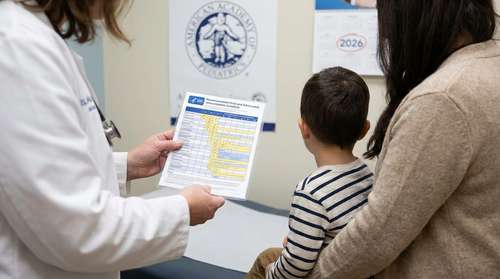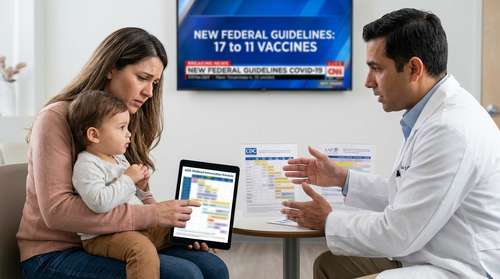
As the second quarter of the year kicks off this week, the operational reality of the revised 2026 childhood vaccine schedule is officially hitting pediatric clinics nationwide. With major health systems rolling out updated electronic health records and consent forms over the last 48 hours, the implementation of these sweeping changes has thrust families into the center of an unprecedented medical debate. For the first time in decades, the nation's top health authorities are completely at odds, resulting in widespread childhood vaccine confusion for parents who simply want to protect their kids.
The Rift: CDC vs AAP Vaccine Guidelines
The turmoil stems from a sweeping directive implemented earlier this year by the Department of Health and Human Services (HHS) and the Centers for Disease Control and Prevention (CDC). Modeled after the immunization frameworks of smaller peer nations like Denmark, the new federal immunization recommendations drastically reduce the number of universally recommended childhood vaccines from 17 to 11.
Under the new CDC framework, only 11 immunizations—including those for measles, mumps, rubella, polio, pertussis, and chickenpox—remain universally recommended for all children. Meanwhile, the human papillomavirus (HPV) vaccine has been formally reduced from a multi-dose series down to a single dose.
However, the American Academy of Pediatrics (AAP) has firmly rejected the federal overhaul. Arguing that the new guidelines circumvented the traditional evidence-based advisory process, the AAP released its own competing schedule that continues to universally recommend protection against 18 diseases. Medical professionals have been quick to point out that comparing the U.S. to Denmark is inherently flawed; Denmark features universal healthcare, extensive parental leave, and a much smaller, homogenous population that naturally alters disease transmission risks. This historic split has created a complex landscape where navigating the CDC vs AAP vaccine guidelines has become a daily struggle for frontline pediatricians.
The Chaos of "Shared Clinical Decision Making"
One of the most significant shifts in the 2026 schedule is the recategorization of several common vaccines into a shared clinical decision making model. Shots that were once routine—including those for influenza, COVID-19, rotavirus, and hepatitis A and B—now require individualized consultations between doctors and parents to determine necessity.
While federal officials argue this framework increases flexibility, reduces coercion, and respects parental choice, it has created significant bottlenecks in exam rooms this week. Recent polling from the Annenberg Public Policy Center reveals that a large portion of U.S. adults misunderstand the term. While 68% understand it means reviewing medical history with a provider, 25% think it simply means discussing the shot with family, and 22% mistakenly believe it signals that the vaccine is not a good idea for everyone. According to Patrick E. Jamieson, director of the Annenberg Health and Risk Communication Institute, this framework incorrectly suggests to parents that the public health community has doubts about the safety or efficacy of these thoroughly studied vaccines. This deep-rooted misunderstanding is fueling acute childhood vaccine confusion for parents who arrive at their pediatrician's office expecting a clear, unified set of medical instructions.
Navigating Insurance and Access
Despite the regulatory reshuffling and shifting categories, there is a vital silver lining for concerned families. Federal officials and the AAP have both confirmed that all vaccines—even those moved to the shared clinical decision making or high-risk categories—will continue to be fully covered by Affordable Care Act insurance plans, Medicaid, and the Vaccines for Children program without out-of-pocket costs.
What the RSV Vaccine for Infants 2026 Means for You
A particularly contentious area of the new schedule involves the prevention of respiratory syncytial virus (RSV), which remains the most common cause of hospitalization among infants in the United States. Under the updated CDC framework, the immunization is no longer universally recommended for all babies. Instead, it has been restricted to a "high-risk" category, specifically recommended only for infants whose mothers did not receive the maternal RSV vaccine during pregnancy or those with severe underlying conditions like chronic lung disease.
Conversely, the AAP's guidelines continue to push for broader prophylactic protection against the virus to prevent severe respiratory distress. Understanding the exact protocols for the RSV vaccine for infants 2026 requires parents to actively track maternal vaccination records and passionately advocate for their child's specific health needs during clinical visits.
Preparing for a Potential Vaccine-Preventable Disease Surge 2026
As state health departments and local practices finalize their policies this week—many explicitly opting to defy the CDC and follow the AAP—infectious disease experts are sounding the alarm. Public health advocates warn that this disjointed, "choose-your-own-adventure" approach to critical immunizations could drastically lower vaccination rates for highly contagious illnesses. For context, vaccines that were just removed from the universal list previously prevented over 30 million cases of rotavirus and 6 million cases of hepatitis B over the past three decades.
Without universal recommendations driving school mandates and streamlined pediatric workflows, medical professionals fear the U.S. could soon experience a localized vaccine-preventable disease surge 2026. As the spring season progresses and families prepare for summer camps and daycares, parents are strongly encouraged to consult directly with their pediatricians. By reviewing the AAP's evidence-based guidelines alongside the new federal immunization recommendations, families can make informed, scientifically backed decisions to ensure their children remain fully protected against preventable threats.