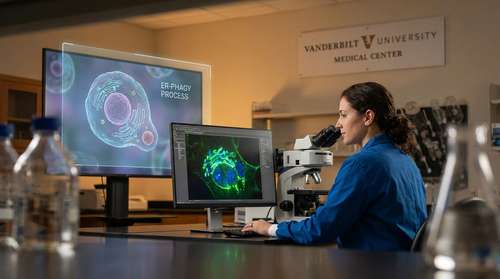
In a groundbreaking development that challenges our fundamental understanding of getting old, researchers at Vanderbilt University have identified a hidden cellular mechanism that actively drives the aging process. The study, published this week in Nature Cell Biology, reveals that aging is not merely the passive accumulation of damage, but a deliberate "remodeling" program executed by our own cells. This discovery centers on a process called ER-phagy, where cells systematically dismantle their own protein-producing factories, potentially triggering the onset of age-related diseases long before symptoms appear.
The 'Factory Shutdown': How Cells Rewrite Their Own Architecture
For decades, scientists believed that cellular aging was largely a result of wear and tear—like a car rusting over time. However, the new findings from the laboratory of Kris Burkewitz, assistant professor of cell and developmental biology at Vanderbilt, suggest a far more active scenario. The research team discovered that as cells age, they initiate a programmed reorganization of the endoplasmic reticulum (ER), the massive internal network responsible for synthesizing proteins and lipids.
Using advanced genetic tools and high-resolution microscopy on C. elegans—a transparent worm model that shares key genetic pathways with humans—the team watched in real-time as aging cells began to selectively target and break down specific parts of their ER. This wasn't random destruction. The cells were specifically using ER-phagy to reduce the "rough" ER domains, which are studded with ribosomes and dedicated to protein production. Meanwhile, the "smooth" ER regions, involved in fat storage and lipid metabolism, were often preserved or emphasized.
"Changes in the ER occur relatively early in the aging process," said Burkewitz in a statement regarding the Vanderbilt aging study 2026. "One of the most exciting implications of this is that it may be one of the triggers for what comes later: dysfunction and disease."
ER-Phagy: The Double-Edged Sword of Longevity
The term ER-phagy refers to a specialized form of autophagy, the body's recycling system. While autophagy is generally considered beneficial for clearing out "junk," this specific form of remodeling appears to drive a shift that correlates with cellular decline. By dismantling the rough ER, the cell effectively downsizes its capacity to create new proteins—the building blocks of life—while shifting focus toward lipid management.
This "remodeling" might be an ancient survival strategy intended to conserve energy in older organisms, but in the context of modern human longevity, it becomes a liability. The drastic reduction in protein synthesis capacity can leave cells vulnerable to stress and unable to maintain their function, paving the way for the hallmarks of biological aging.
Key Findings from the Nature Cell Biology Study
- Selective Destruction: The process specifically targets the protein-manufacturing centers of the cell.
- Early Onset: This remodeling happens early in adulthood, suggesting it initiates the aging cascade rather than resulting from it.
- Genetic Control: The process is driven by specific genes that could potentially be targeted with medication.
Implications for Preventing Age-Related Disease
The identification of these cellular aging triggers offers a radical new approach to medicine. Currently, most treatments for age-related conditions like Alzheimer’s, diabetes, and cardiovascular disease target the symptoms after they manifest. The Vanderbilt discovery suggests that by blocking or modulating this ER remodeling process, we might be able to prevent the cellular environment that allows these diseases to take root.
Collaborating with Rafael Arrojo e Drigo, assistant professor of molecular physiology and biophysics, the team is now investigating how this structural shift impacts the cell's metabolism. If the smooth ER (fat processing) becomes dominant as the rough ER (protein processing) shrinks, it could explain why older adults are more prone to metabolic disorders and insulin resistance.
"If researchers can identify exactly what initiates these early ER changes, they may be able to prevent the cascade of events that leads to age-related disease," the study authors noted. This pivot from treating disease to maintaining cellular architecture represents a significant leap in healthy aging breakthroughs.
A New Frontier in Longevity Science News
This research aligns with a growing trend in longevity science news where the focus is shifting from extending lifespan to extending "healthspan"—the number of years spent in good health. By understanding that aging is a programmed event involving ER-phagy longevity research, scientists can stop looking for a "fountain of youth" and start engineering precision therapies that keep our cellular factories running at full capacity.
The next phase of research will focus on identifying small molecules or gene therapies that can halt this remodeling process in human cells. If successful, we could see a new class of drugs designed not just to treat specific ailments, but to stabilize the very machinery of life, reversing biological aging markers before they ever result in a diagnosis.
As we move through 2026, the implications of the Vanderbilt study are clear: aging is not an accident. It is a biological choice made by our cells—and it is a choice we may soon be able to overrule.