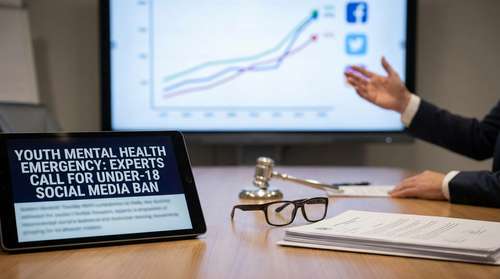
Leading medical experts are issuing their starkest warning yet regarding the youth mental health crisis, calling the unregulated access to algorithmic feeds "the most urgent public health issue of our time." On Monday, Dr. Rangan Chatterjee, a renowned British physician and host of the Feel Better, Live More podcast, spearheaded a renewed push for a mandatory social media ban for minors under 18. His comments come as new 2026 data reveals record-breaking rates of adolescent anxiety and depression, intensifying the global debate on whether the digital world is fundamentally incompatible with a healthy childhood.
"Failing a Generation": The Clinical Case for an 18+ Ban
In a wide-ranging interview released this week, Dr. Chatterjee argued that current safety measures are insufficient to protect developing brains from the addictive design of platforms like TikTok and Instagram. "I think successive governments have been very weak here, and they are failing a whole generation of children," Chatterjee stated, emphasizing that the impact of social media on children goes beyond mere distraction.
Chatterjee shared a compelling clinical anecdote involving a 16-year-old patient who had been hospitalized for self-harm and recommended antidepressants. Instead of medication, the doctor prescribed a strict digital detox, removing screens one hour before bed. Within two months, the teenager’s condition had transformed, a recovery Chatterjee attributes to restoring natural sleep rhythms and reducing the relentless social comparison fueled by algorithmic feeds. He insists that without a federal social media ban for minors, clinicians are fighting a losing battle against tech giants designed to monopolize attention.
Global Momentum: Social Media Regulation in 2026
The call for an age limit of 18 is not happening in a vacuum. The landscape of social media regulation 2026 has shifted dramatically, with governments worldwide moving from observation to enforcement.
The Australian Precedent
Proponents of the ban frequently point to Australia, which successfully legislated a ban on social media for children under 16 late last year. Early reports from 2026 suggest the policy has begun to reshape social norms, giving parents the legislative backing to say "no" to smartphones without fear of their child being socially ostracized. European nations are following suit, with Greece implementing strict age verification and France and Spain finalizing similar bills to raise the digital age of consent.
The US Legal Battle
In the United States, the legal pressure is mounting. Following the Surgeon General’s updated 2025 advisory on the youth mental health crisis, over 200 school districts have filed lawsuits against major tech companies. These suits allege that platforms knowingly exploited the neurobiology of minors, contributing to the skyrocketing teen anxiety and depression trends observed over the last decade.
The Data Debate: Algorithms vs. Adolescent Brains
The push for a ban is underpinned by alarming statistics. Recent figures indicate that problematic social media use among adolescents has risen sharply, with 25% of teen girls reporting that these platforms directly harm their mental health. Furthermore, Dr. Chatterjee highlighted the danger of unrestricted content, noting that a quarter of 11-year-olds have now been exposed to violent or pornographic material online.
While some industry-funded studies continue to argue that the link between screen time and depression is not causal, public health officials are increasingly rejecting this "wait and see" approach. They argue that the impact of social media on children—specifically the displacement of sleep, physical activity, and in-person socialization—is a verified health hazard that requires immediate intervention, similar to regulations on tobacco or alcohol.
Reclaiming Childhood: The Movement for Analog Connection
Beyond legislation, a cultural shift is underway. Dr. Chatterjee and other experts are advocating for more than just bans; they are pushing for a return to "analog childhoods." This includes calls to ban screen-based homework for primary school children and to delay smartphone ownership until late adolescence.
"Everything good in our lives comes from the ability to be present," Chatterjee reminded listeners. As the mental health public health emergency deepens, the consensus among experts is clear: the cost of inaction is a generation unable to connect with the real world, and the time for voluntary guidelines is over.