For decades, the standard medical prescription for a healthy life has been hours of moderate-intensity workouts. But a massive paradigm shift is quietly transforming how doctors and scientists view human movement. If you have been searching for the minimum vigorous exercise for longevity, a groundbreaking April 2026 study has finally pinpointed the exact dosage. According to the research, committing to 15 minutes vigorous exercise per week provides an astonishing protective shield against major chronic conditions, upending standard guidelines and redefining what it means to stay fit.
The Science Behind the '15-Minute Rule'
Published in the European Heart Journal in early April 2026, the findings stem from a comprehensive analysis of roughly 96,000 participants from the UK Biobank. Led by Professor Minxue Shen alongside an international research team, this stands out as one of the most compelling new exercise science studies 2026 has offered. Rather than relying on notoriously flawed self-reported health questionnaires—where people often overestimate their gym time—the researchers captured objective, technical-grade data.
Participants wore wrist-worn accelerometers that continuously logged both the volume and the exact intensity of their daily movements over a full week. The researchers then tracked their health outcomes over a seven-year period. The primary objective was to find out if the sheer amount of time spent moving mattered more than how hard the participants pushed their bodies.
Quality Over Quantity
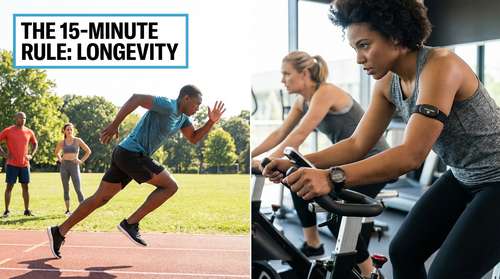
The results decisively favored intensity. Individuals who engaged in short, breathless bursts of movement experienced dramatic drops in overall mortality and disease rates, even if their total exercise time was relatively low. Researchers discovered that hitting the minimum vigorous exercise for longevity—just 15 to 20 minutes a week of high-effort exertion—lowered the overall risk of dying by 46%. This translates to roughly two to three minutes a day of activity that leaves you momentarily out of breath.
Why Intensity Outperforms Duration
We are constantly told to track our steps, yet heart rate spikes might be the true biological upgrade our bodies need. The physiological response to intense, oxygen-demanding movement triggers cellular adaptations that a gentle, hour-long stroll simply cannot replicate. Pushing your body to the point of breathlessness forces your heart to operate more efficiently, improves blood vessel flexibility, and enhances your muscles' capacity to utilize oxygen.
Surprising Impacts on Brain and Heart Health
The clinical data regarding chronic illness prevention is where this study truly shines. When evaluating exercise for dementia prevention, the team noted a staggering 63% reduction in risk among those in the highest-intensity group. Beyond cognitive decline, the risk of developing Type II diabetes plummeted by 60%.
When examining the connection between vigorous activity heart health and longevity, the answers are rooted in vascular compliance. High-intensity surges reduce systemic inflammation and lower the chance of major cardiovascular events, such as heart attacks and strokes, by roughly 31%. In fact, the researchers noted that short bursts of hard effort act as a powerful anti-inflammatory trigger, offering profound protection against immune-mediated conditions like arthritis.
Embracing Minimalist Fitness Trends 2026
This realization that fewer minutes yield massive dividends aligns perfectly with the minimalist fitness trends 2026 is bringing to the mainstream. You do not need expensive boutique gym memberships, specialized athleisure wear, or two-hour daily time blocks to protect your health. Instead, the goal is to integrate Vigorous Intermittent Lifestyle Physical Activity (VILPA) into your existing routine.
VILPA relies on brief, hard efforts naturally built into daily life. The defining metric is the talk test: you should be pushing yourself hard enough that speaking in full sentences becomes difficult, though you still remain in control of your body. By reframing how we interact with our environment, hitting the minimum vigorous exercise for longevity becomes entirely frictionless.
Everyday Ways to Spike Your Heart Rate
To reap the maximum short burst training benefits highlighted by the researchers, consider adding these brief spikes of exertion to your schedule:
- Attack the stairs: Skip the elevator and sprint up flights of stairs for 20 to 60 seconds.
- Speed your commute: Walk as fast as you physically can for the last block of your journey to work or while walking the dog.
- Power through chores: Carry heavy groceries up an incline at a brisk, unbroken pace.
- Active play: Engage in highly active, physically demanding games with your children or pets.
By proving that a fraction of an hour per week can radically alter your biological trajectory, this research permanently dismantles the common excuse of lacking time. As always, consult a medical professional before starting intense physical routines, especially if you have a history of cardiovascular or joint issues. But for most adults, leaning into discomfort for just two minutes a day is the ultimate prescription for a resilient, disease-free future.