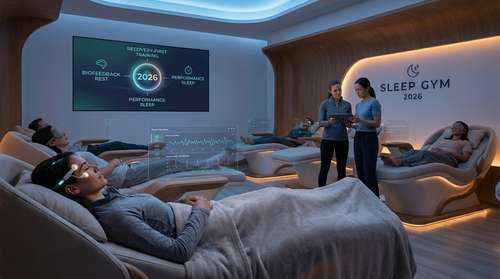
If you told a fitness enthusiast five years ago that they would pay top dollar to take a guided nap, they would have laughed you out of the weight room. But by mid-March 2026, the most coveted booking on any wellness app isn't a high-intensity interval class or a heavy lifting session. It is a spot in a sleep studio. Welcome to the era of sleep gyms 2026, one of the most unexpected yet entirely logical viral fitness trends sweeping across global wellness hubs. Rather than treating rest as something that happens passively after a tough workout, these specialized centers are turning recovery into an active, measurable discipline.
The Rise of Recovery-First Training
We have officially hit a turning point in workout culture. For decades, the industry mantra was always to push harder. Now, widespread burnout and chronic fatigue have paved the way for recovery-first training. According to recent 2026 industry reports from platforms like Glofox, standalone recovery studios designed explicitly for nervous system downregulation are among the most profitable new business models in the sector.
Instead of tracking calories burned, members track their recovery scores. Franchises like Pause Studio, which initiated a massive 34-location expansion heading into this year, have proven that consumers crave spaces dedicated to holistic restoration. People are finally realizing that punishing the body with heavy weights and endless cardio only yields results if the body can adequately repair itself.
Inside Modern Mental Fitness Studios
Walking into a modern recovery space feels like stepping onto a sci-fi movie set. You won’t find barbells, squat racks, or blaring pop music. Instead, these mental fitness studios greet you with sensory-deprivation chambers, infrared saunas, and atmospheric pods.
The core philosophy here involves treating sleep as a skill—something that must be actively practiced and optimized. Facilities utilize technology originally developed for elite athletic performance to force the body into a state of parasympathetic dominance, commonly known as the rest and digest phase. Standard protocols often include:
- CVAC Pods: Pressurized atmospheric chambers that fluctuate pressure to increase oxygen-carrying capacity and simulate the neurological benefits of deep sleep.
- Pneumatic Compression: Specialized boots that flush metabolic waste from the legs and stimulate the vagus nerve to immediately lower stress levels.
- Infrared Saunas: Deep-penetrating heat therapy that upregulates melatonin production to quickly reset circadian rhythms.
The Tech Behind Biofeedback Recovery
What truly separates a standard spa day from what the leading sleep gyms 2026 has to offer is the aggressive integration of data. The American College of Sports Medicine (ACSM) recently highlighted wearable-integrated coaching as a dominant trend for the year. At a sleep gym, your smart ring or fitness strap serves as your personal trainer.
This is the frontier of biofeedback recovery. Before a session begins, algorithms analyze your heart rate variability (HRV), body temperature, and your previous night's sleep metrics. If your wearable detects a high level of central nervous system fatigue, the studio's AI-controlled environment adapts instantly. Ambient lighting shifts to red-light frequencies designed to stimulate melatonin. Acoustic therapies drop to delta-wave-inducing frequencies, and smart mattresses adjust to the exact temperature needed to lower your core body heat. Your rest is micro-managed by bio-intelligence to ensure maximum recovery in minimal time.
Why High-Performance Rest is Going Viral
Social media has undeniably poured gasoline on this movement. Over the last 48 hours alone, a trend dubbed the Parasympathetic Plunge has taken over TikTok, with thousands of users posting their post-plunge, deep-sleep session analytics. The sheer volume of traffic crashed booking platforms for major studio chains over the weekend, cementing this as one of the definitive viral trends of the year. Waitlists for premium studios in New York and Los Angeles currently exceed six months.
But the appeal of high-performance rest extends far beyond digital clout. The target demographic has completely shifted. This isn't just for marathoners seeking marginal gains anymore. Busy executives, chronically exhausted parents, and longevity-focused adults are fueling the membership boom. They understand that mitigating the stress of modern life requires more than occasionally sleeping in on a Sunday.
Will the Momentum Last?
While some fitness fads fade as quickly as they appear, the structural shift toward intelligent health suggests otherwise. The realization that you cannot out-work a damaged nervous system is fundamentally changing how we approach physical longevity. For anyone tracking the expansion of sleep gyms 2026 represents a fundamental shift in how we view health. The gym of the future isn't just a place to tear muscle fibers down; it is a high-tech sanctuary built to put them back together.