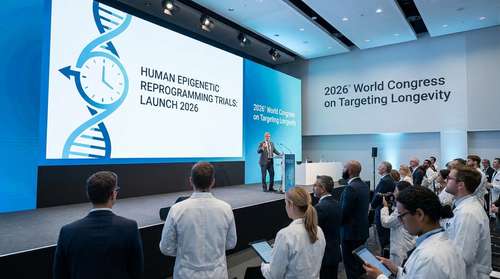
As international researchers gather for the 2nd World Congress on Targeting Longevity in Berlin this week, the medical community is witnessing a profound paradigm shift. The long-anticipated reverse aging human trials have officially commenced, marking the moment science transitions from managing age-related symptoms to directly targeting the aging process itself. Leading the charge are revolutionary therapies that focus on epigenetic reprogramming, a technique that acts as a software update for aging cells. By restoring youthful genetic expression, researchers are proving that treating aging as a disease is no longer science fiction, but an imminent clinical reality.
The Dawn of Biological Clock Restoration
For decades, medicine has approached aging as an inevitable deterioration, sequentially treating the downstream consequences—like cardiovascular issues, vision loss, and cognitive decline—as they appear. However, the latest geroscience breakthroughs fundamentally challenge this reactive model. Aging is increasingly understood as a progressive loss of coordination between biological systems, driven by the degradation of our epigenome.
The epigenome consists of biochemical markers that sit on top of our DNA, dictating which genes are turned on or off. Over time, these markers lose their strict organization, causing cells to misread their own genetic instructions—a concept Harvard geneticist David Sinclair established as the Information Theory of Aging. Biological clock restoration aims to reverse this drift. By delivering specific regenerative signals, scientists can instruct cells to reset their epigenetic markers to a more youthful state, regaining lost function and promoting dramatic healthspan extension.
Inside the Historic Reverse Aging Human Trials
The most concrete evidence of this medical revolution is the launch of the ER-100 clinical trial by Life Biosciences, a biotech company rooted in Sinclair's pioneering research. Cleared by the FDA earlier this year, this Phase 1 trial represents a watershed moment: the first targeted attempt at cellular age reversal in human volunteers using epigenetic reprogramming. The David Sinclair longevity 2026 milestone centers entirely on this partial epigenetic reprogramming.
Rather than attempting to rejuvenate the entire body at once, this initial trial focuses on two severe age-related eye conditions: open-angle glaucoma (OAG) and non-arteritic anterior ischemic optic neuropathy (NAION). Researchers are utilizing three of the Nobel Prize-winning Yamanaka factors—specifically OCT4, SOX2, and KLF4 (OSK)—delivered directly into patients' eyes via adeno-associated viral vectors. The dosage is strictly controlled by an oral antibiotic, doxycycline, which acts as an on/off switch for the reprogramming genes.
The Mechanism: Upgrading the Cellular Software
The science driving these trials relies on a highly refined version of a groundbreaking discovery. Originally, Shinya Yamanaka proved that four specific proteins could revert adult cells into embryonic stem cells. However, full cellular reversion in a living organism can trigger unchecked tumor growth. Sinclair's laboratory made a critical adjustment: removing the c-Myc protein and utilizing only the remaining three OSK factors. This targeted approach strips away the epigenetic noise acquired over a lifetime without erasing the cell's specialized identity, proving to be the precise balance needed for safe intervention.
The trial currently underway recruits 18 adult participants between the ages of 40 and 85. In the initial dose-escalation phase, researchers inject the therapy into a single eye, followed by an eight-week regimen of doxycycline to activate the rejuvenation process. While primary data will strictly assess safety and tolerability, secondary markers will monitor visual acuity and optical nerve regeneration, with initial readouts expected later this year.
Geroscience Breakthroughs at the Berlin Congress
The timing of these clinical developments perfectly aligns with the agenda of the 2nd World Congress on Targeting Longevity, held April 8-9, 2026, in Berlin. Organized by the World Mitochondria Society and the International Society of Microbiota, the conference signals a massive strategic pivot across the medical industry. Scientists are moving away from the simplistic search for a single anti-aging pill.
Presentations this year emphasize longevity as a dynamic dialogue between the body's mitochondria, immune system, and microbial ecosystems. When biological coordination fails, cellular senescence accelerates. The innovative therapies being discussed in Berlin seek to preserve system-level resilience, tackling the root causes of tissue degradation before chronic diseases can fully manifest.
What Treating Aging as a Disease Means for the Future
The FDA's willingness to evaluate gene therapies that modify the upstream epigenetic drivers of aging is a monumental regulatory shift. It validates the Information Theory of Aging, suggesting that the body naturally retains the blueprint for youth and merely needs the right biochemical push to access it.
While the current ER-100 trial evaluates ocular safety, the implications extend far beyond the optic nerve. If partial reprogramming proves safe and effective in humans, the platform could rapidly expand to target liver disease, severe neurodegenerative conditions, and widespread metabolic decline. Medical science has crossed the threshold from observational longevity research into active, targeted intervention, altering the trajectory of human healthspan permanently.