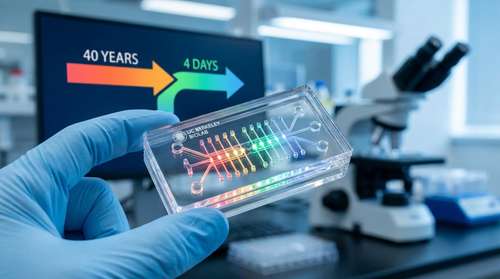
The quest to unravel the mysteries of human longevity has long been hindered by a simple, unavoidable hurdle: time. But a revolutionary UC Berkeley longevity breakthrough 2026 is rewriting the rules of biomedical science. In a groundbreaking study published on March 25, 2026, in Nature Biomedical Engineering, researchers unveiled a miniaturized system that effectively compresses four decades of human biological decline into a mere 96 hours. This pioneering organ-on-a-chip aging research allows scientists to observe the aging process in real-time, sidestepping the ethical and practical limitations of decades-long human trials. By creating a literal time machine for human cells, scientists are finally equipped to screen life-extending therapeutics with unprecedented speed and accuracy.
The Dawn of Rapid Biological Aging Simulation
For decades, pharmaceutical developers have relied heavily on animal models to understand how our bodies deteriorate over time. However, the biology of a rodent is vastly different from that of a human, leading to a stark and expensive reality in modern medicine. Over $130 billion is spent annually on drug development in the United States alone, yet more than 90% of pharmacological candidates ultimately fail when they reach clinical trials. Regulators, including the US Food and Drug Administration, and researchers alike have recognized the urgent need for a more relevant pipeline that accurately reflects human biology.
Enter the latest innovation in anti-aging drug testing technology. Co-led by metabolic biologist Andreas Stahl and longevity pioneer Irina Conboy, the UC Berkeley team engineered a microfluidic device housing human fat and liver cells derived from induced pluripotent stem cells. By precisely manipulating the biological environment within these interconnected microscopic chambers, the researchers triggered a rapid biological aging simulation. Within just four days, the cellular tissues exhibited the exact molecular degradation and physiological markers mirroring 40 years of human aging. It is a massive leap forward that fundamentally alters how we test the efficacy and safety of new medical interventions.
Recreating the Vital Fat-Liver Connection
The aging-on-a-chip system specifically targets the crucial, yet often overlooked, communication between visceral fat and the liver. As we grow older, fat tissue releases a shifting profile of hormones and metabolites that travel through the bloodstream directly to the liver. This age-altered signaling is a major culprit behind widespread metabolic conditions like insulin resistance, type 2 diabetes, and nonalcoholic fatty liver disease. By successfully mimicking this organ-to-organ crosstalk using fluid flows as microscopic as one milliliter per day, the researchers built a highly accurate physiological model of human metabolic decline.
Oxytocin for Healthy Aging: A Surprising Winner
With a fully functional, accelerated aging model established, the scientific team set out to rigorously test several prominent longevity interventions. The roster of candidates included senolytics, a TGF-beta signaling inhibitor, the widely discussed immunosuppressant rapamycin, and the hormone oxytocin. What they discovered during these rapid trials represents one of the most significant cellular rejuvenation breakthroughs of the decade.
The data decisively pointed to oxytocin for healthy aging as the most potent and reliable intervention. Tissues treated with the hormone showed dramatically reduced inflammation, decreased cellular senescence, and markedly improved insulin sensitivity. According to the study, oxytocin restored healthy fat and sugar metabolism more comprehensively than any other pharmacological treatment tested on the chip. While previous animal studies hinted at oxytocin's ability to promote fat redistribution and curb systemic inflammation in mice, seeing these exact mechanisms validated in an accurate human tissue model cements its tremendous potential for future human therapies.
The Fall of Rapamycin?
Conversely, the experiment cast serious doubt on rapamycin, arguably the most heavily hyped and broadly consumed off-label anti-aging drug in the current biohacking community. The organ-on-a-chip system revealed that rapamycin produced almost no rejuvenative effects on the aged fat and liver tissues. As Conboy noted, this rapid screening could have saved researchers years of wasted effort and millions of dollars. Uncontrolled, decade-long human trials of rapamycin are now beginning to report similarly underwhelming metabolic results, perfectly aligning with what the UC Berkeley team observed in just 96 hours.
Charting the Course for Biological Age Reversal 2026
The global implications of this new diagnostic technology extend far beyond the validation of a single hormone. As the worldwide population over the age of 60 is projected to more than double by the year 2050, mitigating age-related diseases is a pressing macroeconomic and public health priority. This microfluidic chip provides a highly scalable, cost-effective platform to evaluate exactly how various compounds influence our cellular clocks without waiting a lifetime for longitudinal clinical results.
Notably, alongside the pharmaceutical tests, the researchers found that exposing the aged synthetic tissues to actual blood serum from young donors also yielded immense restorative effects. This finding beautifully bridges the gap between historical young blood experiments and modern microfluidic screening. As we look toward the promising horizon of biological age reversal 2026, the ability to rapidly test next-generation therapeutics on specialized human tissue models promises to dramatically accelerate the arrival of safe, clinically verified longevity treatments. The days of relying solely on rodents to unlock the secrets of the human lifespan are numbered, replaced by a microscopic, fluid-filled chip that holds the key to extending human healthspan.