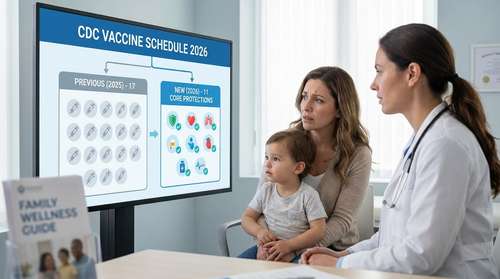
In a historic and controversial shift that is reshaping the landscape of American pediatric healthcare, the Centers for Disease Control and Prevention (CDC) has officially overhauled the childhood immunization schedule for 2026. Announced on January 5, 2026, the new guidelines reduce the number of universally recommended vaccines from 17 down to 11 core protections. This significant policy change, driven by the Department of Health and Human Services (HHS), moves several previously standard immunizations—including those for Hepatitis B, RSV, and Influenza—into "high-risk" or "shared clinical decision-making" categories.
For parents and pediatricians alike, the CDC vaccine schedule 2026 represents a fundamental pivot from a "one-size-fits-all" public health strategy to one emphasizing individual risk assessment and alignment with international standards. As families across the nation scramble to understand what this means for school mandates and wellness visits, a heated debate has erupted between federal officials and major medical organizations regarding the future of childhood immunization updates.
The New "11 Core Protections": What Remains Routine?
Under the new framework, the CDC maintains that 11 vaccines are essential for every child, citing "international consensus" as the primary benchmark. These core immunizations are deemed critical for preventing diseases with high mortality or morbidity rates across the general population.
The CDC 11 core protections now universally recommended for all children include:
- Diphtheria, Tetanus, and Pertussis (DTaP)
- Polio (IPV)
- Measles, Mumps, and Rubella (MMR)
- Haemophilus influenzae type b (Hib)
- Pneumococcal conjugate
- Varicella (Chickenpox)
- Human Papillomavirus (HPV) – (Note: Dosage recommendation reduced to one dose)
Federal officials note that these vaccines align closely with schedules in peer nations like Denmark, a comparison frequently cited by HHS Secretary Robert F. Kennedy Jr. and Acting CDC Director Jim O'Neill during the announcement.
Major Shift: Hepatitis B, RSV, and Flu Moved to "High-Risk"
The most debated aspect of the pediatric health news is the reclassification of vaccines that have been routine for decades. The new schedule no longer automatically recommends the following for every healthy child, instead placing them in categories requiring a doctor-parent discussion:
- Hepatitis B: Previously given at birth, it is now recommended based on maternal screening results and individual risk factors.
- Respiratory Syncytial Virus (RSV): Now targeted specifically for high-risk infants rather than a universal rollout.
- Influenza (Flu) & COVID-19: Shifted to "shared clinical decision-making," meaning parents must proactively choose these annually in consultation with their provider.
- Hepatitis A, Rotavirus, and Meningococcal: Also moved to conditional or risk-based recommendations.
This "shared decision-making" model aims to reduce what HHS describes as "coercion" in public health, giving parents more autonomy. However, critics argue it places a heavy burden on pediatricians to assess risk for diseases that can be hard to predict.
Medical Community Pushback and the "Two-Schedule" Reality
The release of the 2026 schedule has sparked immediate and fierce opposition from the medical establishment. The American Academy of Pediatrics (AAP) has taken the unprecedented step of releasing its own, alternative 2026 schedule, which retains the original 17 routine vaccines.
Dr. Jake Scott, an infectious disease specialist quoted in recent reports, called the overhaul "the most significant weakening of childhood vaccine recommendations in modern American history." The AAP and other family vaccination guide resources warn that moving vaccines like Hep B and Flu to an "optional" status could lead to a resurgence of preventable outbreaks, as reactive protection is often less effective than preventive community immunity.
Consequently, American families now face a confusing "two-schedule" reality. While the federal CDC schedule has shrunk, many pediatric practices are advising parents to stick to the broader AAP guidelines to ensure maximum protection.
State Mandates and School Entry Confusion
A critical question for parents is: How does this affect mandatory school vaccines? The answer depends entirely on where you live. School entry requirements are determined by state laws, not federal CDC guidelines.
As of late January 2026, a fractured landscape has emerged:
- 27 States & D.C. have announced they will not follow the new CDC reductions and will maintain their existing, more comprehensive school entry requirements based on prior standards or the AAP schedule.
- Other States are moving to align their school mandates with the new, leaner federal list, effectively removing requirements for vaccines like Meningococcal and Hepatitis A for school enrollment.
This divergence means a child in one state might need 17 shots to attend kindergarten, while a cousin across the border might only need the core 11. Parents are urged to check with their local school districts and healthvot family wellness resources for state-specific updates.
Insurance Coverage Remains Intact
Amidst the confusion, there is one piece of clear, positive news. The HHS has confirmed that all vaccines previously recommended—including those moved to the "high-risk" list—will continue to be fully covered by insurance without co-pays.
This ensures that parents who wish to continue following the broader immunization schedule (like the one recommended by the AAP) can do so without financial penalty. Whether for the flu shot or the Hep B birth dose, access remains free for families with ACA-compliant insurance or Medicaid, preserving the option for comprehensive protection despite the change in federal recommendations.