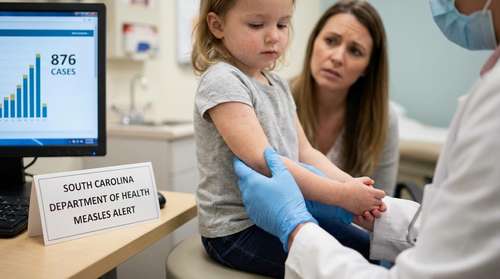
A massive measles outbreak in South Carolina has escalated into a critical public health emergency, with state officials confirming 876 cases as of Tuesday, February 3, 2026. The surge includes 29 new infections reported in the last 24 hours alone, marking the largest localized flare-up of the virus in the United States since the disease was declared eliminated in 2000. As the outbreak spreads beyond its epicenter in Spartanburg County to new regions like Sumter, the American Academy of Pediatrics (AAP) has issued urgent new guidance, imploring families to adhere to the 2026 immunization schedule despite conflicting messages from federal levels.
South Carolina Measles Cases Hit Record Highs
The situation in the Palmetto State is deteriorating rapidly. According to the South Carolina Department of Public Health (DPH), the outbreak is overwhelmingly affecting children, who account for 788 of the total 876 cases. Most concerning to health officials is the vulnerability of the youngest residents; 233 of the confirmed patients are under the age of five.
While Spartanburg County remains the epicenter with 841 confirmed infections, the virus has breached containment lines. New cases have been identified in Greenville, Anderson, and Cherokee counties, with a concerning new detection in a Sumter County resident—indicating the virus is moving toward the center of the state. "We feel like we're really kind of staring over the edge," warned local health officials, noting that the virus is moving faster than contact tracers can contain it.
AAP Issues Urgent Vaccine Guidance Amid Confusion
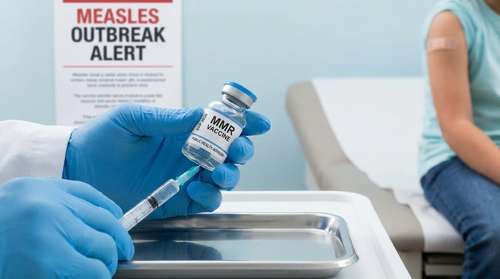
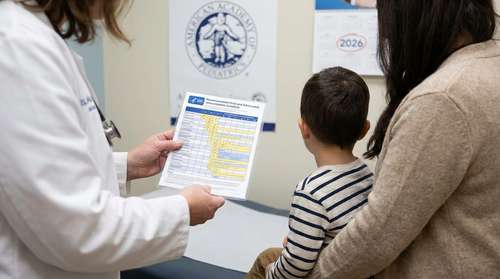
In response to the crisis, the American Academy of Pediatrics (AAP) has taken the extraordinary step of issuing an urgent reaffirmation of its 2026 immunization schedule. This move comes as a direct countermeasure to recent shifts in federal rhetoric that have sowed confusion among parents regarding the necessity of the MMR (measles, mumps, rubella) vaccine.
Dr. Martha Edwards, President of the South Carolina Chapter of the AAP, issued a stark call for leadership and clarity. "What we need now is honesty, leadership, and clear communication," Dr. Edwards stated in a briefing Tuesday. "We know how measles spreads. We know how to prevent it... But we cannot do it alone."
The AAP's new guidance emphasizes that the MMR vaccine protection remains the gold standard for safety and efficacy. Data from the current outbreak supports this unequivocally: 94% of the infected individuals in South Carolina were unvaccinated. Only 22 fully vaccinated individuals have contracted the virus, all of whom experienced milder symptoms, highlighting the vaccine's critical role in preventing severe illness.
Critical Symptoms of Measles in Children
With the virus circulating in schools and public spaces, parents are urged to be hyper-vigilant. Measles is not just a rash; it is a highly contagious respiratory virus that can lead to severe complications like pneumonia and encephalitis. Symptoms typically appear 7 to 14 days after exposure.
Watch for these early warning signs:
- High Fever: Often spiking above 104°F (40°C).
- The "Three C's": Cough, Coryza (runny nose), and Conjunctivitis (red, watery eyes).
- Koplik Spots: Tiny white spots with bluish-white centers found inside the mouth on the inner lining of the cheek—often appearing 2-3 days before the rash.
- The Rash: A red, blotchy rash that usually begins at the hairline and spreads downward to the neck, trunk, arms, legs, and feet.
School Transmission and Quarantine Protocols
The outbreak has severely disrupted education, with measles school transmission becoming a primary vector. Several schools, including Holly Springs-Motlow Elementary and Campobello Gramling School, have reported student exposures, forcing hundreds into quarantine.
State protocols are strict: unvaccinated students exposed to the virus must be excluded from school, sports, and all extracurricular activities for 21 days. However, DPH officials note that this exclusion can be avoided if the unvaccinated student receives a dose of the MMR vaccine within 72 hours of exposure. This "post-exposure prophylaxis" is currently the most effective tool schools have to keep classrooms open.
"This is a moment that calls for collective responsibility," Dr. Edwards added, urging parents to check their children's vaccination records immediately. With the U.S. at genuine risk of losing its official measles elimination status if this outbreak continues into the spring, the decisions made by South Carolina families in the next few days will likely determine the national trajectory of the disease for 2026.