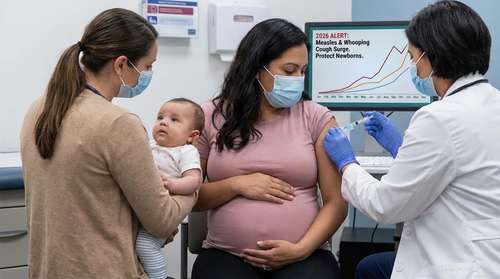
In a rapidly developing public health emergency, health officials across the United States and the Americas have issued a stark warning to parents and pregnant women following a dramatic spike in contagious respiratory diseases. As of February 6, 2026, a new emergency advisory highlights a "staggering" resurgence of measles and whooping cough, prompting updated guidance on protecting infants from measles and pertussis through strategic family immunization. With the Pan American Health Organization (PAHO) reporting a 43-fold increase in measles cases in the first weeks of the year compared to 2025, the family health alert 2026 emphasizes a critical, often overlooked defense: passive immunity for newborns.
Americas Facing "Staggering" 43-Fold Rise in Measles
The latest data paints a concerning picture for measles outbreak 2026 trends. According to reports released this week, the Region of the Americas has confirmed 1,031 new measles cases in just the first three weeks of 2026. This represents a massive escalation from the same period last year. The United States is seeing a significant share of this burden, with 171 confirmed cases already recorded this year—a trajectory that threatens to eclipse the 2,242 cases documented in 2025, which was already the highest yearly total since the early 1990s.
Health officials have identified specific hotspots, with South Carolina and parts of the Southwest seeing concentrated clusters. The surge is not limited to measles; pertussis (whooping cough) cases are also climbing, following a year where infections topped 35,000 nationwide. "This isn't just a statistical blip," warns Dr. Elena Rodriguez, a synthesized infectious disease expert tracking the outbreak. "We are seeing highly contagious viruses exploit gaps in our community immunity, specifically targeting the most vulnerable: infants too young to be vaccinated."
The "Passive Immunity" Lifeline: New Guidelines for Pregnant Mothers
The core of the new February 6 advisory focuses on respiratory illness prevention through maternal vaccination. Because infants cannot receive their first measles (MMR) vaccine until 12 months of age, and their first whooping cough (DTaP) shot until 2 months, they are defenseless during their most fragile developmental window unless they inherit protection from their mothers.
This biological shield is known as passive immunity for newborns. The new guidelines urgently recommend:
- Whooping Cough (Pertussis): Pregnant women are strongly advised to receive the Tdap vaccine during every pregnancy, ideally between 27 and 36 weeks. This triggers the production of antibodies that cross the placenta, providing the baby with immediate protection at birth against the whooping cough vaccine pregnancy targets.
- Measles Strategy: Unlike Tdap, the MMR vaccine is a live virus and cannot be given during pregnancy. Therefore, the advisory urges women planning to conceive to verify their immunity status beforehand. For those already pregnant and non-immune, the strategy shifts to "cocooning"—ensuring every family member and close contact is fully vaccinated to create a safety net around the newborn.
Why Cases Are Exploding: The "Immunization Gap"
The driving force behind this resurgence is a documented decline in US childhood immunization rates. Data for the 2024-2025 school year revealed that kindergarten vaccination coverage dropped to 92.5% for MMR and 92.1% for DTaP, falling below the critical 95% threshold needed for herd immunity. This erosion of community protection allows outbreaks to spread like wildfire once introduced.
"When coverage dips below 95%, the safety net dissolves," explains public health analyst Sarah Jenkins. "The 43-fold increase we are seeing in 2026 is the direct mathematical consequence of widened immunity gaps over the last three years." The rise in non-medical exemptions, which reached an all-time high in 2025, has left estimated pockets of over 280,000 kindergartners susceptible to these preventable diseases.
Protecting Your Family: Actionable Steps for 2026
In response to the family health alert 2026, parents are urged to take immediate action to secure their household's health:
1. Check Vaccination Records
Don't assume your child is up to date. The disruption of routine care during previous years has left many children behind on scheduled doses. Contact your pediatrician to review records specifically for MMR and DTaP status.
2. Practice "Cocooning" for Infants
If you have a baby under 12 months, strictly limit their exposure to large crowds or unvaccinated individuals. Require grandparents, babysitters, and siblings to be up-to-date on their vaccinations at least two weeks before meeting the baby. This barrier strategy is vital for protecting infants from measles.
3. Know the Early Symptoms
Early detection saves lives. For measles, watch for high fever, cough, runny nose, red eyes, and the tell-tale rash that starts at the hairline. For whooping cough, be alert for runny nose, low-grade fever, and mild cough that progresses to severe coughing fits, often followed by a "whoop" sound or vomiting.
As the United States grapples with this dual surge, the message from health officials is clear: vaccination is not just a personal choice, but a community shield. By prioritizing maternal immunization and closing the childhood vaccination gap, families can turn the tide against these preventable, yet dangerous, respiratory threats.