The quest for a longer, healthier life usually focuses on individual habits like rigorous diets, daily exercise, and optimized sleep schedules. But new longevity research published this week indicates that your environment might be quietly dictating your cellular lifespan. A groundbreaking April 2026 study from the NYU School of Global Public Health reveals that where you live can directly trigger premature cellular senescence, essentially aging your body faster than your chronological years. By examining the biological markers of over 1,200 American adults, researchers proved that a simple zip code is one of the most powerful neighborhood health predictors we face today.
Chronological Versus Biological Aging
To understand how a neighborhood can physically age you, it helps to distinguish between the candles on your birthday cake and the actual wear and tear on your body. Chronological age is simply the number of years you have been alive. Biological aging, however, refers to the physiological decline of your cells, tissues, and organs.
As your body endures stress, certain cells stop dividing. Instead of dying off naturally and making room for new growth, these "zombie cells" remain metabolically active. They secrete a toxic mix of inflammatory substances that damage surrounding healthy tissue. This state of suspended animation is called cellular senescence. Over time, the continuous accumulation of these senescent cells drives systemic inflammation and drastically increases the risk of age-related diseases like diabetes, cardiovascular failure, and general physical frailty. While some cellular decay is entirely natural, environmental pressures can severely accelerate the biological timeline.
NYU's Groundbreaking Methodology
The NYU research team set out to map the hidden intersection between community resources and molecular health. Utilizing comprehensive data from 1,215 participants in the Midlife in the United States (MIDUS) study, scientists extracted blood samples to deeply analyze the transcriptomic markers of aging.
Simultaneously, they evaluated the participants' living conditions using the Childhood Opportunity Index 3.0. This robust database tracks 44 location-specific metrics, including education quality, air quality, green spaces, walkability, local employment rates, and housing stability.
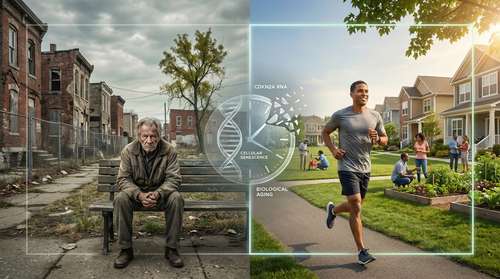
The results, published in the journal Social Science and Medicine, completely shift our understanding of healthy aging 2026. Researchers discovered that individuals residing in low-opportunity areas exhibited significantly faster biological decline. Two people could maintain identical diets and exercise routines, yet age at drastically different rates solely because of the structural deficits in their immediate surroundings.
Mariana Rodrigues, the study's lead author and an NYU PhD student, points out that structural conditions physically embed themselves into human biology over time. Health is no longer just a byproduct of personal choice; it is heavily mediated by the environment.
Decoding the CDKN2A RNA Biomarker
To quantify this environmental damage, the NYU team looked at specific molecular signatures circulating in the blood. They focused intensely on CDKN2A RNA, a prominent biomarker that signals a hard halt in cell division and acts as a key upstream regulator of the senescence process.
Participants living in low-opportunity neighborhoods showed a stark, statistically significant elevation in CDKN2A RNA abundance. Even after scientists adjusted the data to rigorously account for individual lifestyle choices, personal income, and pre-existing health conditions, the biological damage linked to the neighborhood persisted. The data strongly suggests that living in a disadvantaged area triggers a specific, localized stress response that forces healthy cells into early retirement. Interestingly, other downstream markers of aging, like DNA damage responses (DDR30), did not show the same strong correlation, proving that neighborhood stress operates through very distinct biological pathways.
The Crushing Weight of Economic Stress
While many might assume heavy pollution or a lack of public parks are the main culprits behind geographic health disparities, the data pointed elsewhere. The strongest association between premature cellular decay and neighborhood opportunity came down directly to social and economic resources.
These crucial elements, heavily studied as the social determinants of health, include local job availability, housing affordability, and community wealth. In the NYU study, they easily outweighed environmental factors like air quality. Adolfo Cuevas, the study's senior author and an associate professor of social and behavioral sciences, explained that stressors tied to unstable jobs and unaffordable housing aren't fleeting moments of anxiety. They are persistent, daily conditions that fundamentally alter the human nervous system.
Living under the constant weight of financial and housing insecurity keeps the body trapped in a perpetual fight-or-flight state. This chronic, low-grade stress exhausts cellular resilience, forcing the rapid accumulation of senescent cells.
Rethinking Community Investment as Healthcare
In the rapidly expanding field of longevity research, the focus is beginning to shift from the pharmacy to the city planner. Understanding that your surroundings heavily dictate your cellular health changes how the medical field must approach preventative medicine. A truly effective anti-aging strategy cannot rely solely on expensive supplements, cold plunges, or elite gym memberships if a person's immediate environment continues to degrade their molecular stability.
The landscape of healthy aging 2026 demands a wider lens. Public health initiatives moving forward must prioritize community investment as a foundational form of healthcare. Improving access to stable employment, securing affordable housing, and building robust local economies are no longer just political talking points—they are critical medical interventions. Combating biological aging will require treating vulnerable neighborhoods with the exact same urgency and precision as we treat the patients living inside them.