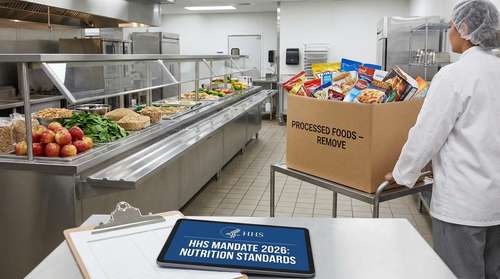
For decades, the American hospital stay has been synonymous with a predictable, albeit heavily criticized, culinary experience: sugary juice boxes, gelatin desserts, and heavily processed meat. However, this week marks a massive turning point for healthcare facilities across the country. The newly enforced HHS hospital nutrition mandate 2026 requires medical centers to completely overhaul their cafeterias and patient trays by eliminating ultra-processed foods and sugar-sweetened beverages. Facilities that fail to comply with these rigorous new dietary standards risk losing their federal funding entirely.
A Historic Shift in Hospital Food Reform
The policy overhaul, officially set into motion through a "Quality and Safety Special Alert," signals a radical departure from the institutional status quo. Health and Human Services Secretary Robert F. Kennedy Jr., alongside Centers for Medicare & Medicaid Services (CMS) Administrator Dr. Mehmet Oz, recently directed administrators that medical facilities must drastically reduce the prevalence of ultra-processed foods in hospitals.
Under this rigorous directive, menus must now strictly align with the updated Dietary Guidelines for Americans 2026. Released earlier this year, these federal guidelines prioritize nutrient-dense whole foods, high-quality proteins, and healthy fats over cheap, artificial alternatives.
"Quality health care starts with quality food," Secretary Kennedy stated during a recent leadership roundtable at Nicklaus Children's Hospital in Miami, emphasizing that treating chronic disease while serving meals that actively contribute to those very illnesses is a fundamental failure of the medical system.
Targeting Ultra-Processed Foods in Hospitals
The specifics of the mandate leave little room for interpretation. Under the new Medicare nutrition standards, CMS has instructed hospital nutrition departments to eliminate refined grains from patient menus, replacing them entirely with 100 percent whole grains. Furthermore, deep-fried proteins and vegetables are explicitly restricted; all medical facilities must pivot to baked, roasted, or grilled preparations.
The directive also heavily restricts the use of processed deli meats, which have long been a lunch staple in hospital cafeterias. Dietary teams are now instructed to swap out processed cold cuts in favor of freshly prepared lean proteins. Additionally, refined breakfast cereals coated in added sugars are being entirely replaced by nutrient-dense alternatives, such as steel-cut oats paired with fresh berries and nuts.
Most notably, the policy takes aggressive aim at the hospital beverage sector. Facilities must stop offering sugar-sweetened beverages and juices as routine options. Moving forward, standard patient meals should contain less than 10 grams of added sugar unless specifically required for clinical reasons. Senior advisors to the HHS highlighted the glaring hypocrisy that 90 percent of pediatric wards treating youth for prediabetes and obesity still feature full-sugar soda machines on their premises. By enforcing this comprehensive hospital food reform, the administration intends to remove these inflammatory triggers from the healing environment permanently.
Embracing the Farm-to-Hospital Model
Replacing synthetic, pre-packaged goods requires immediate and robust supply chain solutions. To facilitate this transition, officials are actively promoting a "farm-to-hospital" procurement model. In Florida, the Department of Agriculture is currently working directly with regional medical systems to source fresh, local produce straight from farmers to patient bedsides. This strategy not only guarantees higher-quality ingredients for recovery but also bolsters domestic agricultural economies, effectively cutting out the middleman of corporate food processors.
Tying Funding to the RFK Jr Nutrition Policy
The true regulatory power of the RFK Jr nutrition policy lies in its enforcement mechanism. The CMS alert acts as a strict enforcement of existing Medicare Conditions of Participation. These foundational rules govern whether a healthcare facility remains legally eligible to receive Medicare and Medicaid payouts.
By explicitly linking financial reimbursements to dietary quality, the federal government is classifying nutritional intervention as a non-negotiable component of patient safety. Dr. Oz framed the requirement as a primary clinical necessity rather than a mere administrative hurdle. According to the CMS Administrator, when hospitals ensure the food on the tray perfectly aligns with the clinical notes in the patient's chart, individuals experience faster physical recoveries, fewer post-surgical complications, and vastly improved long-term outcomes.
While some industry observers initially expressed concerns regarding the financial burden of upgrading commercial kitchens, early projections indicate the transition may only increase overall food budgets by a nominal 5 percent. Proponents of the policy argue this minor cost increase is swiftly offset by a drastic reduction in food waste. When patients are served freshly prepared, appetizing meals, they are significantly more likely to eat them, leaving far fewer untouched trays destined for the garbage.
Redefining Whole Food Patient Care
The ultimate vision of this federal action is to transform clinical spaces into hubs of holistic, preventative healing. Whole food patient care requires acknowledging that nutrition acts as foundational medicine. The updated dietary framework flips the script on traditional institutional feeding, elevating real, minimally processed ingredients while banning chemical additives.
Major medical organizations are already voicing their strong support for the sweeping changes. Recent scientific statements from cardiovascular health organizations have heavily underscored the mandate's principles, noting that poor diet quality remains a dominant driver of cardiovascular disease morbidity. By forcing hospitals to serve unsaturated fats, prioritize plant-based proteins, and eliminate excessive sodium, the government is aligning facility operations with cutting-edge cardiology recommendations. The American Academy of Pediatrics has similarly praised the shift, emphasizing that shielding children from heavily processed ingredients during vulnerable hospital stays is critical for long-term developmental health.
For individuals recovering from major surgery or managing cardiometabolic risks, exposure to clean dietary patterns during hospitalization serves as an invaluable educational tool. When clinical dietitians provide discharge counseling, they can seamlessly reference the actual meals served during the stay, making it highly practical for patients to maintain these life-saving habits at home.
This aggressive push to elevate clinical food standards is a central pillar of the ongoing "Make America Healthy Again" initiative. By systematically dismantling the deeply ingrained culture of processed convenience in cafeteria kitchens, federal health officials are sending an unequivocal message to the medical industry: authentic recovery cannot happen on an artificially fueled stomach.