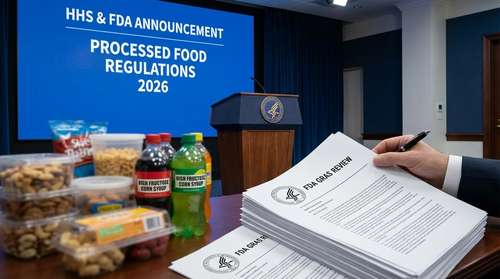
In a watershed moment for American food policy, U.S. Health Secretary Robert F. Kennedy Jr. has officially announced that the Department of Health and Human Services (HHS) and the FDA will move to reassess the safety of high fructose corn syrup (HFCS) and other ubiquitous additives. The announcement, made earlier this week, signals the administration's intent to close the controversial "Generally Recognized as Safe" (GRAS) loophole and establish strict new ultra-processed food regulations 2026. This move represents the most significant challenge to the industrial food complex in decades.
RFK Jr. Targets the GRAS "Loophole"
During a high-profile interview on CBS's 60 Minutes this week, Secretary Kennedy confirmed that the FDA is preparing to "act on" a citizen petition filed in August 2025 by former FDA Commissioner Dr. David Kessler. The petition explicitly calls for the revocation of the GRAS status for high fructose corn syrup, maltodextrin, and other refined carbohydrates that have been linked to the nation’s chronic disease epidemic.
"The questions you're asking are questions the FDA should have asked a long, long time ago," Kennedy stated, emphasizing that the era of self-regulation for food manufacturers is ending. "There's no way for an American to know if a product is safe if it's ultra-processed and filled with ingredients that bypassed rigorous federal review."
The FDA GRAS system reform is central to the "Make America Healthy Again" (MAHA) agenda. Originally intended for common ingredients like vinegar and salt, the GRAS provision has allowed companies to introduce thousands of synthetic chemicals into the food supply by independently declaring them "safe" without FDA approval. This "self-affirmation" process is now squarely in the crosshairs of the new RFK Jr. nutrition policy.
High Fructose Corn Syrup Safety Review Underway
The immediate focus of the crackdown is a comprehensive high fructose corn syrup safety review. While the industry has long defended HFCS as nutritional equivalent to sugar, the administration is pivoting to a hazard-based approach that considers metabolic health. The Kessler petition argues that the sheer volume of these additives in the American diet constitutes a chronic toxicity that the original safety statutes never anticipated.
If the FDA revokes the GRAS status of HFCS, manufacturers would be forced to prove—through rigorous scientific data—that the ingredient is safe for the population at current consumption levels. This shift could potentially force a reformulation of thousands of products, from sodas and breads to condiments and snack foods.
Defining Ultra-Processed Foods
Parallel to the additive review, the FDA is racing to finalize a federal UPF definition by late 2026. Following a public comment period that concluded in late 2025, the agency is working with the USDA to create a legal framework for categorizing foods based on their processing level, likely drawing from the NOVA classification system.
This definition is critical for future policy. Once established, it could serve as the basis for warning labels, school lunch restrictions, and eligibility for federal nutrition programs. "We are not just looking at calories anymore," an FDA spokesperson noted regarding the upcoming guidelines. "We are looking at the industrial formulation of the food itself."
Industry Pushback and Health Risks
The food industry is expected to mount a vigorous legal defense, arguing that singled-out ingredients like HFCS are safe in moderation and that food additive health risks are overstated. Trade groups have already warned that such sweeping regulatory changes could disrupt supply chains and raise grocery prices.
However, public health advocates warn that the status quo is untenable. With obesity and diabetes rates at historical highs, the demand for an American food safety update has reached a fever pitch. By targeting the legal mechanisms that allowed these ingredients to proliferate, the HHS is taking a systemic approach to dietary health that goes far beyond the traditional advice to simply "eat less."
As the FDA begins its scientific review, 2026 is shaping up to be the year the U.S. government finally draws a hard line on what constitutes "food." For consumers, this could mean a radically more transparent grocery aisle in the very near future.