For decades, the standard medical advice for a long, vibrant life was relatively simple: lace up your walking shoes and get your heart rate up. Aerobic fitness was long championed as the gold standard of well-being. However, a major paradigm shift is underway. A massive new scientific analysis proves that if you want to predict how long—and how well—you will live, you should look at your muscles. A groundbreaking investigation confirms that muscle strength has overtaken cardiovascular endurance as the ultimate foundation for healthy aging for women. The message is clear: survival requires physical power.
The Science Behind Muscle Mass and Longevity
The findings stem from the highly anticipated JAMA Network Open aging study 2026, spearheaded by researchers at the University at Buffalo. The study evaluated 5,472 women aged 63 to 99, tracking their health outcomes over an average eight-year period. Instead of hooking participants up to treadmills to test their lung capacity, scientists measured two remarkably simple baseline metrics: handgrip strength and the time it took to complete five unassisted chair stands.
The results were staggering. Women who demonstrated the highest grip strength had a 33% lower risk of all-cause mortality compared to those with the weakest grips. Furthermore, those who could rapidly stand from a chair and sit back down without using their arms saw a 37% reduction in death rates. The most startling revelation? These lower mortality rates held true even for women who consistently fell short of the recommended 150 minutes of weekly aerobic exercise. Cardiovascular fitness still matters, but the correlation between muscle mass and longevity is entirely independent—and potentially more critical for maintaining functional independence.
Why Strength Outperforms Cardio for Lifespan Protection
To understand why muscle is such a potent biological shield, we have to look at how the human body degrades over time. Beginning in our 40s, we experience a silent, progressive condition known as sarcopenia—the natural age-related loss of muscle tissue. While aerobic exercises like brisk walking or swimming do wonders for your heart, blood pressure, and cholesterol, they do very little to stop your skeletal muscles from shrinking.
When older adults lose muscle, they lose their body's primary shock absorbers and metabolic engines. Muscles help regulate blood sugar, reduce systemic inflammation, and protect bone density. Preventing sarcopenia is therefore not a cosmetic endeavor; it is a life-saving medical necessity. Dr. Michael LaMonte, the lead author of the study, summarized the reality perfectly: if you lack the muscular strength to get out of a chair, engaging in any aerobic activity becomes nearly impossible. Without a strong muscular framework, the cardiovascular system becomes trapped in an immobile body.
The Hidden Dangers of Muscle Weakness
A lack of strength directly accelerates the risk of catastrophic falls. In geriatric medicine, a fall resulting in a fractured hip or pelvis frequently marks the beginning of a sharp downward trajectory in overall health. Having the lower-body power to catch yourself when you stumble, or the grip strength to hold onto a railing, is quite literally the difference between life and death.
Practical Women's Health Longevity Habits
The incredible news from this research is that you do not need to look like a competitive bodybuilder to reap the survival benefits. The physiological adaptations required for healthy aging for women can be triggered right in your living room. The focus must shift from merely staying active to actively building resilience through progressive physical challenges.
Building sustainable women's health longevity habits starts with shifting the daily routine. Rather than relying exclusively on a morning walk, integrating targeted strength movements two to three times a week provides the structural integrity the body desperately needs.
Implementing Strength Training for Seniors
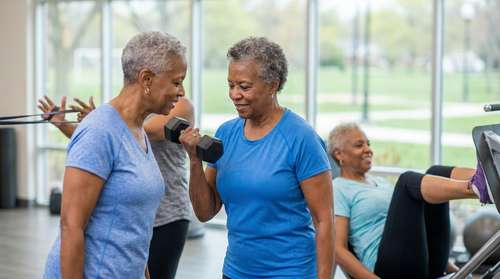
Many older adults avoid lifting weights due to a misconception that it causes joint damage or is meant exclusively for younger athletes. In reality, strength training for seniors is highly adaptable and fundamentally safe when executed with proper form. The goal is progressive overload—challenging the muscles just enough to force them to adapt and grow stronger over time.
If you are new to this, resistance training for elderly individuals does not require an expensive gym membership or intimidating heavy barbells. You can generate profound physiological benefits using household items or simple bodyweight mechanics:
- The Sit-to-Stand Exercise: Mimicking the exact metric used in the JAMA Network Open aging study 2026, practice sitting in a sturdy chair, crossing your arms over your chest, and driving through your heels to stand up. Lower yourself back down with control. Doing three sets of ten repetitions daily builds immense lower-body power.
- Household Resistance: Use filled water bottles, heavy cans, or thick resistance bands to perform bicep curls, overhead presses, and rows. The resistance forces muscle fibers to tear slightly and rebuild stronger.
- Grip Work: Since grip strength is a direct proxy for central nervous system vitality and overall muscle output, practice carrying heavy grocery bags in each hand for as long as possible.
The Nutritional Component of Muscle Building
Exercise provides the stimulus, but nutrition provides the raw materials. To build and preserve muscle, adequate protein intake is non-negotiable. As the body ages, it experiences anabolic resistance, meaning it becomes less efficient at converting dietary protein into muscle tissue. Experts recommend prioritizing high-quality protein sources—like lean meats, eggs, Greek yogurt, or plant-based legumes—at every meal to support muscular repair.
A New Era of Aging
For years, the medical community heavily prioritized cardiovascular fitness, leaving strength and power out of the mainstream conversation. This new data forces a massive reevaluation of how we approach our later decades. The correlation between muscle mass and longevity proves that our muscles act as a physiological retirement account: the more you invest today, the more independence you can withdraw tomorrow.
By incorporating basic resistance routines into your weekly schedule, you are not just adding years to your life; you are adding profound quality to those years. Muscular strength is the ultimate currency of healthy aging for women, ensuring you have the physical freedom to travel, play with grandchildren, and navigate the world on your own terms.