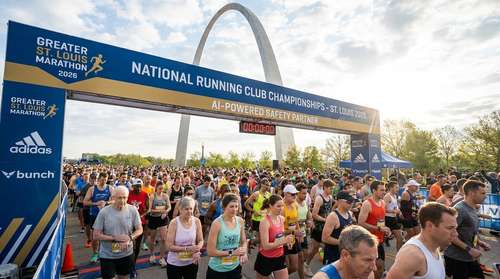
The streets of downtown St. Louis are pulsing with energy this Saturday morning as the highly anticipated Greater St. Louis Marathon 2026 officially gets underway. Starting at 1400 Market Street, the vibrant weekend festival is breaking new ground by playing host to the prestigious National Running Club Championships. However, the true story of today’s race extends far beyond the elite athletes chasing podium finishes. This year's marathon has fundamentally reimagined the endurance landscape, introducing a pioneering approach to course accessibility and deploying unprecedented medical technology that is already making waves across the global athletic community.
Championing Accessibility: The Era of Inclusive Marathon Walking
For decades, stringent course time limits have effectively barred thousands of aspiring athletes from experiencing the magic of crossing a 26.2-mile finish line. Event organizers in St. Louis have shattered this barrier with the launch of their highly publicized "Early Start" initiative.
At exactly 6:00 a.m. CDT—a full hour before the main gun time—a dedicated wave of participants crossed the starting line. This specialized heat was explicitly designed for those expecting to finish the full marathon in six to seven and a half hours, firmly establishing inclusive marathon walking as a permanent fixture in major road races.
This policy change directly supports current spring marathon season trends, which increasingly emphasize participation and long-term community health over strict competition. The extended time limit provides a critical avenue for adaptive athletes, participants managing medical conditions, and those engaging in endurance training for seniors. Supported by dedicated lead vehicles, tail vehicles, and pacers of varying speeds, these early-start athletes will receive official finish times—proving that endurance is measured by relentless determination, not just speed.
Real-Time Safety: The Integration of AI Fitness Wearables
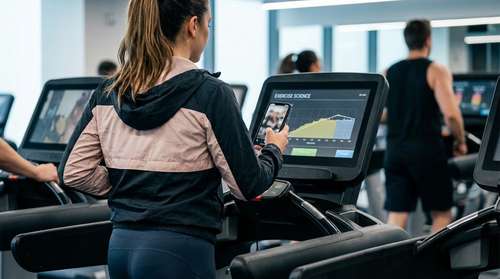
While the expanded field of runners and walkers takes on the streets, medical teams are working behind the scenes with a futuristic advantage. This morning marks the record-breaking deployment of AI fitness wearables integrated directly into the event's medical protocol.
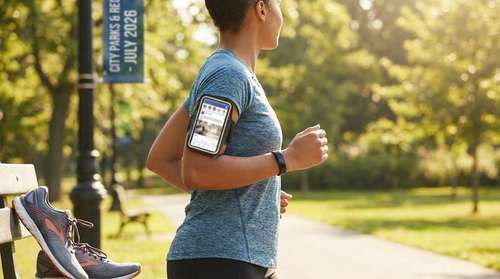
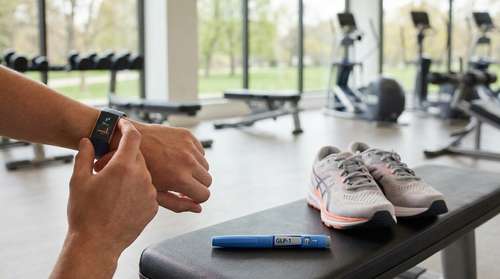
Thousands of athletes were outfitted with specialized biometric sensors that continuously transmit real-time data to a central medical command center. These advanced algorithms monitor core body temperature, heart rate variability, and hydration levels, instantly flagging anomalies that could indicate heat exhaustion or cardiac distress. If a runner’s vitals dip into dangerous territory, medical personnel stationed along the route are immediately alerted with precise GPS coordinates.
The shift toward proactive medical care using these AI fitness wearables highlights how technology is revolutionizing the sports landscape. Instead of reacting to an emergency at mile 22, the medical team can intercept a participant at mile 20 whose biometric data indicates an impending crisis. It is a technological leap that sets a new gold standard for medical safety at mass-participation sporting events.
The National Running Club Championships Ignite Fierce Competition
As the technological and inclusivity milestones make headlines, the competitive spirit of the Greater St. Louis Marathon 2026 remains hotter than ever. The integration of the National Running Club Championships has brought a massive influx of regional and national running teams to the Gateway City.
Teams from coast to coast are battling it out across the 5K, 10K, half marathon, and full marathon distances. The stakes are immense, as clubs vie for overall point titles and regional bragging rights. Spectators lining the route are treated to a sea of vibrant club singlets, highly organized cheer zones, and intense tactical racing.
Iconic Landmarks and a Scenic Urban Route
The marathon course itself acts as a dynamic backdrop for today's historic milestones. Runners are taking a full-spectrum tour of the city, passing through sweeping urban vistas and vibrant neighborhoods. The route features crucial segments between miles 18 and 21 winding through the iconic Forest Park, providing participants with scenic views of Jefferson Lake, the James S. McDonnell Planetarium, and the Nathan Frank Bandstand. For both the elite teams and the early-start walkers, these lush surroundings offer a crucial psychological boost during the grueling latter half of the race.
With the main field well underway, the athletic world is eagerly awaiting the final marathon results April 2026, which are expected to drop early this afternoon as the elite pack crosses the finish line.
A Gateway to the Future of Endurance Sports
The success of today's launch provides a clear blueprint for the future of mass-participation events. By merging fiercely competitive championships with radical inclusivity and state-of-the-art safety monitoring, the event has fundamentally redefined what a modern race should look like.
As participants prepare for the lively post-race festival—complete with local cuisine, toasted ravioli, and live music—the community energy is unmistakable. Today isn't just about covering distance; it is about moving the entire sport forward. The Greater St. Louis Marathon 2026 has proven that an event can seamlessly celebrate the world's fastest club runners while fiercely protecting and empowering the determined walkers experiencing their very first finish line.